

190
Trace Elements in Abiotic and Biotic Environments
26.2 SOILS
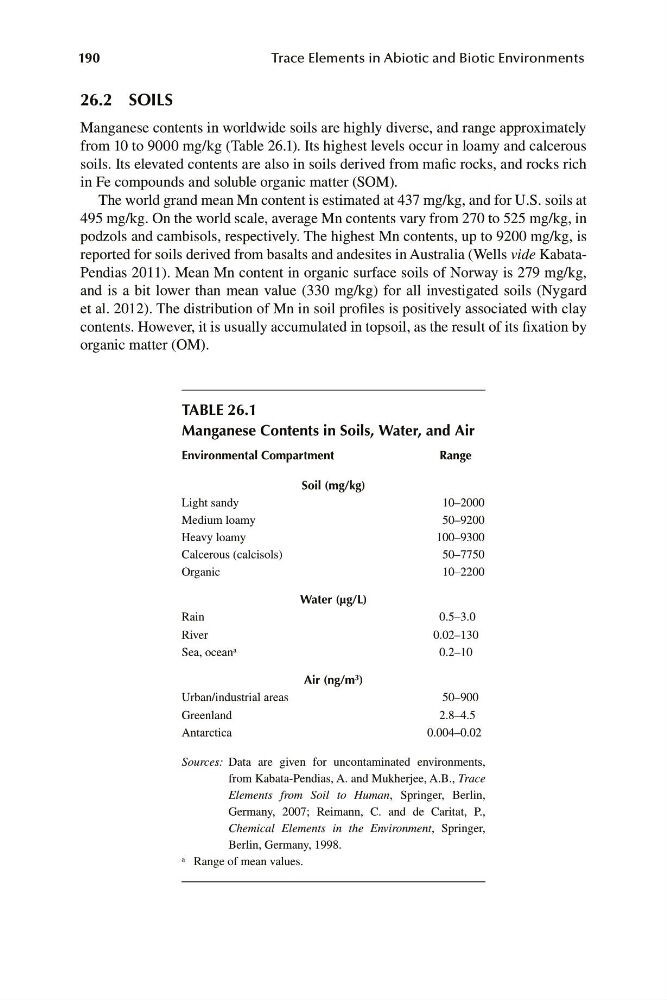
Manganese contents in worldwide soils are highly diverse, and range approximately
from 10 to 9000 mg/kg (Table 26.1). Its highest levels occur in loamy and calcerous
soils. Its elevated contents are also in soils derived from mafic rocks, and rocks rich
in Fe compounds and soluble organic matter (SOM).
The world grand mean Mn content is estimated at 437 mg/kg, and for U.S. soils at
495 mg/kg. On the world scale, average Mn contents vary from 270 to 525 mg/kg, in
podzols and cambisols, respectively. The highest Mn contents, up to 9200 mg/kg, is
reported for soils derived from basalts and andesites in Australia (Wells vide KabataPendias 2011). Mean Mn content in organic surface soils of Norway is 279 mg/kg,
and is a bit lower than mean value (330 mg/kg) for all investigated soils (Nygard
et al. 2012). The distribution of Mn in soil profiles is positively associated with clay
contents. However, it is usually accumulated in topsoil, as the result of its fixation by
organic matter (OM).
TABLE 26.1
Manganese Contents in Soils, Water, and Air
Environmental Compartment
Range
Soil (mg/kg)
Light sandy
10–2000
Medium loamy
50–9200
Heavy loamy
100–9300
Calcerous (calcisols)
50–7750
Organic
10–2200
Water (μg/L)
Rain
0.5–3.0
River
0.02–130
Sea, ocean a
0.2–10
Air (ng/m 3 )
Urban/industrial areas
50–900
Greenland
2.8–4.5
Antarctica
0.004–0.02
Sources: Data are given for uncontaminated environments,
from Kabata-Pendias, A. and Mukherjee, A.B., Trace
Elements from Soil to Human, Springer, Berlin,
Germany, 2007; Reimann, C. and de Caritat, P.,
Chemical Elements in the Environment, Springer,
Berlin, Germany, 1998.
a Range of mean values.