

188
Trace Elements in Abiotic and Biotic Environments
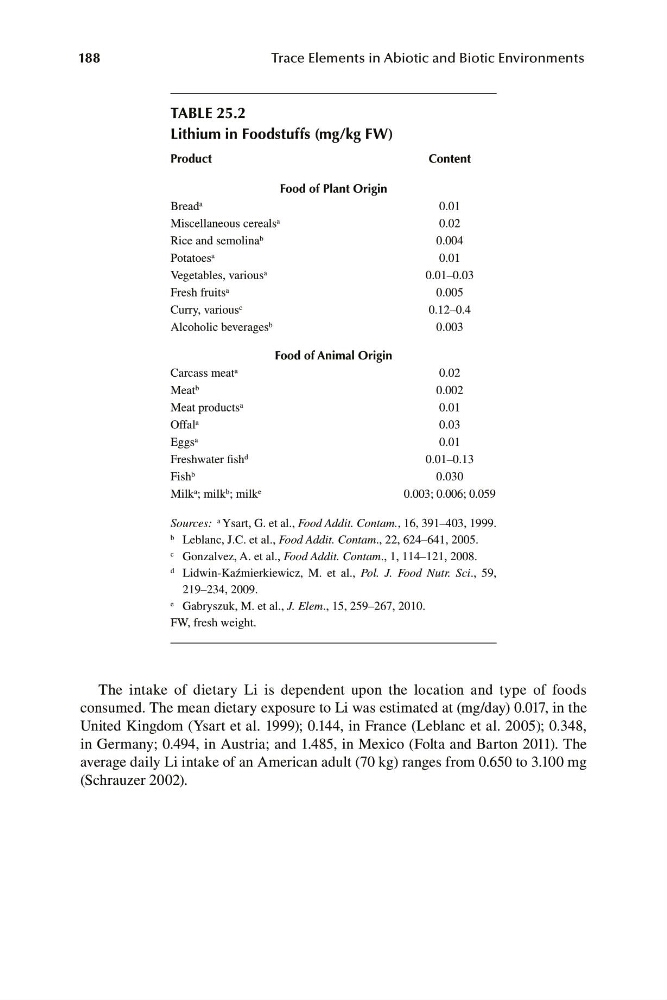
TABLE 25.2
Lithium in Foodstuffs (mg/kg FW)
Product
Content
Food of Plant Origin
Bread a
0.01
Miscellaneous cereals a
0.02
Rice and semolina b
0.004
Potatoes a
0.01
Vegetables, various a
0.01–0.03
Fresh fruits a
0.005
Curry, various c
0.12–0.4
Alcoholic beverages b
0.003
Food of Animal Origin
Carcass meat a
0.02
Meat b
0.002
Meat products a
0.01
Offal a
0.03
Eggs a
0.01
Freshwater fish d
0.01–0.13
Fish b
0.030
Milk a ; milk b ; milk e
0.003; 0.006; 0.059
Sources: a Ysart, G. et al., Food Addit. Contam., 16, 391–403, 1999.
b Leblanc, J.C. et al., Food Addit. Contam., 22, 624–641, 2005.
c Gonzalvez, A. et al., Food Addit. Contam., 1, 114–121, 2008.
d Lidwin-Kaźmierkiewicz, M. et al., Pol. J. Food Nutr. Sci., 59,
219–234, 2009.
e Gabryszuk, M. et al., J. Elem., 15, 259–267, 2010.
FW, fresh weight.
The intake of dietary Li is dependent upon the location and type of foods
consumed. The mean dietary exposure to Li was estimated at (mg/day) 0.017, in the
United Kingdom (Ysart et al. 1999); 0.144, in France (Leblanc et al. 2005); 0.348,
in Germany; 0.494, in Austria; and 1.485, in Mexico (Folta and Barton 2011). The
average daily Li intake of an American adult (70 kg) ranges from 0.650 to 3.100 mg
(Schrauzer 2002).
Trace Elements in Abiotic and Biotic Environments
TABLE 25.2
Lithium in Foodstuffs (mg/kg FW)
Product
Content
Food of Plant Origin
Bread a
0.01
Miscellaneous cereals a
0.02
Rice and semolina b
0.004
Potatoes a
0.01
Vegetables, various a
0.01–0.03
Fresh fruits a
0.005
Curry, various c
0.12–0.4
Alcoholic beverages b
0.003
Food of Animal Origin
Carcass meat a
0.02
Meat b
0.002
Meat products a
0.01
Offal a
0.03
Eggs a
0.01
Freshwater fish d
0.01–0.13
Fish b
0.030
Milk a ; milk b ; milk e
0.003; 0.006; 0.059
Sources: a Ysart, G. et al., Food Addit. Contam., 16, 391–403, 1999.
b Leblanc, J.C. et al., Food Addit. Contam., 22, 624–641, 2005.
c Gonzalvez, A. et al., Food Addit. Contam., 1, 114–121, 2008.
d Lidwin-Kaźmierkiewicz, M. et al., Pol. J. Food Nutr. Sci., 59,
219–234, 2009.
e Gabryszuk, M. et al., J. Elem., 15, 259–267, 2010.
FW, fresh weight.
The intake of dietary Li is dependent upon the location and type of foods
consumed. The mean dietary exposure to Li was estimated at (mg/day) 0.017, in the
United Kingdom (Ysart et al. 1999); 0.144, in France (Leblanc et al. 2005); 0.348,
in Germany; 0.494, in Austria; and 1.485, in Mexico (Folta and Barton 2011). The
average daily Li intake of an American adult (70 kg) ranges from 0.650 to 3.100 mg
(Schrauzer 2002).