

176
Trace Elements in Abiotic and Biotic Environments
shoots or flowers. Much controversy exists in the literature on the question of how
much airborne Pb is fixed onto the hairy or waxy cuticles of leaves and how much
Pb is actually taken into foliar cells. It has been suggested that most of the Pb pollution (up to 95% of the total Pb content) can be removed from the leaf surface by
washing with detergents. Lead contents of leaves, needles, and sprouts of all plants
correlate with its atmospheric concentrations. Elevated Pb content, up to 165 mg/kg,
in edible mushrooms (Boletus sp.) growing in the smelting area, also originated from
the atmospheric deposition (Komarek et al. vide Kabata-Pendias 2011). The common mushroom, chanterelles (Cantharellus cibarius), grown in mountains of Poland
contains higher amounts of Pb, mean 0.86 mg/kg, than those grown in the Baltic Sea
coast, mean 0.43 mg/kg (Falandysz et al. 2012).
Elevated Pb contents are usually in various plants growing in vicinities of metal
smelters, Pb mines, Pb recycling factories, and roadsides. Also, sewage sludge may
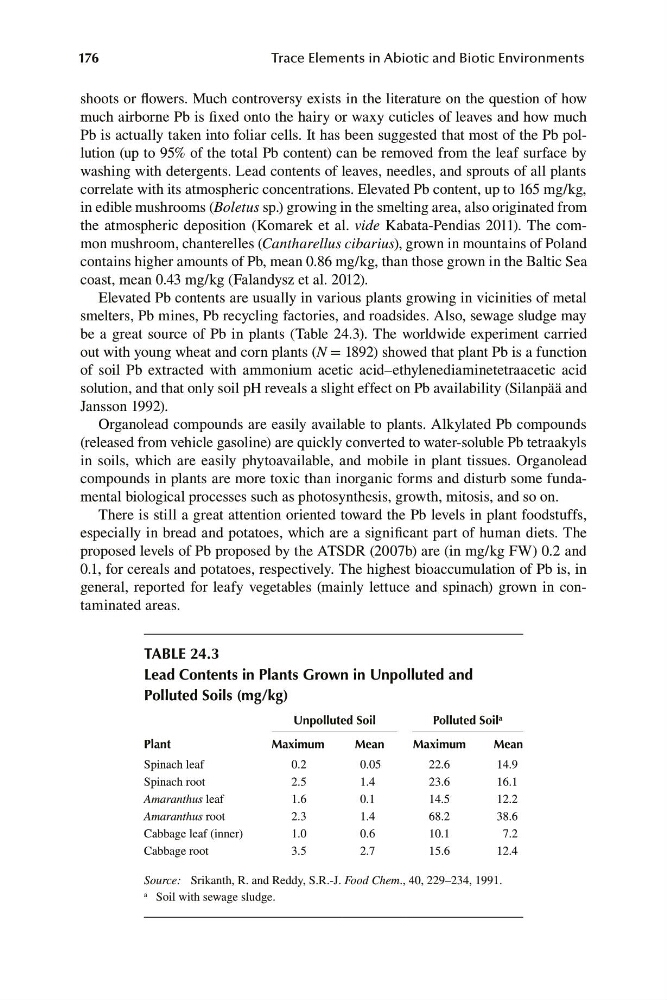
be a great source of Pb in plants (Table 24.3). The worldwide experiment carried
out with young wheat and corn plants (N = 1892) showed that plant Pb is a function
of soil Pb extracted with ammonium acetic acid–ethylenediaminetetraacetic acid
solution, and that only soil pH reveals a slight effect on Pb availability (Silanpää and
Jansson 1992).
Organolead compounds are easily available to plants. Alkylated Pb compounds
(released from vehicle gasoline) are quickly converted to water-soluble Pb tetraakyls
in soils, which are easily phytoavailable, and mobile in plant tissues. Organolead
compounds in plants are more toxic than inorganic forms and disturb some fundamental biological processes such as photosynthesis, growth, mitosis, and so on.
There is still a great attention oriented toward the Pb levels in plant foodstuffs,
especially in bread and potatoes, which are a significant part of human diets. The
proposed levels of Pb proposed by the ATSDR (2007b) are (in mg/kg FW) 0.2 and
0.1, for cereals and potatoes, respectively. The highest bioaccumulation of Pb is, in
general, reported for leafy vegetables (mainly lettuce and spinach) grown in contaminated areas.
TABLE 24.3
Lead Contents in Plants Grown in Unpolluted and
Polluted Soils (mg/kg)
Unpolluted Soil
Polluted Soil a
Plant
Maximum
Mean
Maximum
Mean
Spinach leaf
0.2
0.05
22.6
14.9
Spinach root
2.5
1.4
23.6
16.1
Amaranthus leaf
1.6
0.1
14.5
12.2
Amaranthus root
2.3
1.4
68.2
38.6
Cabbage leaf (inner)
1.0
0.6
10.1
7.2
Cabbage root
3.5
2.7
15.6
12.4
Source: Srikanth, R. and Reddy, S.R.-J. Food Chem., 40, 229–234, 1991.
a Soil with sewage sludge.