

168
Trace Elements in Abiotic and Biotic Environments
that Pb amounts in the glacier of Greenland has increased during the last 100 years,
from 0.05 to 0.5 μg/L (Buat-Menard vide Kabata-Pendias 2011).
24.2 SOILS
The worldwide mean Pb contents in soils is estimated at 27 mg/kg. Lead background average contents given for soils of different countries vary (in mg/kg) from
18 (Sweden) to 27 (China). Mean Pb content in organic surface soils of Norway is
43.6 mg/kg, and is a little bit lower than mean value (46.4 mg/kg) for all investigated
soils (Nygard et al. 2012). Soils in Spitsbergen, Norway, contain Pb within the range
of 0.14–9.33 mg/kg (Gulińska et al. 2003), whereas its contents of soils in Alaska
range from 4 to 349 mg/kg (Gough et al. 1988).
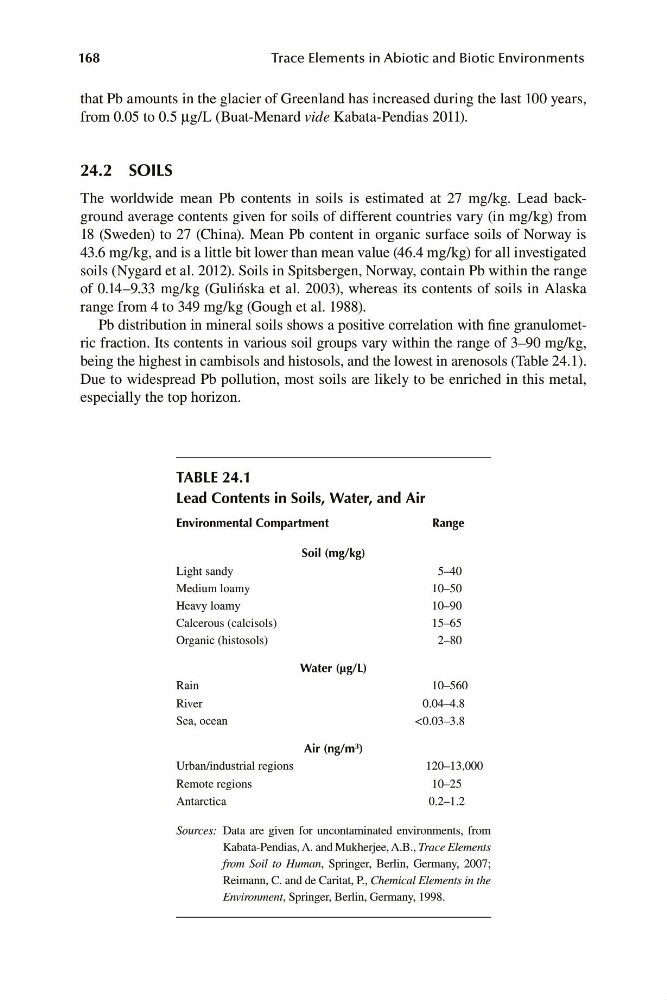
Pb distribution in mineral soils shows a positive correlation with fine granulometric fraction. Its contents in various soil groups vary within the range of 3–90 mg/kg,
being the highest in cambisols and histosols, and the lowest in arenosols (Table 24.1).
Due to widespread Pb pollution, most soils are likely to be enriched in this metal,
especially the top horizon.
TABLE 24.1
Lead Contents in Soils, Water, and Air
Environmental Compartment
Range
Soil (mg/kg)
Light sandy
5–40
Medium loamy
10–50
Heavy loamy
10–90
Calcerous (calcisols)
15–65
Organic (histosols)
2–80
Water (μg/L)
Rain
10–560
River
0.04–4.8
Sea, ocean
<0.03–3.8
Air (ng/m 3 )
Urban/industrial regions
120–13,000
Remote regions
10–25
Antarctica
0.2–1.2
Sources: Data are given for uncontaminated environments, from
Kabata-Pendias, A. and Mukherjee, A.B., Trace Elements
from Soil to Human, Springer, Berlin, Germany, 2007;
Reimann, C. and de Caritat, P., Chemical Elements in the
Environment, Springer, Berlin, Germany, 1998.