

Iron [Fe, 26]
157
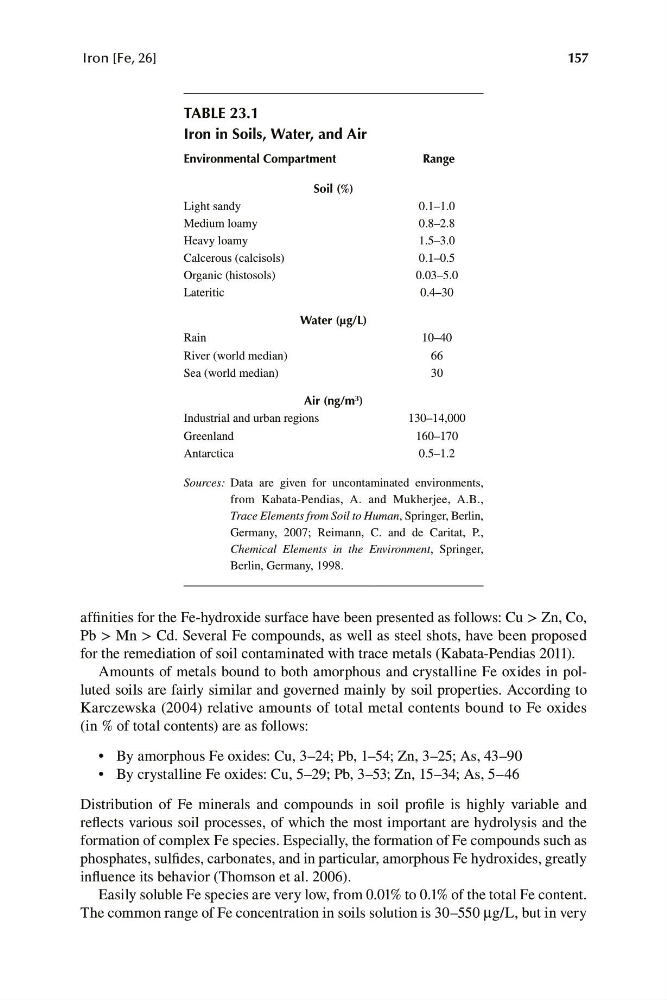
TABLE 23.1
Iron in Soils, Water, and Air
Environmental Compartment
Range
Soil (%)
Light sandy
0.1–1.0
Medium loamy
0.8–2.8
Heavy loamy
1.5–3.0
Calcerous (calcisols)
0.1–0.5
Organic (histosols)
0.03–5.0
Lateritic
0.4–30
Water (μg/L)
Rain
10–40
River (world median)
66
Sea (world median)
30
Air (ng/m 3 )
Industrial and urban regions
130–14,000
Greenland
160–170
Antarctica
0.5–1.2
Sources: Data are given for uncontaminated environments,
from Kabata-Pendias, A. and Mukherjee, A.B.,
Trace Elements from Soil to Human, Springer, Berlin,
Germany, 2007; Reimann, C. and de Caritat, P.,
Chemical Elements in the Environment, Springer,
Berlin, Germany, 1998.
affinities for the Fe-hydroxide surface have been presented as follows: Cu > Zn, Co,
Pb > Mn > Cd. Several Fe compounds, as well as steel shots, have been proposed
for the remediation of soil contaminated with trace metals (Kabata-Pendias 2011).
Amounts of metals bound to both amorphous and crystalline Fe oxides in polluted soils are fairly similar and governed mainly by soil properties. According to
Karczewska (2004) relative amounts of total metal contents bound to Fe oxides
(in % of total contents) are as follows:
r By amorphous Fe oxides: Cu, 3–24; Pb, 1–54; Zn, 3–25; As, 43–90
r By crystalline Fe oxides: Cu, 5–29; Pb, 3–53; Zn, 15–34; As, 5–46
Distribution of Fe minerals and compounds in soil profile is highly variable and
reflects various soil processes, of which the most important are hydrolysis and the
formation of complex Fe species. Especially, the formation of Fe compounds such as
phosphates, sulfides, carbonates, and in particular, amorphous Fe hydroxides, greatly
influence its behavior (Thomson et al. 2006).
Easily soluble Fe species are very low, from 0.01% to 0.1% of the total Fe content.
The common range of Fe concentration in soils solution is 30–550 μg/L, but in very