

Iodine [I, 53]
151
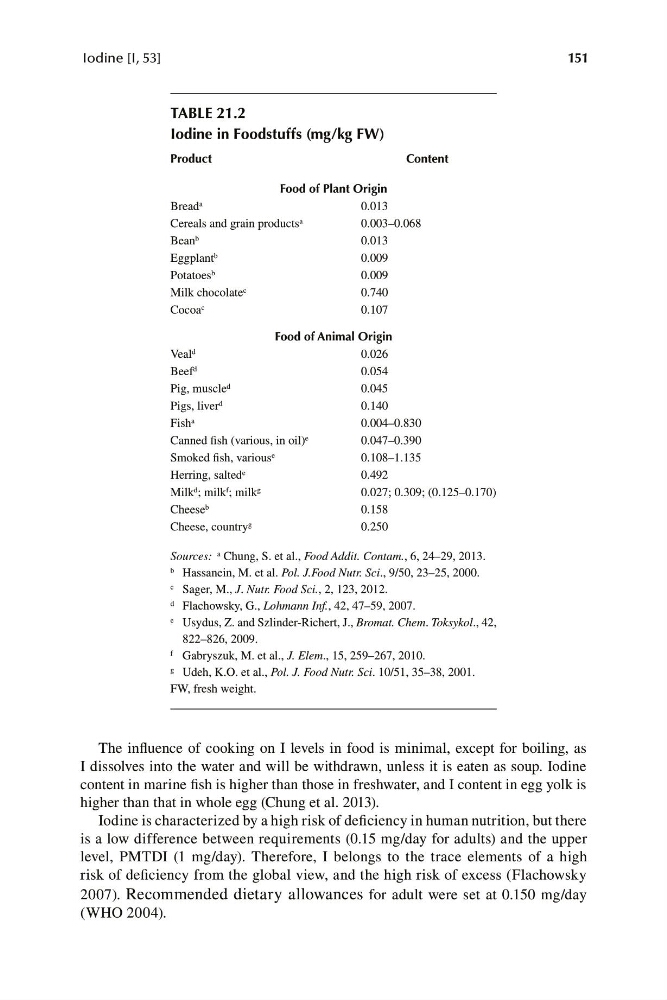
TABLE 21.2
Iodine in Foodstuffs (mg/kg FW)
Product
Content
Food of Plant Origin
Bread a
0.013
Cereals and grain products a
0.003–0.068
Bean b
0.013
Eggplant b
0.009
Potatoes b
0.009
Milk chocolate c
0.740
Cocoa c
0.107
Food of Animal Origin
Veal d
0.026
Beef d
0.054
Pig, muscle d
0.045
Pigs, liver d
0.140
Fish a
0.004–0.830
Canned fish (various, in oil) e
0.047–0.390
Smoked fish, various e
0.108–1.135
Herring, salted e
0.492
Milk d ; milk f ; milk g
0.027; 0.309; (0.125–0.170)
Cheese b
0.158
Cheese, country g
0.250
Sources: a Chung, S. et al., Food Addit. Contam., 6, 24–29, 2013.
b Hassanein, M. et al. Pol. J.Food Nutr. Sci., 9/50, 23–25, 2000.
c Sager, M., J. Nutr. Food Sci., 2, 123, 2012.
d Flachowsky, G., Lohmann Inf., 42, 47–59, 2007.
e Usydus, Z. and Szlinder-Richert, J., Bromat. Chem. Toksykol., 42,
822–826, 2009.
f Gabryszuk, M. et al., J. Elem., 15, 259–267, 2010.
g Udeh, K.O. et al., Pol. J. Food Nutr. Sci. 10/51, 35–38, 2001.
FW, fresh weight.
The influence of cooking on I levels in food is minimal, except for boiling, as
I dissolves into the water and will be withdrawn, unless it is eaten as soup. Iodine
content in marine fish is higher than those in freshwater, and I content in egg yolk is
higher than that in whole egg (Chung et al. 2013).
Iodine is characterized by a high risk of deficiency in human nutrition, but there
is a low difference between requirements (0.15 mg/day for adults) and the upper
level, PMTDI (1 mg/day). Therefore, I belongs to the trace elements of a high
risk of deficiency from the global view, and the high risk of excess (Flachowsky
2007). Recommended dietary allowances for adult were set at 0.150 mg/day
(WHO 2004).