

146
Trace Elements in Abiotic and Biotic Environments
Iodine is broadly used in a number of chemicals and pharmaceutics, for both
external and internal medical applications. It is also added in nutrition (for both
human and animals). There is no adequate substitute for I, so other substances cannot
replace its applications. Iodine is used as a disinfectant, but in some EU countries
it is prohibited. Health aspects of I deficiency in the food chain is a real problem in
several regions of the world.
In some countries, there is a recommendation to use iodized salt in food, as a
simple way to assure adequate I amounts in the human diet. However, the Ministry
of Health of China announced the reduction of I content in salt, owing to fears that
iodized salt is causing a rise in thyroid disease.
Radioactive 131 I is used in medical diagnosis. Iodine is a catalytic component in
some chemical reactions and is used in the production of some dyes, inks, and photosensitive photographic compounds.
21.2 SOILS
The worldwide mean I content in soils is estimated at 2.8 mg/kg. However, its
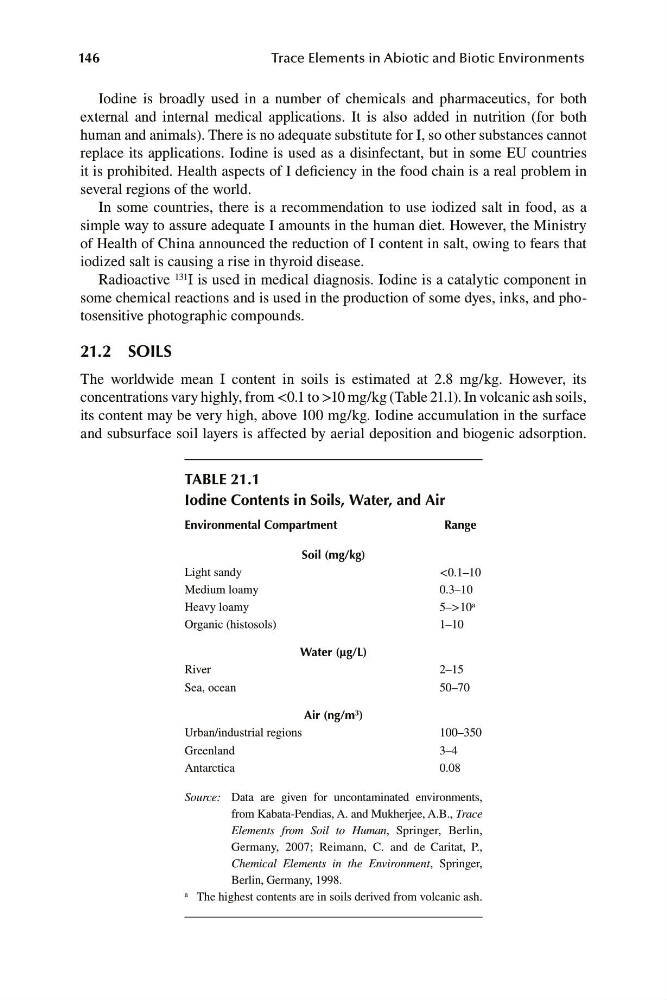
concentrations vary highly, from <0.1 to >10 mg/kg (Table 21.1). In volcanic ash soils,
its content may be very high, above 100 mg/kg. Iodine accumulation in the surface
and subsurface soil layers is affected by aerial deposition and biogenic adsorption.
TABLE 21.1
Iodine Contents in Soils, Water, and Air
Environmental Compartment
Range
Soil (mg/kg)
Light sandy
<0.1–10
Medium loamy
0.3–10
Heavy loamy
5–>10 a
Organic (histosols)
1–10
Water (μg/L)
River
2–15
Sea, ocean
50–70
Air (ng/m 3 )
Urban/industrial regions
100–350
Greenland
3–4
Antarctica
0.08
Source: Data are given for uncontaminated environments,
from Kabata-Pendias, A. and Mukherjee, A.B., Trace
Elements from Soil to Human, Springer, Berlin,
Germany, 2007; Reimann, C. and de Caritat, P.,
Chemical Elements in the Environment, Springer,
Berlin, Germany, 1998.
a The highest contents are in soils derived from volcanic ash.