

144
Trace Elements in Abiotic and Biotic Environments
TABLE 20.2
Indium in Foodstuffs (mg/kg FW)
Product
Content
Food of Plant Origin
Bread
<0.02
Miscellaneous cereals
<0.02
Vegetables
<0.004
Canned vegetables
0.096
Fresh fruits
<0.003
Fruit products
0.031
Food of Animal Origin
Carcass meat
<0.01
Offal
<0.01
Fish
<0.007
Milk
<0.003
Source: Rose, M. et al., Food Addit. Contam., 27,
1380–1404, 2010. With permission.
FW, fresh weight.
hemorrhage and marked thrombocytopenia. Fibrin thrombi were observed in the
liver (Castronovo and Wagner 1971). Indium compounds damage the heart, the
kidneys, and the liver, and may be teratogenic. Hydrated In oxide is 40 times more
toxic than ionic In.
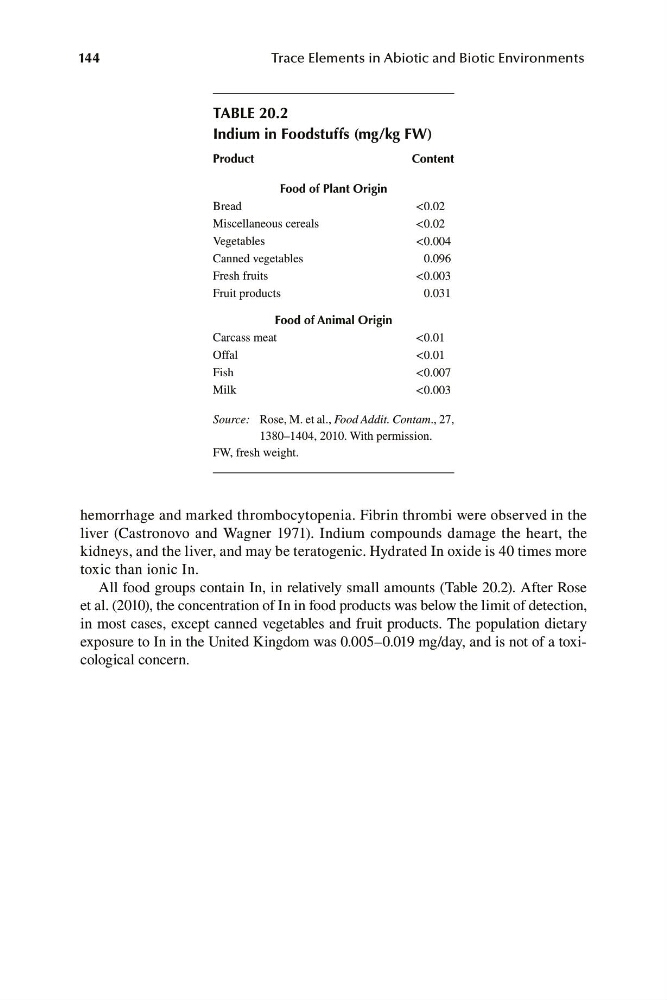
All food groups contain In, in relatively small amounts (Table 20.2). After Rose
et al. (2010), the concentration of In in food products was below the limit of detection,
in most cases, except canned vegetables and fruit products. The population dietary
exposure to In in the United Kingdom was 0.005–0.019 mg/day, and is not of a toxicological concern.