

142
Trace Elements in Abiotic and Biotic Environments
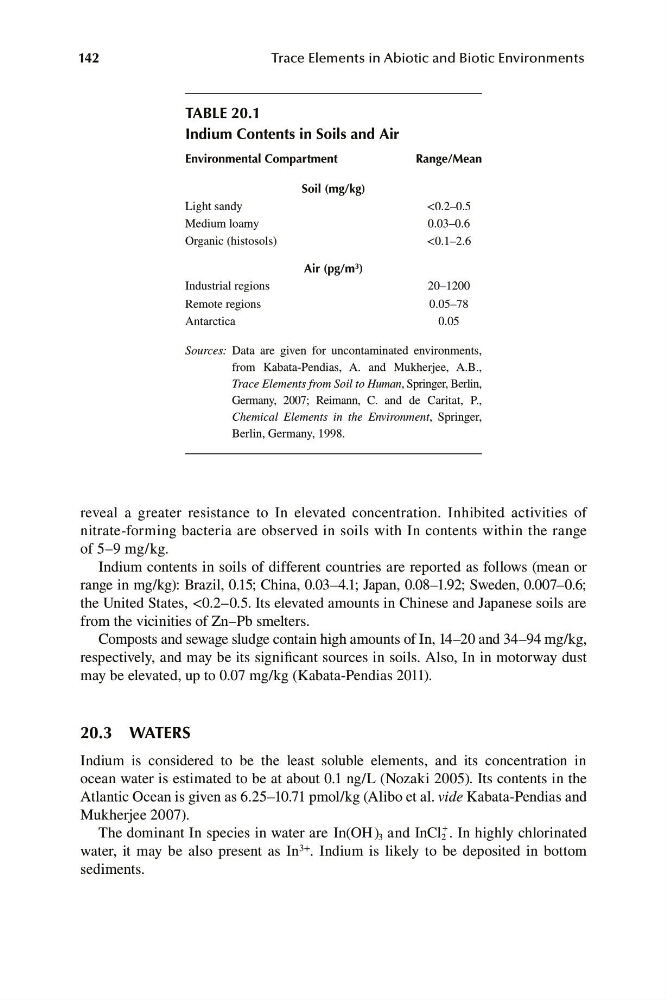
TABLE 20.1
Indium Contents in Soils and Air
Environmental Compartment
Range/Mean
Soil (mg/kg)
Light sandy
<0.2–0.5
Medium loamy
0.03–0.6
Organic (histosols)
<0.1–2.6
Air (pg/m 3 )
Industrial regions
20–1200
Remote regions
0.05–78
Antarctica
0.05
Sources: Data are given for uncontaminated environments,
from Kabata-Pendias, A. and Mukherjee, A.B.,
Trace Elements from Soil to Human, Springer, Berlin,
Germany, 2007; Reimann, C. and de Caritat, P.,
Chemical Elements in the Envi ronment, Springer,
Berlin, Germany, 1998.
reveal a greater resistance to In elevated concentration. Inhibited activities of
nitrate-forming bacteria are observed in soils with In contents within the range
of 5–9 mg/kg.
Indium contents in soils of different countries are reported as follows (mean or
range in mg/kg): Brazil, 0.15; China, 0.03–4.1; Japan, 0.08–1.92; Sweden, 0.007–0.6;
the United States, <0.2–0.5. Its elevated amounts in Chinese and Japanese soils are
from the vicinities of Zn–Pb smelters.
Composts and sewage sludge contain high amounts of In, 14–20 and 34–94 mg/kg,
respectively, and may be its significant sources in soils. Also, In in motorway dust
may be elevated, up to 0.07 mg/kg (Kabata-Pendias 2011).
20.3 WATERS
Indium is considered to be the least soluble elements, and its concentration in
ocean water is estimated to be at about 0.1 ng/L (Nozaki 2005). Its contents in the
Atlantic Ocean is given as 6.25–10.71 pmol/kg (Alibo et al. vide Kabata-Pendias and
Mukherjee 2007).
The dominant In species in water are In OH 3 and InCl 2
. In highly chlorinated
(
)
water, it may be also present as In 3+ . Indium is likely to be deposited in bottom
sediments.
Trace Elements in Abiotic and Biotic Environments
TABLE 20.1
Indium Contents in Soils and Air
Environmental Compartment
Range/Mean
Soil (mg/kg)
Light sandy
<0.2–0.5
Medium loamy
0.03–0.6
Organic (histosols)
<0.1–2.6
Air (pg/m 3 )
Industrial regions
20–1200
Remote regions
0.05–78
Antarctica
0.05
Sources: Data are given for uncontaminated environments,
from Kabata-Pendias, A. and Mukherjee, A.B.,
Trace Elements from Soil to Human, Springer, Berlin,
Germany, 2007; Reimann, C. and de Caritat, P.,
Chemical Elements in the Envi ronment, Springer,
Berlin, Germany, 1998.
reveal a greater resistance to In elevated concentration. Inhibited activities of
nitrate-forming bacteria are observed in soils with In contents within the range
of 5–9 mg/kg.
Indium contents in soils of different countries are reported as follows (mean or
range in mg/kg): Brazil, 0.15; China, 0.03–4.1; Japan, 0.08–1.92; Sweden, 0.007–0.6;
the United States, <0.2–0.5. Its elevated amounts in Chinese and Japanese soils are
from the vicinities of Zn–Pb smelters.
Composts and sewage sludge contain high amounts of In, 14–20 and 34–94 mg/kg,
respectively, and may be its significant sources in soils. Also, In in motorway dust
may be elevated, up to 0.07 mg/kg (Kabata-Pendias 2011).
20.3 WATERS
Indium is considered to be the least soluble elements, and its concentration in
ocean water is estimated to be at about 0.1 ng/L (Nozaki 2005). Its contents in the
Atlantic Ocean is given as 6.25–10.71 pmol/kg (Alibo et al. vide Kabata-Pendias and
Mukherjee 2007).
The dominant In species in water are In OH 3 and InCl 2
. In highly chlorinated
(
)
water, it may be also present as In 3+ . Indium is likely to be deposited in bottom
sediments.