

138
Trace Elements in Abiotic and Biotic Environments
TABLE 19.1
Hafnium Contents in Soils and Water
Environmental Compartment
Range
Soil (mg/kg)
Light sandy
2–19
Medium loamy
5–20
Organic (histosols)
0.0X–0.X a
Water (ng/L)
Rain
<1–2
River
4–110
Sea, ocean
3.4–7.0
Air (ng/m 3 )
Urban
20–590
Greenland
0.04–0.06
Sources: Data are given for uncontaminated environments,
from Kabata-Pendias, A. and Mukherjee, A.B., Trace
Elements from Soil to Human, Springer, Berlin,
Germany, 2007; Reimann, C. and de Caritat, P.,
Chemical Elements in the Environ ment, Springer,
Berlin, Germany, 1998.
a Order of magnitude, Markert, B. and Lieth, H., Fresen. Z.
Anal. Chem., 327, 716–718, 1987.
19.3 WATERS
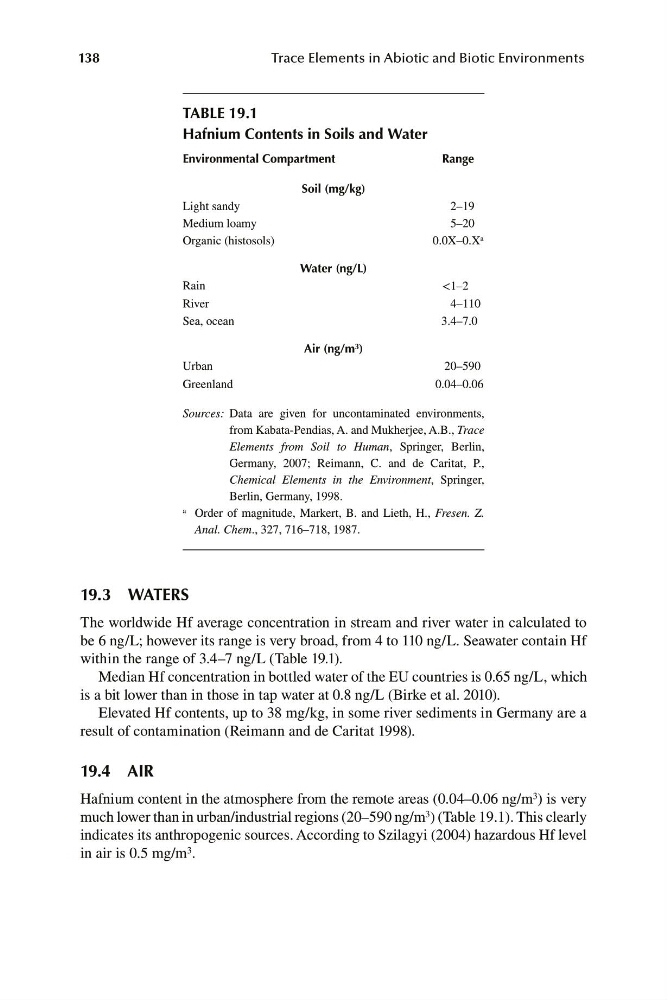
The worldwide Hf average concentration in stream and river water in calculated to
be 6 ng/L; however its range is very broad, from 4 to 110 ng/L. Seawater contain Hf
within the range of 3.4–7 ng/L (Table 19.1).
Median Hf concentration in bottled water of the EU countries is 0.65 ng/L, which
is a bit lower than in those in tap water at 0.8 ng/L (Birke et al. 2010).
Elevated Hf contents, up to 38 mg/kg, in some river sediments in Germany are a
result of contamination (Reimann and de Caritat 1998).
19.4 AIR
Hafnium content in the atmosphere from the remote areas (0.04–0.06 ng/m 3 ) is very
much lower than in urban/industrial regions (20–590 ng/m 3 ) (Table 19.1). This clearly
indicates its anthropogenic sources. According to Szilagyi (2004) hazardous Hf level
in air is 0.5 mg/m 3 .