

Gold [Au, 79]
135
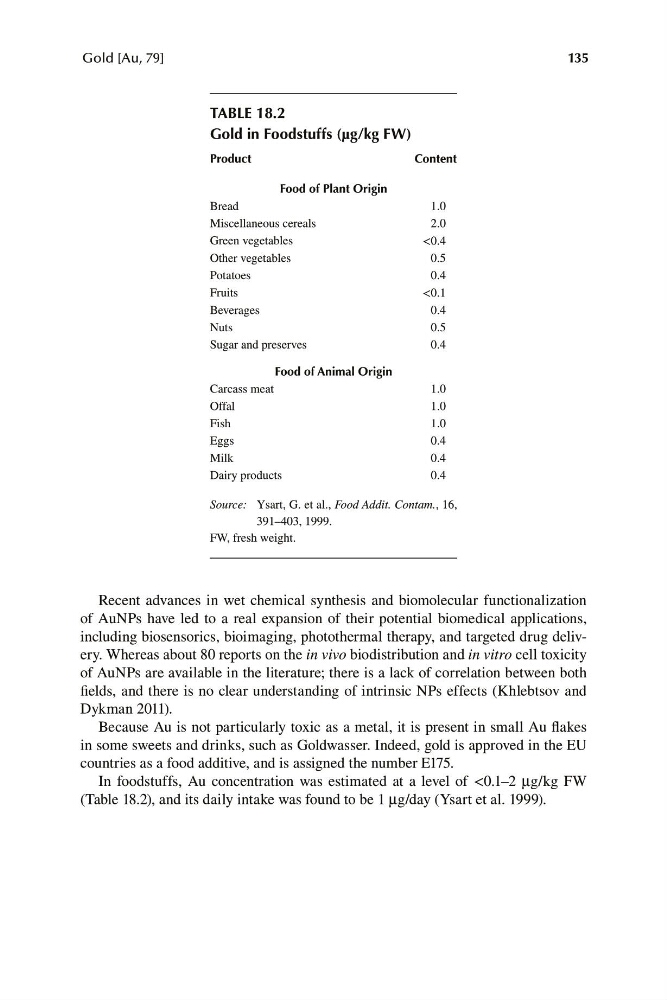
TABLE 18.2
Gold in Foodstuffs (μg/kg FW)
Product
Content
Food of Plant Origin
Bread
1.0
Miscellaneous cereals
2.0
Green vegetables
<0.4
Other vegetables
0.5
Potatoes
0.4
Fruits
<0.1
Beverages
0.4
Nuts
0.5
Sugar and preserves
0.4
Food of Animal Origin
Carcass meat
1.0
Offal
1.0
Fish
1.0
Eggs
0.4
Milk
0.4
Dairy products
0.4
Source: Ysart, G. et al., Food Addit. Contam., 16,
391–403, 1999.
FW, fresh weight.
Recent advances in wet chemical synthesis and biomolecular functionalization
of AuNPs have led to a real expansion of their potential biomedical applications,
including biosensorics, bioimaging, photothermal therapy, and targeted drug delivery. Whereas about 80 reports on the in vivo biodistribution and in vitro cell toxicity
of AuNPs are available in the literature; there is a lack of correlation between both
fields, and there is no clear understanding of intrinsic NPs effects (Khlebtsov and
Dykman 2011).
Because Au is not particularly toxic as a metal, it is present in small Au flakes
in some sweets and drinks, such as Goldwasser. Indeed, gold is approved in the EU
countries as a food additive, and is assigned the number E175.
In foodstuffs, Au concentration was estimated at a level of <0.1–2 μg/kg FW
(Table 18.2), and its daily intake was found to be 1 μg/day (Ysart et al. 1999).