

132
Trace Elements in Abiotic and Biotic Environments
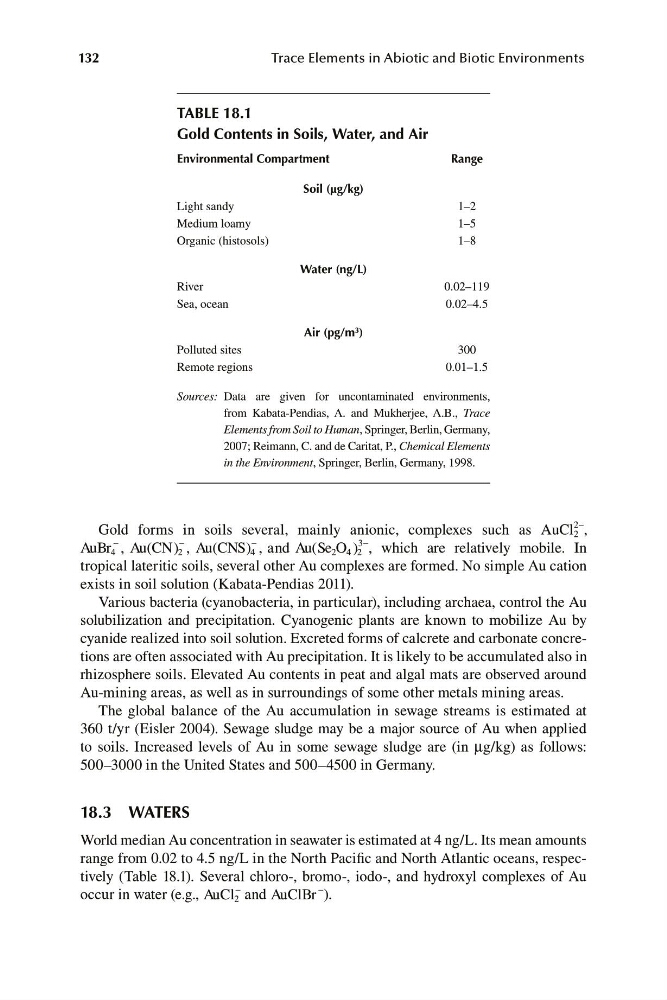
TABLE 18.1
Gold Contents in Soils, Water, and Air
Environmental Compartment
Range
Soil (μg/kg)
Light sandy
1–2
Medium loamy
1–5
Organic (histosols)
1–8
Water (ng/L)
River
0.02–119
Sea, ocean
0.02–4.5
Air (pg/m 3 )
Polluted sites
300
Remote regions
0.01–1.5
Sources: Data are given for uncontaminated environments,
from Kabata-Pendias, A. and Mukherjee, A.B., Trace
Elements from Soil to Human, Springer, Berlin, Germany,
2007; Reimann, C. and de Caritat, P., Chemical Elements
in the Environment, Springer, Berlin, Germany, 1998.
Gold forms in soils several, mainly anionic, complexes such as AuCl 2
2
,
3
AuBr , Au CN )
(
) , and Au Se O
4
(
2 , Au CNS 4
( 2 4 ) 2 , which are relatively mobile. In
tropical lateritic soils, several other Au complexes are formed. No simple Au cation
exists in soil solution (Kabata-Pendias 2011).
Various bacteria (cyanobacteria, in particular), including archaea, control the Au
solubilization and precipitation. Cyanogenic plants are known to mobilize Au by
cyanide realized into soil solution. Excreted forms of calcrete and carbonate concretions are often associated with Au precipitation. It is likely to be accumulated also in
rhizosphere soils. Elevated Au contents in peat and algal mats are observed around
Au-mining areas, as well as in surroundings of some other metals mining areas.
The global balance of the Au accumulation in sewage streams is estimated at
360 t/yr (Eisler 2004). Sewage sludge may be a major source of Au when applied
to soils. Increased levels of Au in some sewage sludge are (in μg/kg) as follows:
500–3000 in the United States and 500–4500 in Germany.
18.3 WATERS
World median Au concentration in seawater is estimated at 4 ng/L. Its mean amounts
range from 0.02 to 4.5 ng/L in the North Pacific and North Atlantic oceans, respectively (Table 18.1). Several chloro-, bromo-, iodo-, and hydroxyl complexes of Au
occur in water (e.g., AuCl 2
and AuClBr
).