

123
Gallium [Ga, 31]
TABLE 16.2
Gallium in Foodstuffs (mg/kg FW)
Product
Content
Wheat a
0.118
Wheat flour a
0.148
Cereal and cereal products b
Rice a
0.001
0.127
Orange juice (Florida) c
Orange juice (Brazil) c
Sweeteners, honey and confectionery b
Fat and oil b
0.030–0.040
0.063–0.145
0.002
0.016
Shrimps and mussels b
0.008
Sources: a Li, Y.-H. et al., Electroanal, 17, 343–347, 2005.
b Millour, S. et al., J. Food Compos. Anal., 25, 108–129, 2012.
c McHard, J.A. et al., J. Agric. Food Chem., 27, 1326–1328, 1979.
FW, fresh weight.
efficacy in suppressing osteolysis and bone pain, associated with multiple myeloma
and bone metastases, and has been suggested as a treatment for osteoporosis.
In addition to antiresorptive activity on bone, Ga also has anabolic activity. It
also shows specific immunomodulating activities. It is effective in suppressing
adjuvant-induced arthritis, experimental encephalomyelitis, experimental autoimmune uveitis, and other diseases. Some studies have suggested possible efficacy
in mouse models for asthma and type I diabetes. Several in vitro experiments have
found Ga effective at inhibiting T-cell and macrophage activation and in suppressing
the secretion of certain cytokines by these cells (Bernstein 1998).
Due to its chemical similarity to Fe, Ga can be substituted for Fe in many biologic
systems and inhibit Fe-dependent processes. When Ga ions are mistakenly picked up
by bacteria, such as Pseudomonas, the ability of the bacteria to respire is interfered
with, and the bacteria die. The mechanism behind this is that Fe is redox active,
which allows for the transfer of electrons during respiration, but Ga is redox inactive
(Kaneko et al. 2007).
There is suggestion on the potential usefulness of Ga maltolate for the prevention
and control of Rhodococcus equi infections. Gallium maltolate, an orally absorbable
form of Ga 3+ ion, is in clinical and preclinical trials as an important treatment for
a number of cancers, infectious disease, and inflammatory disease (Martens et al.
2007).
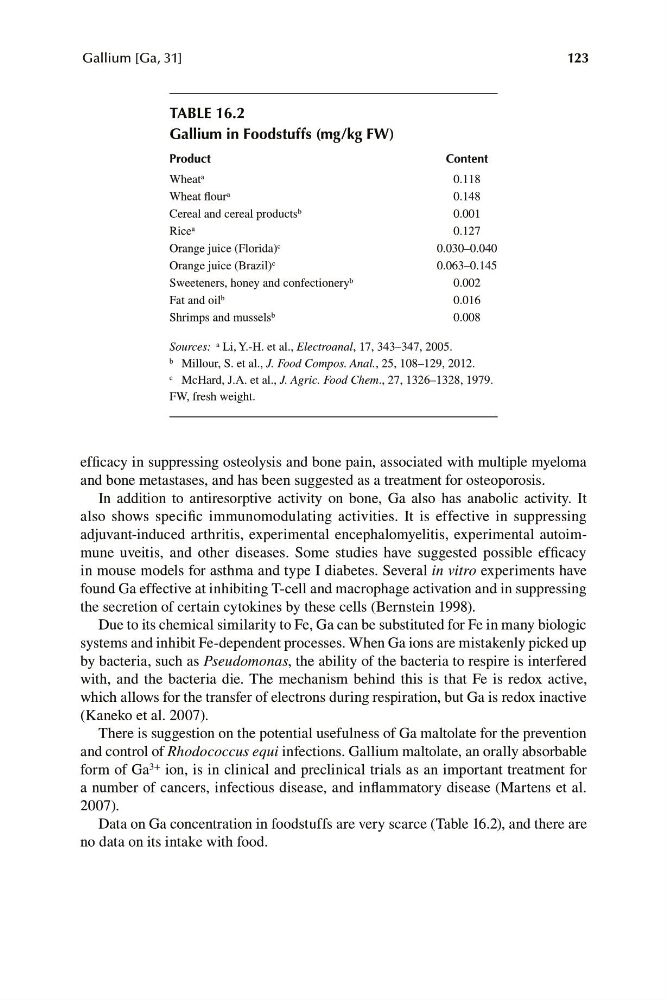
Data on Ga concentration in foodstuffs are very scarce (Table 16.2), and there are
no data on its intake with food.