

120
Trace Elements in Abiotic and Biotic Environments
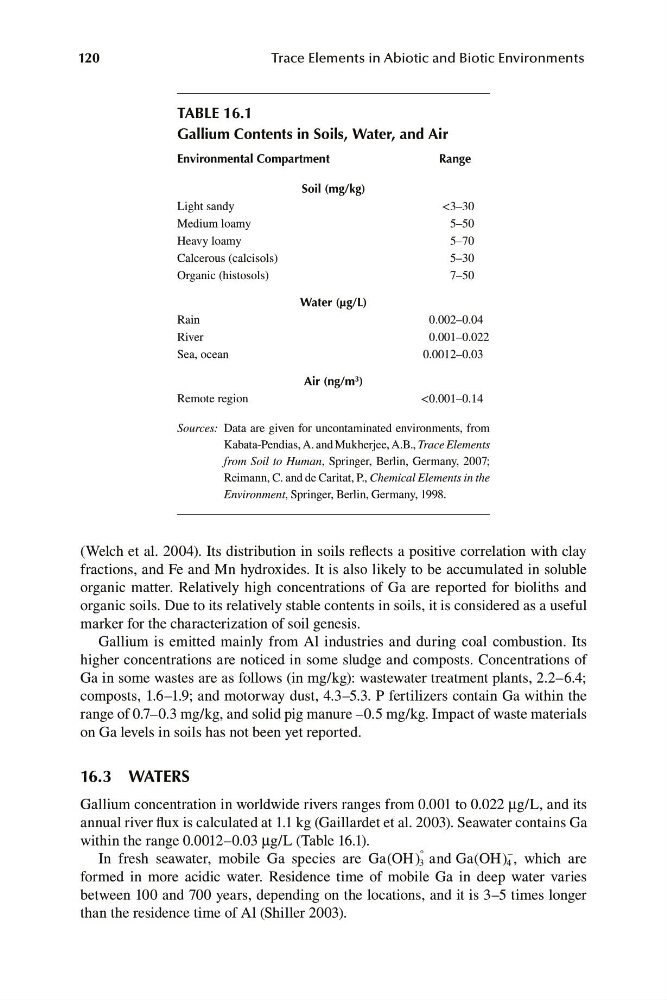
TABLE 16.1
Gallium Contents in Soils, Water, and Air
Environmental Compartment
Range
Soil (mg/kg)
Light sandy
<3–30
Medium loamy
5–50
Heavy loamy
5–70
Calcerous (calcisols)
5–30
Organic (histosols)
7–50
Water (μg/L)
Rain
0.002–0.04
River
0.001–0.022
Sea, ocean
0.0012–0.03
Air (ng/m 3 )
Remote region
<0.001–0.14
Sources: Data are given for uncontaminated environments, from
Kabata-Pendias, A. and Mukherjee, A.B., Trace Elements
from Soil to Human, Springer, Berlin, Germany, 2007;
Reimann, C. and de Caritat, P., Chemical Elements in the
Environment, Springer, Berlin, Germany, 1998.
(Welch et al. 2004). Its distribution in soils reflects a positive correlation with clay
fractions, and Fe and Mn hydroxides. It is also likely to be accumulated in soluble
organic matter. Relatively high concentrations of Ga are reported for bioliths and
organic soils. Due to its relatively stable contents in soils, it is considered as a useful
marker for the characterization of soil genesis.
Gallium is emitted mainly from Al industries and during coal combustion. Its
higher concentrations are noticed in some sludge and composts. Concentrations of
Ga in some wastes are as follows (in mg/kg): wastewater treatment plants, 2.2–6.4;
composts, 1.6–1.9; and motorway dust, 4.3–5.3. P fertilizers contain Ga within the
range of 0.7–0.3 mg/kg, and solid pig manure –0.5 mg/kg. Impact of waste materials
on Ga levels in soils has not been yet reported.
16.3 WATERS
Gallium concentration in worldwide rivers ranges from 0.001 to 0.022 μg/L, and its
annual river flux is calculated at 1.1 kg (Gaillardet et al. 2003). Seawater contains Ga
within the range 0.0012–0.03 μg/L (Table 16.1).
In fresh seawater, mobile Ga species are Ga OH 3
° and Ga OH
(
) 4
− , which are
(
)
formed in more acidic water. Residence time of mobile Ga in deep water varies
between 100 and 700 years, depending on the locations, and it is 3–5 times longer
than the residence time of Al (Shiller 2003).