

117
Fluorine [F, 9]
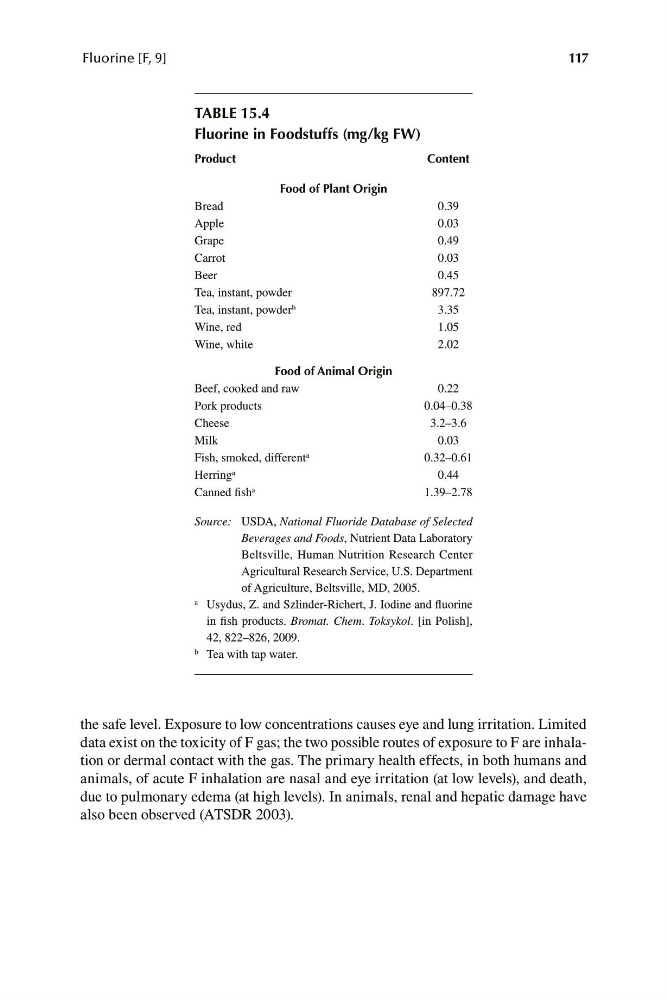
TABLE 15.4
Fluorine in Foodstuffs (mg/kg FW)
Product
Content
Food of Plant Origin
Bread
0.39
Apple
Grape
Carrot
0.03
0.49
0.03
Beer
0.45
Tea, instant, powder
Tea, instant, powder b
Wine, red
897.72
3.35
1.05
Wine, white
2.02
Food of Animal Origin
Beef, cooked and raw
0.22
Pork products
Cheese
0.04–0.38
3.2–3.6
Milk
0.03
Fish, smoked, different a
0.32–0.61
Herring a
Canned fish a
0.44
1.39–2.78
Source: USDA, National Fluoride Database of Selected
Beverages and Foods, Nutrient Data Laboratory
Beltsville, Human Nutrition Research Center
Agricultural Research Service, U.S. Department
of Agriculture, Beltsville, MD, 2005.
a Usydus, Z. and Szlinder-Richert, J. Iodine and fluorine
in fish products. Bromat. Chem. Toksykol. [in Polish],
42, 822–826, 2009.
b Tea with tap water.
the safe level. Exposure to low concentrations causes eye and lung irritation. Limited
data exist on the toxicity of F gas; the two possible routes of exposure to F are inhalation or dermal contact with the gas. The primary health effects, in both humans and
animals, of acute F inhalation are nasal and eye irritation (at low levels), and death,
due to pulmonary edema (at high levels). In animals, renal and hepatic damage have
also been observed (ATSDR 2003).
Fluorine [F, 9]
TABLE 15.4
Fluorine in Foodstuffs (mg/kg FW)
Product
Content
Food of Plant Origin
Bread
0.39
Apple
Grape
Carrot
0.03
0.49
0.03
Beer
0.45
Tea, instant, powder
Tea, instant, powder b
Wine, red
897.72
3.35
1.05
Wine, white
2.02
Food of Animal Origin
Beef, cooked and raw
0.22
Pork products
Cheese
0.04–0.38
3.2–3.6
Milk
0.03
Fish, smoked, different a
0.32–0.61
Herring a
Canned fish a
0.44
1.39–2.78
Source: USDA, National Fluoride Database of Selected
Beverages and Foods, Nutrient Data Laboratory
Beltsville, Human Nutrition Research Center
Agricultural Research Service, U.S. Department
of Agriculture, Beltsville, MD, 2005.
a Usydus, Z. and Szlinder-Richert, J. Iodine and fluorine
in fish products. Bromat. Chem. Toksykol. [in Polish],
42, 822–826, 2009.
b Tea with tap water.
the safe level. Exposure to low concentrations causes eye and lung irritation. Limited
data exist on the toxicity of F gas; the two possible routes of exposure to F are inhalation or dermal contact with the gas. The primary health effects, in both humans and
animals, of acute F inhalation are nasal and eye irritation (at low levels), and death,
due to pulmonary edema (at high levels). In animals, renal and hepatic damage have
also been observed (ATSDR 2003).