

111
Fluorine [F, 9]
quite mobile. Some clay minerals, especially illite and chlorite groups, have a great
capacity for the F fixation. The greatest absorption of F by soil mineral components
is within the pH 6–7. Usually F contents of surface soil horizons are lower than its
concentrations in lower horizons. This indicates a low F affinity for organic matter.
However, in some tropical soils, it may occur organically bound, easily phytoavailable F, which may be attributed to the synthesis by certain microorganisms (KabataPendias 2011).
The input of F to arable soil with P fertilizers has become an environmental problem. A long-time application of P fertilizers, as well as sewage sludge and pesticides, may highly elevate F contents of soils, and increase its phytoaccumulation
(Wu et al. 2007). Fluorine is strongly retained by soils, forming complexes with soil
components. In soils, it is transported to surface water, through leaching or runoff
of particulate-bound fluorides. Leaching removes only a small amount of F (up to
6% of F added) from agricultural soils, which is received up to 20 kg/yr with the
use of P fertilizers (Kabata-Pendias 2011). The seepage water of these soils contains
F between 50 and 200 μg/L.
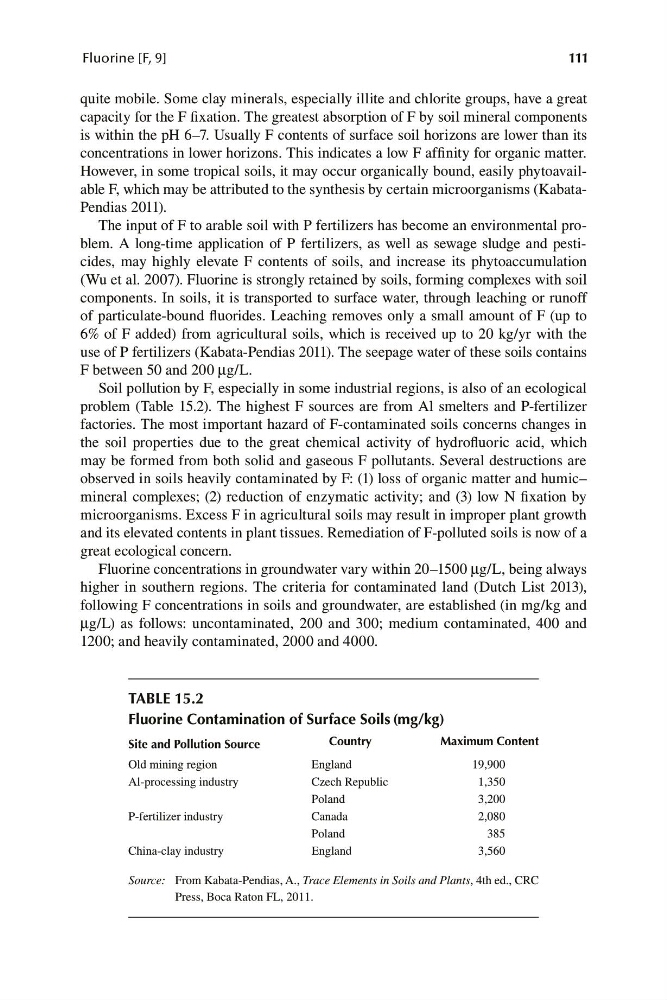
Soil pollution by F, especially in some industrial regions, is also of an ecological
problem (Table 15.2). The highest F sources are from Al smelters and P-fertilizer
fact ories. The most important hazard of F-contaminated soils concerns changes in
the soil properties due to the great chemical activity of hydrofluoric acid, which
may be formed from both solid and gaseous F pollutants. Several destructions are
observed in soils heavily contaminated by F: (1) loss of organic matter and humic–
mineral complexes; (2) reduction of enzymatic activity; and (3) low N fixation by
microorganisms. Excess F in agricultural soils may result in improper plant growth
and its elevated contents in plant tissues. Remediation of F-polluted soils is now of a
great ecological concern.
Fluorine concentrations in groundwater vary within 20–1500 μg/L, being always
higher in southern regions. The criteria for contaminated land (Dutch List 2013),
following F concentrations in soils and groundwater, are established (in mg/kg and
μg/L) as follows: uncontaminated, 200 and 300; medium contaminated, 400 and
1200; and heavily contaminated, 2000 and 4000.
TABLE 15.2
Fluorine Contamination of Surface Soils (mg/kg)
Site and Pollution Source
Country
Maximum Content
Old mining region
England
19,900
Al-processing industry
Czech Republic
1,350
Poland
3,200
P-fertilizer industry
Canada
2,080
Poland
385
China-clay industry
England
3,560
Source: From Kabata-Pendias, A., Trace Elements in Soils and Plants, 4th ed., CRC
Press, Boca Raton FL, 2011.