

_
_
_
_
_
78
Trace Elements in Abiotic and Biotic Environments
TABLE 12.1
Chromium Contents in Soils, Water, and Air
Environmental Compartment
Range
Mean
Soil (mg/kg)
Light sandy
2–350
40
Medium loamy
10–300
60
Heavy loamy
30–1100
80
Calcerous (calcisols)
2–100
50
Organic
2–40
20
Water (μg/L)
Rain
0.2–2.7
0.3
River
0.3–2.1
0.7
Sea, ocean
0.15–0.3
0.2
Air (ng/m 3 )
Urban/industrial areas
1–1100
40
Greenland
0.6–0.8
0.5
Antarctica
0.003–0.01
–
Source: Data are given for uncontaminated environments, from KabataPendias, A. and Mukherjee, A.B., Trace Elements from Soil to
Human, Springer, Berlin, Germany, 2007; Reimann, C. and de
Caritat, P., Chemical Elements in the Environment, Springer,
Berlin, Germany, 1998.
compounds in both acidic and alkaline soils. At the high oxidation state, Cr 6+ is very
mobile in both, acidic and alkaline soils. Nevertheless, above 80% of total Cr contents of most soils is in immobile residual fraction. This explains, partly, elevated
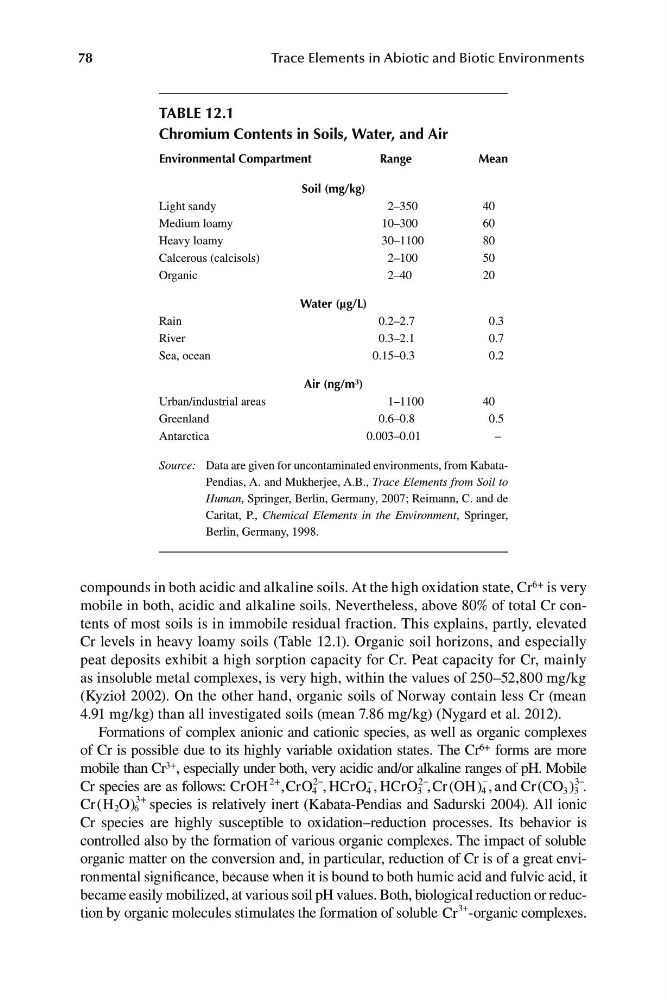
Cr levels in heavy loamy soils (Table 12.1). Organic soil horizons, and especially
peat deposits exhibit a high sorption capacity for Cr. Peat capacity for Cr, mainly
as insoluble metal complexes, is very high, within the values of 250–52,800 mg/kg
(Kyzioł 2002). On the other hand, organic soils of Norway contain less Cr (mean
4.91 mg/kg) than all investigated soils (mean 7.86 mg/kg) (Nygard et al. 2012).
Formations of complex anionic and cationic species, as well as organic complexes
of Cr is possible due to its highly variable oxidation states. The Cr 6+ forms are more
mobile than Cr 3+ , especially under both, very acidic and/or alkaline ranges of pH. Mobile
2+
2
2
3
Cr species are as follows: CrOH ,CrO , HCrO , HCrO , Cr OH
(
)
(
) .
4
4
3
4 , and Cr CO 3 3
Cr H O)
3+ species is relatively inert (Kabata-Pendias and Sadurski 2004). All ionic
( 2 6
Cr species are highly susceptible to oxidation–reduction processes. Its behavior is
controlled also by the formation of various organic complexes. The impact of soluble
organic matter on the conversion and, in particular, reduction of Cr is of a great environmental significance, because when it is bound to both humic acid and fulvic acid, it
became easily mobilized, at various soil pH values. Both, biological reduction or reduction by organic molecules stimulates the formation of soluble Cr
3 -organic complexes.