

72
Trace Elements in Abiotic and Biotic Environments
11.2 SOILS
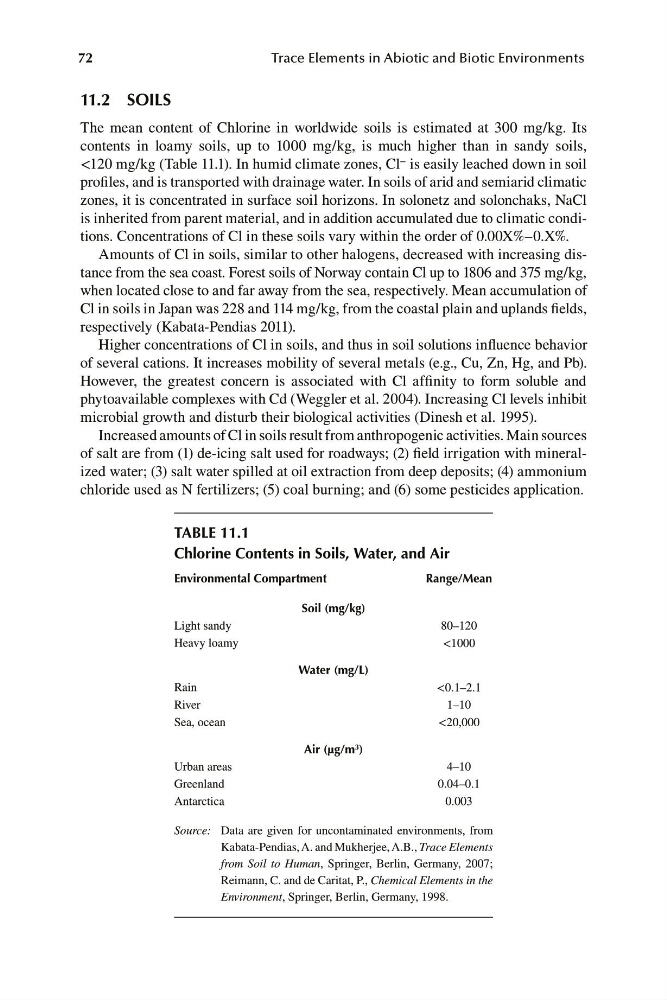
The mean content of Chlorine in worldwide soils is estimated at 300 mg/kg. Its
contents in loamy soils, up to 1000 mg/kg, is much higher than in sandy soils,
<120 mg/kg (Table 11.1). In humid climate zones, Cl − is easily leached down in soil
profiles, and is transported with drainage water. In soils of arid and semiarid climatic
zones, it is concentrated in surface soil horizons. In solonetz and solonchaks, NaCl
is inherited from parent material, and in addition accumulated due to climatic conditions. Concentrations of Cl in these soils vary within the order of 0.00X%–0.X%.
Amounts of Cl in soils, similar to other halogens, decreased with increasing distance from the sea coast. Forest soils of Norway contain Cl up to 1806 and 375 mg/kg,
when located close to and far away from the sea, respectively. Mean accumulation of
Cl in soils in Japan was 228 and 114 mg/kg, from the coastal plain and uplands fields,
respectively (Kabata-Pendias 2011).
Higher concentrations of Cl in soils, and thus in soil solutions influence behavior
of several cations. It increases mobility of several metals (e.g., Cu, Zn, Hg, and Pb).
However, the greatest concern is associated with Cl affinity to form soluble and
phytoavailable complexes with Cd (Weggler et al. 2004). Increasing Cl levels inhibit
microbial growth and disturb their biological activities (Dinesh et al. 1995).
Increased amounts of Cl in soils result from anthropogenic activities. Main sources
of salt are from (1) de-icing salt used for roadways; (2) field irrigation with mineralized water; (3) salt water spilled at oil extraction from deep deposits; (4) ammonium
chloride used as N fertilizers; (5) coal burning; and (6) some pesticides application.
TABLE 11.1
Chlorine Contents in Soils, Water, and Air
Environmental Compartment
Range/Mean
Soil (mg/kg)
Light sandy
80–120
Heavy loamy
<1000
Water (mg/L)
Rain
<0.1–2.1
River
1–10
Sea, ocean
<20,000
Air (μg/m 3 )
Urban areas
4–10
Greenland
0.04–0.1
Antarctica
0.003
Source: Data are given for uncontaminated environments, from
Kabata-Pendias, A. and Mukherjee, A.B., Trace Elements
from Soil to Human, Springer, Berlin, Germany, 2007;
Reimann, C. and de Caritat, P., Chemical Elements in the
Envi ronment, Springer, Berlin, Germany, 1998.
Trace Elements in Abiotic and Biotic Environments
11.2 SOILS
The mean content of Chlorine in worldwide soils is estimated at 300 mg/kg. Its
contents in loamy soils, up to 1000 mg/kg, is much higher than in sandy soils,
<120 mg/kg (Table 11.1). In humid climate zones, Cl − is easily leached down in soil
profiles, and is transported with drainage water. In soils of arid and semiarid climatic
zones, it is concentrated in surface soil horizons. In solonetz and solonchaks, NaCl
is inherited from parent material, and in addition accumulated due to climatic conditions. Concentrations of Cl in these soils vary within the order of 0.00X%–0.X%.
Amounts of Cl in soils, similar to other halogens, decreased with increasing distance from the sea coast. Forest soils of Norway contain Cl up to 1806 and 375 mg/kg,
when located close to and far away from the sea, respectively. Mean accumulation of
Cl in soils in Japan was 228 and 114 mg/kg, from the coastal plain and uplands fields,
respectively (Kabata-Pendias 2011).
Higher concentrations of Cl in soils, and thus in soil solutions influence behavior
of several cations. It increases mobility of several metals (e.g., Cu, Zn, Hg, and Pb).
However, the greatest concern is associated with Cl affinity to form soluble and
phytoavailable complexes with Cd (Weggler et al. 2004). Increasing Cl levels inhibit
microbial growth and disturb their biological activities (Dinesh et al. 1995).
Increased amounts of Cl in soils result from anthropogenic activities. Main sources
of salt are from (1) de-icing salt used for roadways; (2) field irrigation with mineralized water; (3) salt water spilled at oil extraction from deep deposits; (4) ammonium
chloride used as N fertilizers; (5) coal burning; and (6) some pesticides application.
TABLE 11.1
Chlorine Contents in Soils, Water, and Air
Environmental Compartment
Range/Mean
Soil (mg/kg)
Light sandy
80–120
Heavy loamy
<1000
Water (mg/L)
Rain
<0.1–2.1
River
1–10
Sea, ocean
<20,000
Air (μg/m 3 )
Urban areas
4–10
Greenland
0.04–0.1
Antarctica
0.003
Source: Data are given for uncontaminated environments, from
Kabata-Pendias, A. and Mukherjee, A.B., Trace Elements
from Soil to Human, Springer, Berlin, Germany, 2007;
Reimann, C. and de Caritat, P., Chemical Elements in the
Envi ronment, Springer, Berlin, Germany, 1998.