

Figure 5.5
102
Bacterial Cellulose
(a)
(c)
5.0 mm
14.5 mm
8.5 mm
Sample
Sample
Control
Control
Control
Sample
(b)
Figure 5.5
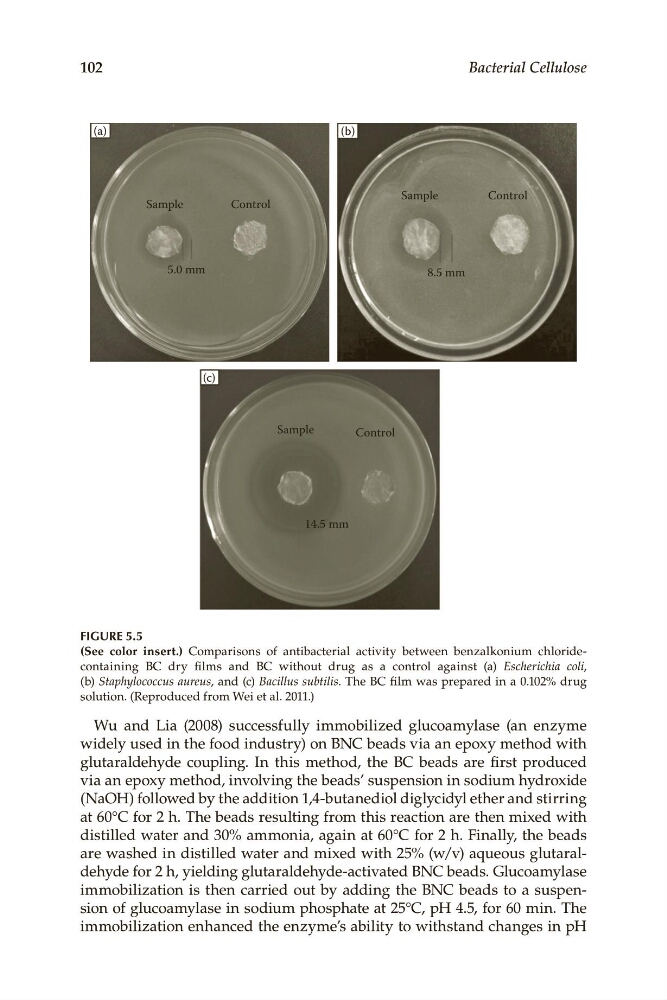
(See color insert.). Comparisons. of. antibacterial. activity. between. benzalkonium. chloridecontaining. BC. dry. films. and. BC. without. drug. as. a. control. against. (a). Escherichia coli,.
(b) Staphylococcus aureus,.and.(c).Bacillus subtilis..The.BC.film.was.prepared.in.a.0.102%.drug.
solution..(Reproduced.from.Wei.et.al..2011.)
Wu. and. Lia. (2008). successfully. immobilized. glucoamylase. (an. enzyme.
widely.used.in.the.food.industry).on.BNC.beads.via.an.epoxy.method.with.
glutaraldehyde. coupling.. In. this. method,. the. BC. beads. are. first. produced.
via.an.epoxy.method,.involving.the.beads’.suspension.in.sodium.hydroxide.
(NaOH).followed.by.the.addition.1,4-butanediol.diglycidyl.ether.and.stirring.
at.60°C.for.2.h..The.beads.resulting.from.this.reaction.are.then.mixed.with.
distilled.water.and.30%.ammonia,.again.at.60°C.for.2.h..Finally,.the.beads.
are.washed.in.distilled.water.and.mixed.with.25%.(w/v).aqueous.glutaraldehyde.for.2.h,.yielding.glutaraldehyde-activated.BNC.beads..Glucoamylase.
immobilization. is. then. carried. out. by. adding. the. BNC. beads. to. a. suspension.of.glucoamylase.in.sodium.phosphate.at.25°C,.pH.4.5,.for.60.min..The.
immobilization.enhanced.the.enzyme’s.ability.to.withstand.changes.in.pH.
102
Bacterial Cellulose
(a)
(c)
5.0 mm
14.5 mm
8.5 mm
Sample
Sample
Control
Control
Control
Sample
(b)
Figure 5.5
(See color insert.). Comparisons. of. antibacterial. activity. between. benzalkonium. chloridecontaining. BC. dry. films. and. BC. without. drug. as. a. control. against. (a). Escherichia coli,.
(b) Staphylococcus aureus,.and.(c).Bacillus subtilis..The.BC.film.was.prepared.in.a.0.102%.drug.
solution..(Reproduced.from.Wei.et.al..2011.)
Wu. and. Lia. (2008). successfully. immobilized. glucoamylase. (an. enzyme.
widely.used.in.the.food.industry).on.BNC.beads.via.an.epoxy.method.with.
glutaraldehyde. coupling.. In. this. method,. the. BC. beads. are. first. produced.
via.an.epoxy.method,.involving.the.beads’.suspension.in.sodium.hydroxide.
(NaOH).followed.by.the.addition.1,4-butanediol.diglycidyl.ether.and.stirring.
at.60°C.for.2.h..The.beads.resulting.from.this.reaction.are.then.mixed.with.
distilled.water.and.30%.ammonia,.again.at.60°C.for.2.h..Finally,.the.beads.
are.washed.in.distilled.water.and.mixed.with.25%.(w/v).aqueous.glutaraldehyde.for.2.h,.yielding.glutaraldehyde-activated.BNC.beads..Glucoamylase.
immobilization. is. then. carried. out. by. adding. the. BNC. beads. to. a. suspension.of.glucoamylase.in.sodium.phosphate.at.25°C,.pH.4.5,.for.60.min..The.
immobilization.enhanced.the.enzyme’s.ability.to.withstand.changes.in.pH.