

Figure 4.7
10
–2
E q
–2
Tensile Modulus, E [MPa]
10
–1
10
0
10
1
10
3
Ligament
10
2
BNC
10
–3
E q
–2
Compressive Modulus, E [MPa]
10
–2
10
–1
10
0
10
2
10
1
BNC
10
0
10
1
10
2
10
0
10
1
10
2
Swelling Degree, q
Swelling Degree, q
(a)
(b)
Figure 4.7
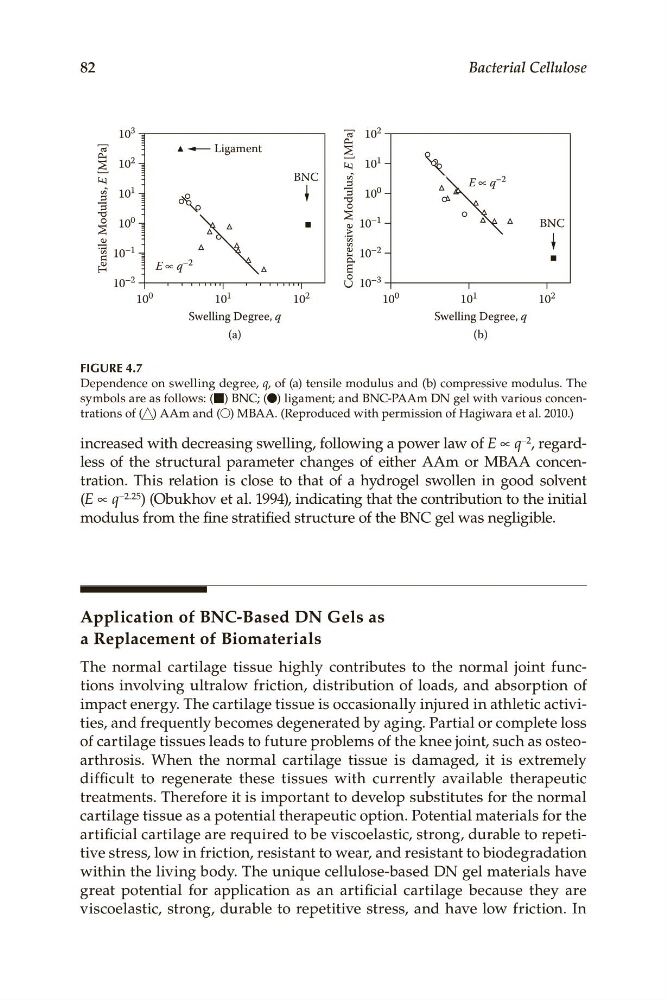
Dependence.on.swelling.degree,.q,.of.(a).tensile.modulus.and.(b).compressive.modulus..The.
symbols.are.as.follows:.(■).BNC;.(●).ligament;.and.BNC-PAAm.DN.gel.with.various.concentrations.of.( ).AAm.and.(○).MBAA..(Reproduced.with.permission.of.Hagiwara.et.al..2010.)
82
Bacterial Cellulose
increased.with.decreasing.swelling,.following.a.power.law.of.E.∝.q −2 ,.regardless. of. the. structural. parameter. changes. of. either. AAm. or. MBAA. concentration.. This. relation. is. close. to. that. of. a. hydrogel. swollen. in. good. solvent.
(E ∝ q −2.25 ).(Obukhov.et.al..1994),.indicating.that.the.contribution.to.the.initial.
modulus.from.the.fine.stratified.structure.of.the.BNC.gel.was.negligible.
Application of BNC-Based DN Gels as
a Replacement of Biomaterials
The. normal. cartilage. tissue. highly. contributes. to. the. normal. joint. functions.involving.ultralow.friction,.distribution.of.loads,.and.absorption.of.
impact.energy..The.cartilage.tissue.is.occasionally.injured.in.athletic.activities,.and.frequently.becomes.degenerated.by.aging..Partial.or.complete.loss.
of.. cartilage.tissues.leads.to.future.problems.of.the.knee.joint,.such.as.osteoarthrosis.. When. the. normal. cartilage. tissue. is. damaged,. it. is. extremely.
difficult. to. regenerate. these. tissues. with. currently. available. therapeutic.
treatments..Therefore.it.is.important.to.develop.substitutes.for.the.normal.
cartilage.tissue.as.a.potential.therapeutic.option..Potential.materials.for.the.
artificial.cartilage.are.required.to.be.viscoelastic,.strong,.durable.to.repetitive.stress,.low.in.friction,.resistant.to.wear,.and.resistant.to.biodegradation.
within.the.living.body..The.unique.cellulose-based.DN.gel.materials.have.
great. potential. for. application. as. an. artificial. cartilage. because. they. are.
. viscoelastic,.strong,.durable.to.repetitive.stress,.and.have.low.friction..In.
10
–2
E q
–2
Tensile Modulus, E [MPa]
10
–1
10
0
10
1
10
3
Ligament
10
2
BNC
10
–3
E q
–2
Compressive Modulus, E [MPa]
10
–2
10
–1
10
0
10
2
10
1
BNC
10
0
10
1
10
2
10
0
10
1
10
2
Swelling Degree, q
Swelling Degree, q
(a)
(b)
Figure 4.7
Dependence.on.swelling.degree,.q,.of.(a).tensile.modulus.and.(b).compressive.modulus..The.
symbols.are.as.follows:.(■).BNC;.(●).ligament;.and.BNC-PAAm.DN.gel.with.various.concentrations.of.( ).AAm.and.(○).MBAA..(Reproduced.with.permission.of.Hagiwara.et.al..2010.)
82
Bacterial Cellulose
increased.with.decreasing.swelling,.following.a.power.law.of.E.∝.q −2 ,.regardless. of. the. structural. parameter. changes. of. either. AAm. or. MBAA. concentration.. This. relation. is. close. to. that. of. a. hydrogel. swollen. in. good. solvent.
(E ∝ q −2.25 ).(Obukhov.et.al..1994),.indicating.that.the.contribution.to.the.initial.
modulus.from.the.fine.stratified.structure.of.the.BNC.gel.was.negligible.
Application of BNC-Based DN Gels as
a Replacement of Biomaterials
The. normal. cartilage. tissue. highly. contributes. to. the. normal. joint. functions.involving.ultralow.friction,.distribution.of.loads,.and.absorption.of.
impact.energy..The.cartilage.tissue.is.occasionally.injured.in.athletic.activities,.and.frequently.becomes.degenerated.by.aging..Partial.or.complete.loss.
of.. cartilage.tissues.leads.to.future.problems.of.the.knee.joint,.such.as.osteoarthrosis.. When. the. normal. cartilage. tissue. is. damaged,. it. is. extremely.
difficult. to. regenerate. these. tissues. with. currently. available. therapeutic.
treatments..Therefore.it.is.important.to.develop.substitutes.for.the.normal.
cartilage.tissue.as.a.potential.therapeutic.option..Potential.materials.for.the.
artificial.cartilage.are.required.to.be.viscoelastic,.strong,.durable.to.repetitive.stress,.low.in.friction,.resistant.to.wear,.and.resistant.to.biodegradation.
within.the.living.body..The.unique.cellulose-based.DN.gel.materials.have.
great. potential. for. application. as. an. artificial. cartilage. because. they. are.
. viscoelastic,.strong,.durable.to.repetitive.stress,.and.have.low.friction..In.