

44
Xenopus
graduate student days in the Spemann lab also played a role
in the renaissance of experimental embryology (Hamburger,
1988). This short book, written when Viktor Hamburger was
88 years old, inspired many of us in the Xenopus community
to take a second look. What followed was a revolution.
4.2. THE SEARCH FOR SPEMANN ORGANIZER
MOLECULES IN XENOPUS
In our laboratory, we used manually dissected Xenopus dorsal
lips to prepare cDNA libraries from which the f rst organizerspecifc gene, goosecoid, was isolated (Cho et al., 1991). Other
laboratories followed some months later, treating Xenopus
animal cap explants with Activin, which induces dorsal
mesoderm and resulted in the isolation of other organizer
transcription factors such as lim-1 and forkhead-1 ( Taira
et al., 1992; Dirksen and Jamrich, 1992). Using a very productive functional assay of microinjecting pools of synthetic
mRNAs which were then sib-selected, Richard Harland succeeded in isolating Noggin, the frst secreted protein of the
Spemann organizer (Smith and Harland, 1992). Douglas
Melton found that Follistatin was also secreted by the organizer (Hemmati-Brivanlou et al., 1994).
The Spemann organizer proved a very productive f shing
ground for novel signaling molecules. At early stages of development, cells are engaged in exchanging signals specifying
their positional information before tissue differentiation takes
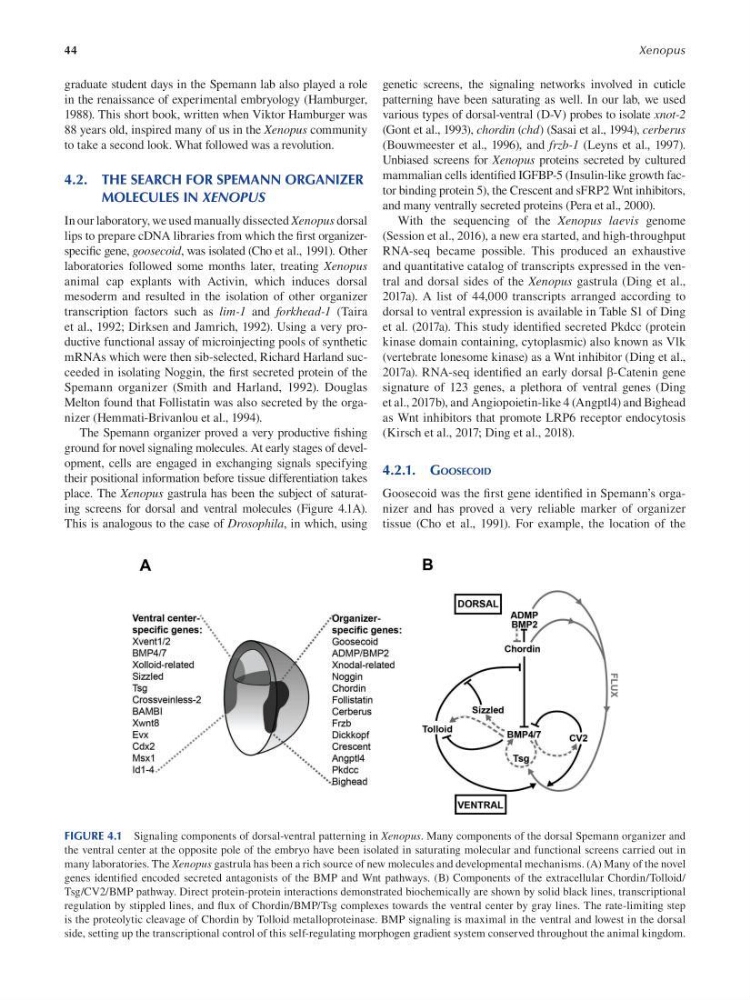
place. The Xenopus gastrula has been the subject of saturating screens for dorsal and ventral molecules (Figure 4.1A).
This is analogous to the case of Drosophila, in which, using
genetic screens, the signaling networks involved in cuticle
patterning have been saturating as well. In our lab, we used
various types of dorsal-ventral (D-V) probes to isolate xnot-2
(Gont et al., 1993), chordin (chd) (Sasai et al., 1994), cerberus
(Bouwmeester et al., 1996), and frzb-1 (Leyns et al., 1997).
Unbiased screens for Xenopus proteins secreted by cultured
mammalian cells identifed IGFBP-5 (Insulin-like growth factor binding protein 5), the Crescent and sFRP2 Wnt inhibitors,
and many ventrally secreted proteins (Pera et al., 2000).
With the sequencing of the Xenopus laevis genome
(Session et al., 2016), a new era started, and high-throughput
RNA-seq became possible. This produced an exhaustive
and quantitative catalog of transcripts expressed in the ventral and dorsal sides of the Xenopus gastrula (Ding et al.,
2017a). A list of 44,000 transcripts arranged according to
dorsal to ventral expression is available in Table S1 of Ding
et al. (2017a). This study identifed secreted Pkdcc (protein
kinase domain containing, cytoplasmic) also known as Vlk
(vertebrate lonesome kinase) as a Wnt inhibitor (Ding et al.,
2017a). RNA-seq identifed an early dorsal β-Catenin gene
signature of 123 genes, a plethora of ventral genes (Ding
et al., 2017b), and Angiopoietin-like 4 (Angptl4) and Bighead
as Wnt inhibitors that promote LRP6 receptor endocytosis
(Kirsch et al., 2017; Ding et al., 2018).
4.2.1. GOOSECOID
Goosecoid was the frst gene identifed in Spemann’s organizer and has proved a very reliable marker of organizer
tissue (Cho et al., 1991). For example, the location of the
FIGURE 4.1 Signaling components of dorsal-ventral patterning in Xenopus. Many components of the dorsal Spemann organizer and
the ventral center at the opposite pole of the embryo have been isolated in saturating molecular and functional screens carried out in
many laboratories. The Xenopus gastrula has been a rich source of new molecules and developmental mechanisms. (A) Many of the novel
genes identifed encoded secreted antagonists of the BMP and Wnt pathways. (B) Components of the extracellular Chordin/Tolloid/
Tsg/CV2/BMP pathway. Direct protein-protein interactions demonstrated biochemically are shown by solid black lines, transcriptional
regulation by stippled lines, and fux of Chordin/BMP/Tsg complexes towards the ventral center by gray lines. The rate-limiting step
is the proteolytic cleavage of Chordin by Tolloid metalloproteinase. BMP signaling is maximal in the ventral and lowest in the dorsal
side, setting up the transcriptional control of this self-regulating morphogen gradient system conserved throughout the animal kingdom.
Xenopus
graduate student days in the Spemann lab also played a role
in the renaissance of experimental embryology (Hamburger,
1988). This short book, written when Viktor Hamburger was
88 years old, inspired many of us in the Xenopus community
to take a second look. What followed was a revolution.
4.2. THE SEARCH FOR SPEMANN ORGANIZER
MOLECULES IN XENOPUS
In our laboratory, we used manually dissected Xenopus dorsal
lips to prepare cDNA libraries from which the f rst organizerspecifc gene, goosecoid, was isolated (Cho et al., 1991). Other
laboratories followed some months later, treating Xenopus
animal cap explants with Activin, which induces dorsal
mesoderm and resulted in the isolation of other organizer
transcription factors such as lim-1 and forkhead-1 ( Taira
et al., 1992; Dirksen and Jamrich, 1992). Using a very productive functional assay of microinjecting pools of synthetic
mRNAs which were then sib-selected, Richard Harland succeeded in isolating Noggin, the frst secreted protein of the
Spemann organizer (Smith and Harland, 1992). Douglas
Melton found that Follistatin was also secreted by the organizer (Hemmati-Brivanlou et al., 1994).
The Spemann organizer proved a very productive f shing
ground for novel signaling molecules. At early stages of development, cells are engaged in exchanging signals specifying
their positional information before tissue differentiation takes
place. The Xenopus gastrula has been the subject of saturating screens for dorsal and ventral molecules (Figure 4.1A).
This is analogous to the case of Drosophila, in which, using
genetic screens, the signaling networks involved in cuticle
patterning have been saturating as well. In our lab, we used
various types of dorsal-ventral (D-V) probes to isolate xnot-2
(Gont et al., 1993), chordin (chd) (Sasai et al., 1994), cerberus
(Bouwmeester et al., 1996), and frzb-1 (Leyns et al., 1997).
Unbiased screens for Xenopus proteins secreted by cultured
mammalian cells identifed IGFBP-5 (Insulin-like growth factor binding protein 5), the Crescent and sFRP2 Wnt inhibitors,
and many ventrally secreted proteins (Pera et al., 2000).
With the sequencing of the Xenopus laevis genome
(Session et al., 2016), a new era started, and high-throughput
RNA-seq became possible. This produced an exhaustive
and quantitative catalog of transcripts expressed in the ventral and dorsal sides of the Xenopus gastrula (Ding et al.,
2017a). A list of 44,000 transcripts arranged according to
dorsal to ventral expression is available in Table S1 of Ding
et al. (2017a). This study identifed secreted Pkdcc (protein
kinase domain containing, cytoplasmic) also known as Vlk
(vertebrate lonesome kinase) as a Wnt inhibitor (Ding et al.,
2017a). RNA-seq identifed an early dorsal β-Catenin gene
signature of 123 genes, a plethora of ventral genes (Ding
et al., 2017b), and Angiopoietin-like 4 (Angptl4) and Bighead
as Wnt inhibitors that promote LRP6 receptor endocytosis
(Kirsch et al., 2017; Ding et al., 2018).
4.2.1. GOOSECOID
Goosecoid was the frst gene identifed in Spemann’s organizer and has proved a very reliable marker of organizer
tissue (Cho et al., 1991). For example, the location of the
FIGURE 4.1 Signaling components of dorsal-ventral patterning in Xenopus. Many components of the dorsal Spemann organizer and
the ventral center at the opposite pole of the embryo have been isolated in saturating molecular and functional screens carried out in
many laboratories. The Xenopus gastrula has been a rich source of new molecules and developmental mechanisms. (A) Many of the novel
genes identifed encoded secreted antagonists of the BMP and Wnt pathways. (B) Components of the extracellular Chordin/Tolloid/
Tsg/CV2/BMP pathway. Direct protein-protein interactions demonstrated biochemically are shown by solid black lines, transcriptional
regulation by stippled lines, and fux of Chordin/BMP/Tsg complexes towards the ventral center by gray lines. The rate-limiting step
is the proteolytic cleavage of Chordin by Tolloid metalloproteinase. BMP signaling is maximal in the ventral and lowest in the dorsal
side, setting up the transcriptional control of this self-regulating morphogen gradient system conserved throughout the animal kingdom.