

19
Xenopus Egg Extracts
initiation and elongation. Several other proteins required
for DNA replication have been identifed and/or characterized in Xenopus egg extracts, including Treslin/TICRR
and its interacting partner Mdm2 binding protein (MTBP)
(Kumagai et al., 2010; Kumagai and Dunphy, 2017).
A second type of Cyclin/Cdk complex was identif ed and
shown to be critical during interphase for DNA replication
(Blow and Nurse, 1990). Like MPF, this kinase contains
an activating Cyclin subunit and a Cdk kinase. The catalytic subunit of the S phase Cdk was identifed as Cdk2, a
protein with sequence similar to Cdc2/Cdk1 (Elledge and
Spottswood, 1991; Paris et al., 1991). Cdk2 interacts with
two different Cyclin subunits, Cyclin E and Cyclin A. Cdk2
bound to Cyclin E was shown to be the principal driver of S
phase entry (Chevalier et al., 1996; Strausfeld et al., 1996 ).
The ability of Cdk2 bound to Cyclin E to drive entry into S
phase is conserved in many models; Cyclin A drives activation of both Cdk1 and Cdk2 kinases and therefore plays
roles in both late S phase and M phase (Coverley et al.,
1993; Hwang and Clurman, 2005; Möröy and Geisen, 2004;
Ohtsubo and Roberts, 1993; Strausfeld et al., 1996; Teixeira
and Reed, 2018). Phosphorylation of replication proteins
by Cyclin E/Cdk2 is important for replication initiation. In
somatic cells, Cyclin E also drives transcription of replication
proteins.
Prior to the onset of DNA replication, Cdk2 bound to
Cyclin E was found to be inhibited by a small protein
called Xic1 (Su et al., 1995). Xic1 is a member of a large
class of proteins called cyclin-dependent kinase inhibitors (CKIs), which function by binding to Cyclin/Cdk
complexes, preventing their catalytic activity. Proteolysis
of Xic1 was shown to be the real trigger for S phase entry
(Yew and Kirschner, 1997; You et al., 2007). Xic1 is
modifed by the Skp1-cullin-F-box protein (SCF) ubiquitin ligase, leading to its destruction by the proteasome.
Interestingly, using Xenopus egg extract, Xic1 degradation was later shown to be linked directly to the assembly
of replication proteins on chromatin (Furstenthal et al.,
2001a, 2001b; You et al., 2002).
Over the years, there have been important technological
breakthroughs that have increased the utility of Xenopus egg
extracts for the study of DNA replication. A critical contribution was the development of nucleoplasmic extract (NPE)
(Walter et al., 1998). NPE is prepared by assembling a large
number of nuclei in low speed egg extract. The nuclei, which
become quite large over time through the recruitment of
karyophilic proteins from the extract, are then collected by
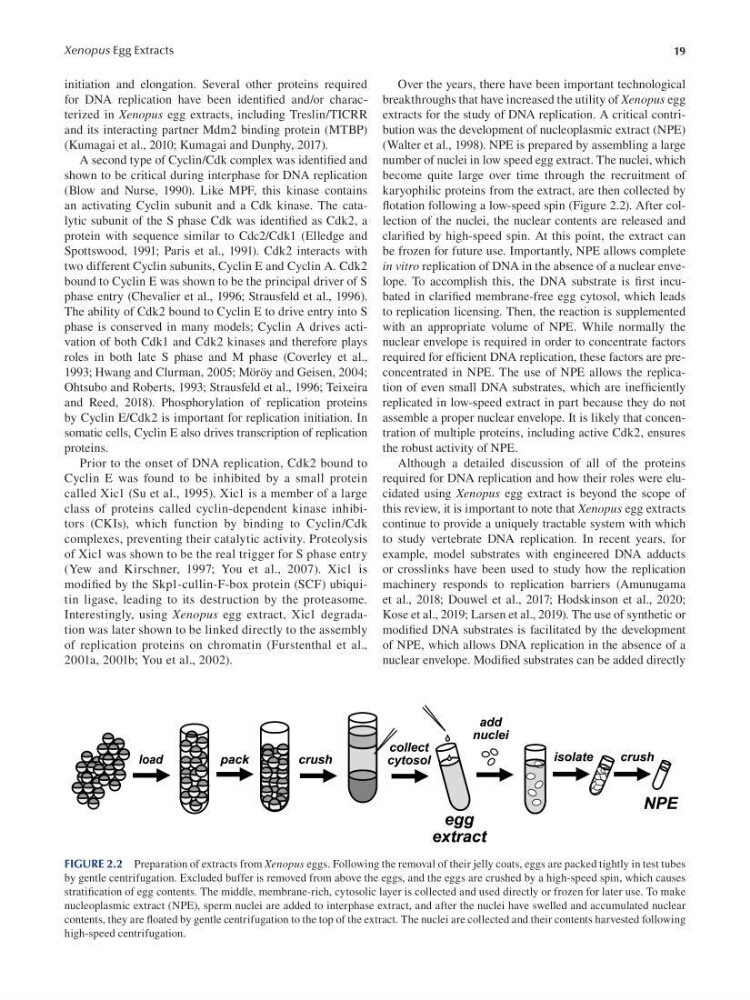
fotation following a low-speed spin (Figure 2.2). After collection of the nuclei, the nuclear contents are released and
clarifed by high-speed spin. At this point, the extract can
be frozen for future use. Importantly, NPE allows complete
in vitro replication of DNA in the absence of a nuclear envelope. To accomplish this, the DNA substrate is f rst incubated in clarifed membrane-free egg cytosol, which leads
to replication licensing. Then, the reaction is supplemented
with an appropriate volume of NPE. While normally the
nuclear envelope is required in order to concentrate factors
required for effcient DNA replication, these factors are preconcentrated in NPE. The use of NPE allows the replication of even small DNA substrates, which are ineff ciently
replicated in low-speed extract in part because they do not
assemble a proper nuclear envelope. It is likely that concentration of multiple proteins, including active Cdk2, ensures
the robust activity of NPE.
Although a detailed discussion of all of the proteins
required for DNA replication and how their roles were elucidated using Xenopus egg extract is beyond the scope of
this review, it is important to note that Xenopus egg extracts
continue to provide a uniquely tractable system with which
to study vertebrate DNA replication. In recent years, for
example, model substrates with engineered DNA adducts
or crosslinks have been used to study how the replication
machinery responds to replication barriers (Amunugama
et al., 2018; Douwel et al., 2017; Hodskinson et al., 2020;
Kose et al., 2019; Larsen et al., 2019). The use of synthetic or
modifed DNA substrates is facilitated by the development
of NPE, which allows DNA replication in the absence of a
nuclear envelope. Modifed substrates can be added directly
FIGURE 2.2 Preparation of extracts from Xenopus eggs. Following the removal of their jelly coats, eggs are packed tightly in test tubes
by gentle centrifugation. Excluded buffer is removed from above the eggs, and the eggs are crushed by a high-speed spin, which causes
stratifcation of egg contents. The middle, membrane-rich, cytosolic layer is collected and used directly or frozen for later use. To make
nucleoplasmic extract (NPE), sperm nuclei are added to interphase extract, and after the nuclei have swelled and accumulated nuclear
contents, they are foated by gentle centrifugation to the top of the extract. The nuclei are collected and their contents harvested following
high-speed centrifugation.
Xenopus Egg Extracts
initiation and elongation. Several other proteins required
for DNA replication have been identifed and/or characterized in Xenopus egg extracts, including Treslin/TICRR
and its interacting partner Mdm2 binding protein (MTBP)
(Kumagai et al., 2010; Kumagai and Dunphy, 2017).
A second type of Cyclin/Cdk complex was identif ed and
shown to be critical during interphase for DNA replication
(Blow and Nurse, 1990). Like MPF, this kinase contains
an activating Cyclin subunit and a Cdk kinase. The catalytic subunit of the S phase Cdk was identifed as Cdk2, a
protein with sequence similar to Cdc2/Cdk1 (Elledge and
Spottswood, 1991; Paris et al., 1991). Cdk2 interacts with
two different Cyclin subunits, Cyclin E and Cyclin A. Cdk2
bound to Cyclin E was shown to be the principal driver of S
phase entry (Chevalier et al., 1996; Strausfeld et al., 1996 ).
The ability of Cdk2 bound to Cyclin E to drive entry into S
phase is conserved in many models; Cyclin A drives activation of both Cdk1 and Cdk2 kinases and therefore plays
roles in both late S phase and M phase (Coverley et al.,
1993; Hwang and Clurman, 2005; Möröy and Geisen, 2004;
Ohtsubo and Roberts, 1993; Strausfeld et al., 1996; Teixeira
and Reed, 2018). Phosphorylation of replication proteins
by Cyclin E/Cdk2 is important for replication initiation. In
somatic cells, Cyclin E also drives transcription of replication
proteins.
Prior to the onset of DNA replication, Cdk2 bound to
Cyclin E was found to be inhibited by a small protein
called Xic1 (Su et al., 1995). Xic1 is a member of a large
class of proteins called cyclin-dependent kinase inhibitors (CKIs), which function by binding to Cyclin/Cdk
complexes, preventing their catalytic activity. Proteolysis
of Xic1 was shown to be the real trigger for S phase entry
(Yew and Kirschner, 1997; You et al., 2007). Xic1 is
modifed by the Skp1-cullin-F-box protein (SCF) ubiquitin ligase, leading to its destruction by the proteasome.
Interestingly, using Xenopus egg extract, Xic1 degradation was later shown to be linked directly to the assembly
of replication proteins on chromatin (Furstenthal et al.,
2001a, 2001b; You et al., 2002).
Over the years, there have been important technological
breakthroughs that have increased the utility of Xenopus egg
extracts for the study of DNA replication. A critical contribution was the development of nucleoplasmic extract (NPE)
(Walter et al., 1998). NPE is prepared by assembling a large
number of nuclei in low speed egg extract. The nuclei, which
become quite large over time through the recruitment of
karyophilic proteins from the extract, are then collected by
fotation following a low-speed spin (Figure 2.2). After collection of the nuclei, the nuclear contents are released and
clarifed by high-speed spin. At this point, the extract can
be frozen for future use. Importantly, NPE allows complete
in vitro replication of DNA in the absence of a nuclear envelope. To accomplish this, the DNA substrate is f rst incubated in clarifed membrane-free egg cytosol, which leads
to replication licensing. Then, the reaction is supplemented
with an appropriate volume of NPE. While normally the
nuclear envelope is required in order to concentrate factors
required for effcient DNA replication, these factors are preconcentrated in NPE. The use of NPE allows the replication of even small DNA substrates, which are ineff ciently
replicated in low-speed extract in part because they do not
assemble a proper nuclear envelope. It is likely that concentration of multiple proteins, including active Cdk2, ensures
the robust activity of NPE.
Although a detailed discussion of all of the proteins
required for DNA replication and how their roles were elucidated using Xenopus egg extract is beyond the scope of
this review, it is important to note that Xenopus egg extracts
continue to provide a uniquely tractable system with which
to study vertebrate DNA replication. In recent years, for
example, model substrates with engineered DNA adducts
or crosslinks have been used to study how the replication
machinery responds to replication barriers (Amunugama
et al., 2018; Douwel et al., 2017; Hodskinson et al., 2020;
Kose et al., 2019; Larsen et al., 2019). The use of synthetic or
modifed DNA substrates is facilitated by the development
of NPE, which allows DNA replication in the absence of a
nuclear envelope. Modifed substrates can be added directly
FIGURE 2.2 Preparation of extracts from Xenopus eggs. Following the removal of their jelly coats, eggs are packed tightly in test tubes
by gentle centrifugation. Excluded buffer is removed from above the eggs, and the eggs are crushed by a high-speed spin, which causes
stratifcation of egg contents. The middle, membrane-rich, cytosolic layer is collected and used directly or frozen for later use. To make
nucleoplasmic extract (NPE), sperm nuclei are added to interphase extract, and after the nuclei have swelled and accumulated nuclear
contents, they are foated by gentle centrifugation to the top of the extract. The nuclei are collected and their contents harvested following
high-speed centrifugation.