

306
Xenopus
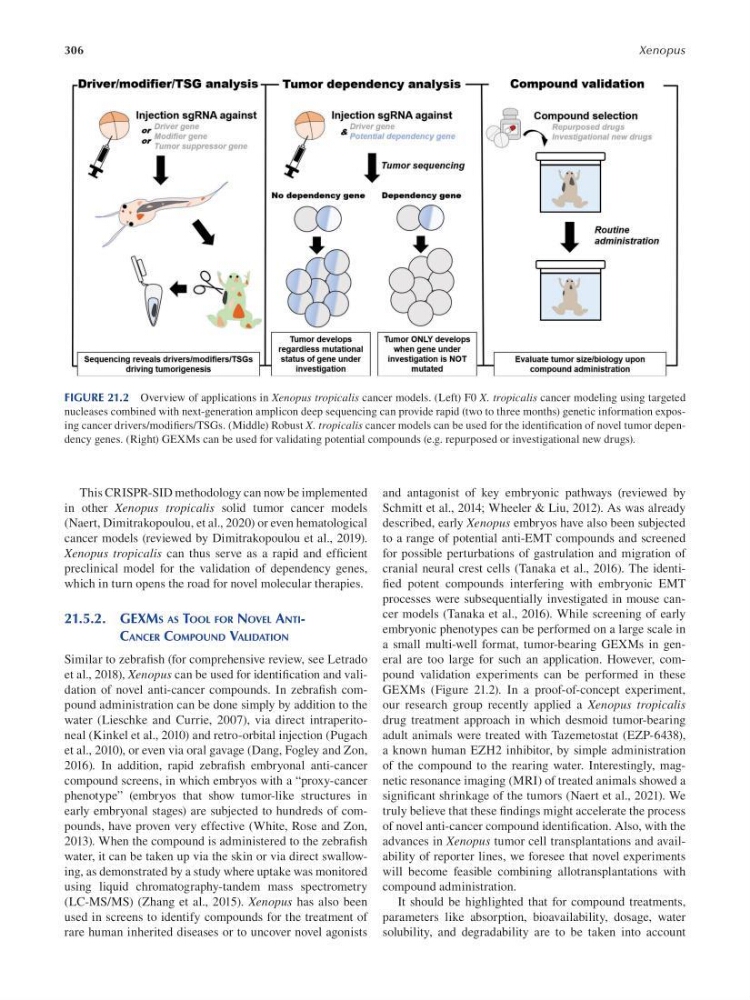
FIGURE 21.2 Overview of applications in Xenopus tropicalis cancer models. (Left) F0 X. tropicalis cancer modeling using targeted
nucleases combined with next-generation amplicon deep sequencing can provide rapid (two to three months) genetic information exposing cancer drivers/modifers/TSGs. (Middle) Robust X. tropicalis cancer models can be used for the identifcation of novel tumor dependency genes. (Right) GEXMs can be used for validating potential compounds (e.g. repurposed or investigational new drugs).
This CRISPR-SID methodology can now be implemented
in other Xenopus tropicalis solid tumor cancer models
(Naert, Dimitrakopoulou, et al., 2020) or even hematological
cancer models (reviewed by Dimitrakopoulou et al., 2019).
Xenopus tropicalis can thus serve as a rapid and eff cient
preclinical model for the validation of dependency genes,
which in turn opens the road for novel molecular therapies.
21.5.2. GEXMS AS TOOL FOR NOVEL ANTICANCER COMPOUND VALIDATION
Similar to zebrafsh (for comprehensive review, see Letrado
et al., 2018), Xenopus can be used for identifcation and validation of novel anti-cancer compounds. In zebraf sh compound administration can be done simply by addition to the
water (Lieschke and Currie, 2007), via direct intraperitoneal (Kinkel et al., 2010) and retro-orbital injection (Pugach
et al., 2010), or even via oral gavage (Dang, Fogley and Zon,
2016). In addition, rapid zebrafsh embryonal anti-cancer
compound screens, in which embryos with a “proxy-cancer
phenotype” (embryos that show tumor-like structures in
early embryonal stages) are subjected to hundreds of compounds, have proven very effective (White, Rose and Zon,
2013). When the compound is administered to the zebraf sh
water, it can be taken up via the skin or via direct swallowing, as demonstrated by a study where uptake was monitored
using liquid chromatography-tandem mass spectrometry
(LC-MS/MS) (Zhang et al., 2015). Xenopus has also been
used in screens to identify compounds for the treatment of
rare human inherited diseases or to uncover novel agonists
and antagonist of key embryonic pathways (reviewed by
Schmitt et al., 2014; Wheeler & Liu, 2012). As was already
described, early Xenopus embryos have also been subjected
to a range of potential anti-EMT compounds and screened
for possible perturbations of gastrulation and migration of
cranial neural crest cells (Tanaka et al., 2016). The identifed potent compounds interfering with embryonic EMT
processes were subsequentially investigated in mouse cancer models (Tanaka et al., 2016). While screening of early
embryonic phenotypes can be performed on a large scale in
a small multi-well format, tumor-bearing GEXMs in general are too large for such an application. However, compound validation experiments can be performed in these
GEXMs (Figure 21.2). In a proof-of-concept experiment,
our research group recently applied a Xenopus tropicalis
drug treatment approach in which desmoid tumor-bearing
adult animals were treated with Tazemetostat (EZP-6438),
a known human EZH2 inhibitor, by simple administration
of the compound to the rearing water. Interestingly, magnetic resonance imaging (MRI) of treated animals showed a
signifcant shrinkage of the tumors (Naert et al., 2021). We
truly believe that these fndings might accelerate the process
of novel anti-cancer compound identifcation. Also, with the
advances in Xenopus tumor cell transplantations and availability of reporter lines, we foresee that novel experiments
will become feasible combining allotransplantations with
compound administration.
It should be highlighted that for compound treatments,
parameters like absorption, bioavailability, dosage, water
solubility, and degradability are to be taken into account
Xenopus
FIGURE 21.2 Overview of applications in Xenopus tropicalis cancer models. (Left) F0 X. tropicalis cancer modeling using targeted
nucleases combined with next-generation amplicon deep sequencing can provide rapid (two to three months) genetic information exposing cancer drivers/modifers/TSGs. (Middle) Robust X. tropicalis cancer models can be used for the identifcation of novel tumor dependency genes. (Right) GEXMs can be used for validating potential compounds (e.g. repurposed or investigational new drugs).
This CRISPR-SID methodology can now be implemented
in other Xenopus tropicalis solid tumor cancer models
(Naert, Dimitrakopoulou, et al., 2020) or even hematological
cancer models (reviewed by Dimitrakopoulou et al., 2019).
Xenopus tropicalis can thus serve as a rapid and eff cient
preclinical model for the validation of dependency genes,
which in turn opens the road for novel molecular therapies.
21.5.2. GEXMS AS TOOL FOR NOVEL ANTICANCER COMPOUND VALIDATION
Similar to zebrafsh (for comprehensive review, see Letrado
et al., 2018), Xenopus can be used for identifcation and validation of novel anti-cancer compounds. In zebraf sh compound administration can be done simply by addition to the
water (Lieschke and Currie, 2007), via direct intraperitoneal (Kinkel et al., 2010) and retro-orbital injection (Pugach
et al., 2010), or even via oral gavage (Dang, Fogley and Zon,
2016). In addition, rapid zebrafsh embryonal anti-cancer
compound screens, in which embryos with a “proxy-cancer
phenotype” (embryos that show tumor-like structures in
early embryonal stages) are subjected to hundreds of compounds, have proven very effective (White, Rose and Zon,
2013). When the compound is administered to the zebraf sh
water, it can be taken up via the skin or via direct swallowing, as demonstrated by a study where uptake was monitored
using liquid chromatography-tandem mass spectrometry
(LC-MS/MS) (Zhang et al., 2015). Xenopus has also been
used in screens to identify compounds for the treatment of
rare human inherited diseases or to uncover novel agonists
and antagonist of key embryonic pathways (reviewed by
Schmitt et al., 2014; Wheeler & Liu, 2012). As was already
described, early Xenopus embryos have also been subjected
to a range of potential anti-EMT compounds and screened
for possible perturbations of gastrulation and migration of
cranial neural crest cells (Tanaka et al., 2016). The identifed potent compounds interfering with embryonic EMT
processes were subsequentially investigated in mouse cancer models (Tanaka et al., 2016). While screening of early
embryonic phenotypes can be performed on a large scale in
a small multi-well format, tumor-bearing GEXMs in general are too large for such an application. However, compound validation experiments can be performed in these
GEXMs (Figure 21.2). In a proof-of-concept experiment,
our research group recently applied a Xenopus tropicalis
drug treatment approach in which desmoid tumor-bearing
adult animals were treated with Tazemetostat (EZP-6438),
a known human EZH2 inhibitor, by simple administration
of the compound to the rearing water. Interestingly, magnetic resonance imaging (MRI) of treated animals showed a
signifcant shrinkage of the tumors (Naert et al., 2021). We
truly believe that these fndings might accelerate the process
of novel anti-cancer compound identifcation. Also, with the
advances in Xenopus tumor cell transplantations and availability of reporter lines, we foresee that novel experiments
will become feasible combining allotransplantations with
compound administration.
It should be highlighted that for compound treatments,
parameters like absorption, bioavailability, dosage, water
solubility, and degradability are to be taken into account