

304
Xenopus
associated with activation of discrete signaling pathways.
Interestingly, activation of these cancer pathways can often
be mediated by either the aberrant activation of oncogenes
or by the inactivation of tumor suppressor genes. As an
example, the Wnt pathway can be activated by either a gainof-function (GOF) mutation in the proto-oncogene CTNNB1
or a loss-of-function (LOF) mutation in the tumor suppressor gene APC. Similarly, GOF mutation in PI3KCA or LOF
of the TSG PTEN in essence have a similar functional outcome. As described earlier, the inactivation of TSGs is most
convenient to achieve via CRISPR. In addition, it is also
very straightforward to introduce LOF mutations simultaneously in multiple tumor suppressor genes by means of multiplexed injections.
Modeling human cancer in Xenopus can encompass the
generation of heterozygote or homozygote lines harboring
mutations in key TSGs (e.g. tp53 -/- , tp53 +/- , apc +/-) that
consequently are prone to accelerated cancer development
during their life span (Naert, Dimitrakopoulou, et al., 2020).
However, in these models, cancer initiation is dependent on the
stochastic acquisition of second hit mutations or LOH, which
may still take several months or even years. Alternatively,
since cells carrying biallelic hits in TSGs encounter strong
positive selective pressure, rapid F0 modeling is possible even
with low-effciency nucleases and in a multiplexed fashion
(Van Nieuwenhuysen et al., 2015; Zuckermann et al., 2015;
Naert et al., 2016; Naert, Dimitrakopoulou, et al., 2020).
Since loss of biallelic WT alleles and/or second hit mutations
are experimentally induced at an early developmental time
point, these models in general are very fast, mostly requiring
less than three months until tumor formation, and are very
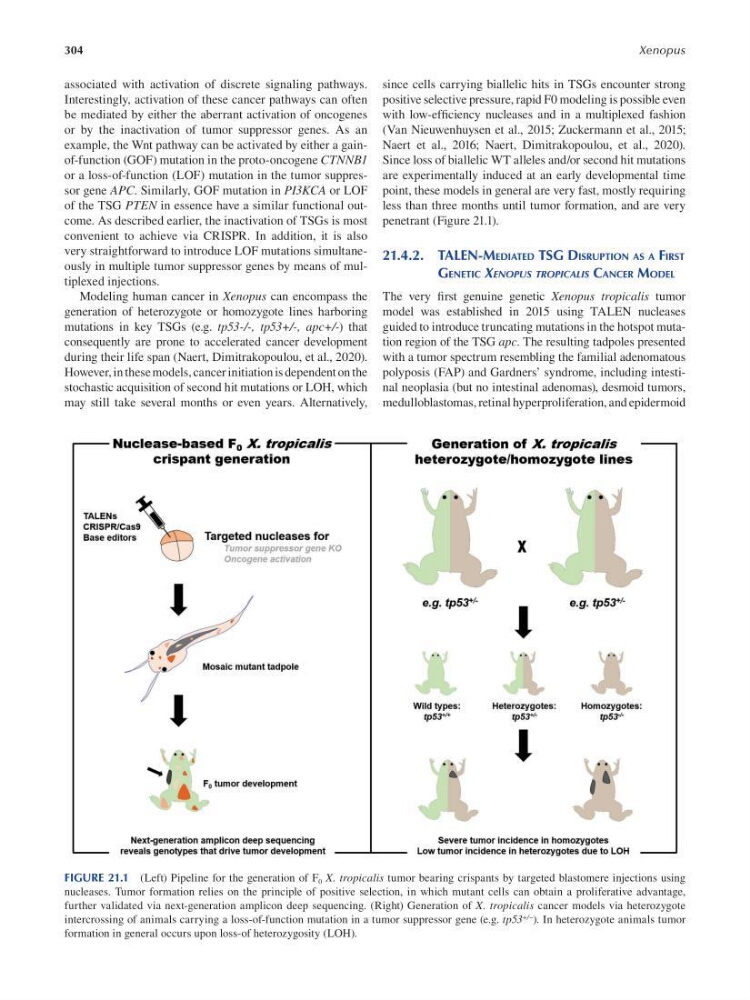
penetrant (Figure 21.1).
21.4.2. TALEN-MEDIATED TSG DISRUPTION AS A FIRST
GENETIC XENOPUS TROPICALIS CANCER MODEL
The very frst genuine genetic Xenopus tropicalis tumor
model was established in 2015 using TALEN nucleases
guided to introduce truncating mutations in the hotspot mutation region of the TSG apc. The resulting tadpoles presented
with a tumor spectrum resembling the familial adenomatous
polyposis (FAP) and Gardners’ syndrome, including intestinal neoplasia (but no intestinal adenomas), desmoid tumors,
medulloblastomas, retinal hyperproliferation, and epidermoid
FIGURE 21.1 (Left) Pipeline for the generation of F 0 X. tropicalis tumor bearing crispants by targeted blastomere injections using
nucleases. Tumor formation relies on the principle of positive selection, in which mutant cells can obtain a proliferative advantage,
further validated via next-generation amplicon deep sequencing. (Right) Generation of X. tropicalis cancer models via heterozygote
intercrossing of animals carrying a loss-of-function mutation in a tumor suppressor gene (e.g. tp53 +/− ). In heterozygote animals tumor
formation in general occurs upon loss-of heterozygosity (LOH).
Xenopus
associated with activation of discrete signaling pathways.
Interestingly, activation of these cancer pathways can often
be mediated by either the aberrant activation of oncogenes
or by the inactivation of tumor suppressor genes. As an
example, the Wnt pathway can be activated by either a gainof-function (GOF) mutation in the proto-oncogene CTNNB1
or a loss-of-function (LOF) mutation in the tumor suppressor gene APC. Similarly, GOF mutation in PI3KCA or LOF
of the TSG PTEN in essence have a similar functional outcome. As described earlier, the inactivation of TSGs is most
convenient to achieve via CRISPR. In addition, it is also
very straightforward to introduce LOF mutations simultaneously in multiple tumor suppressor genes by means of multiplexed injections.
Modeling human cancer in Xenopus can encompass the
generation of heterozygote or homozygote lines harboring
mutations in key TSGs (e.g. tp53 -/- , tp53 +/- , apc +/-) that
consequently are prone to accelerated cancer development
during their life span (Naert, Dimitrakopoulou, et al., 2020).
However, in these models, cancer initiation is dependent on the
stochastic acquisition of second hit mutations or LOH, which
may still take several months or even years. Alternatively,
since cells carrying biallelic hits in TSGs encounter strong
positive selective pressure, rapid F0 modeling is possible even
with low-effciency nucleases and in a multiplexed fashion
(Van Nieuwenhuysen et al., 2015; Zuckermann et al., 2015;
Naert et al., 2016; Naert, Dimitrakopoulou, et al., 2020).
Since loss of biallelic WT alleles and/or second hit mutations
are experimentally induced at an early developmental time
point, these models in general are very fast, mostly requiring
less than three months until tumor formation, and are very
penetrant (Figure 21.1).
21.4.2. TALEN-MEDIATED TSG DISRUPTION AS A FIRST
GENETIC XENOPUS TROPICALIS CANCER MODEL
The very frst genuine genetic Xenopus tropicalis tumor
model was established in 2015 using TALEN nucleases
guided to introduce truncating mutations in the hotspot mutation region of the TSG apc. The resulting tadpoles presented
with a tumor spectrum resembling the familial adenomatous
polyposis (FAP) and Gardners’ syndrome, including intestinal neoplasia (but no intestinal adenomas), desmoid tumors,
medulloblastomas, retinal hyperproliferation, and epidermoid
FIGURE 21.1 (Left) Pipeline for the generation of F 0 X. tropicalis tumor bearing crispants by targeted blastomere injections using
nucleases. Tumor formation relies on the principle of positive selection, in which mutant cells can obtain a proliferative advantage,
further validated via next-generation amplicon deep sequencing. (Right) Generation of X. tropicalis cancer models via heterozygote
intercrossing of animals carrying a loss-of-function mutation in a tumor suppressor gene (e.g. tp53 +/− ). In heterozygote animals tumor
formation in general occurs upon loss-of heterozygosity (LOH).