

264
Xenopus
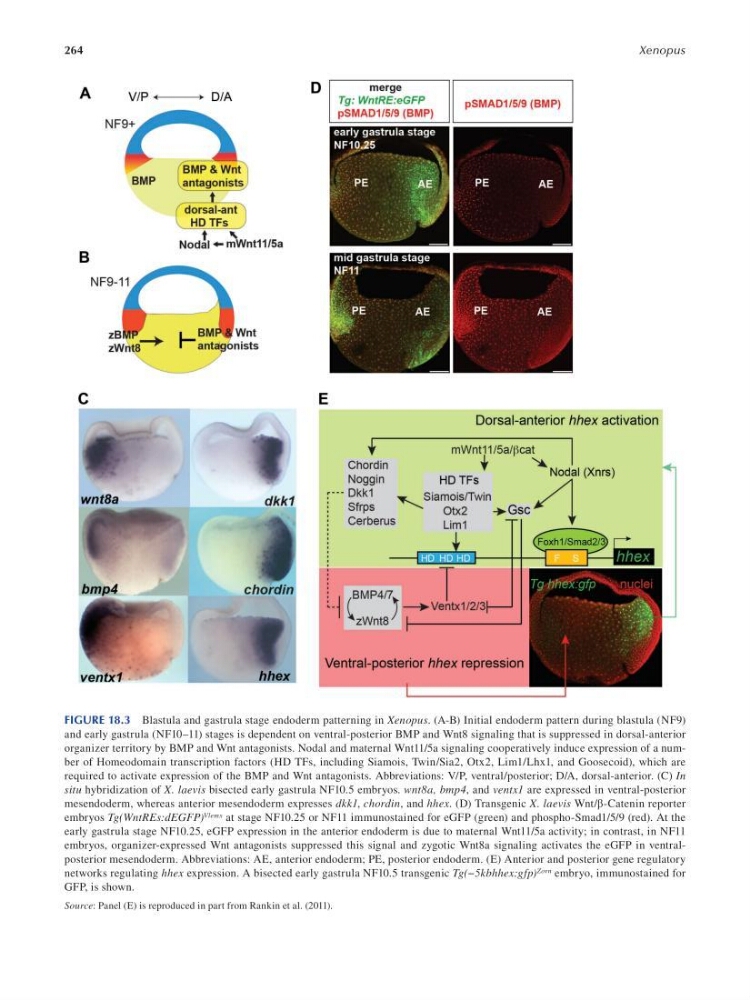
FIGURE 18.3 Blastula and gastrula stage endoderm patterning in Xenopus. (A-B) Initial endoderm pattern during blastula (NF9)
and early gastrula (NF10–11) stages is dependent on ventral-posterior BMP and Wnt8 signaling that is suppressed in dorsal-anterior
organizer territory by BMP and Wnt antagonists. Nodal and maternal Wnt11/5a signaling cooperatively induce expression of a number of Homeodomain transcription factors (HD TFs, including Siamois, Twin/Sia2, Otx2, Lim1/Lhx1, and Goosecoid), which are
required to activate expression of the BMP and Wnt antagonists. Abbreviations: V/P, ventral/posterior; D/A, dorsal-anterior. (C) In
situ hybridization of X. laevis bisected early gastrula NF10.5 embryos. wnt8a, bmp4, and ventx1 are expressed in ventral-posterior
mesendoderm, whereas anterior mesendoderm expresses dkk1, chordin, and hhex. (D) Transgenic X. laevis Wnt/β-Catenin reporter
embryos Tg(WntREs:dEGFP) Vlemx at stage NF10.25 or NF11 immunostained for eGFP (green) and phospho-Smad1/5/9 (red). At the
early gastrula stage NF10.25, eGFP expression in the anterior endoderm is due to maternal Wnt11/5a activity; in contrast, in NF11
embryos, organizer-expressed Wnt antagonists suppressed this signal and zygotic Wnt8a signaling activates the eGFP in ventralposterior mesendoderm. Abbreviations: AE, anterior endoderm; PE, posterior endoderm. (E) Anterior and posterior gene regulatory
networks regulating hhex expression. A bisected early gastrula NF10.5 transgenic Tg(−5kbhhex:gfp) Zorn embryo, immunostained for
GFP, is shown.
Source: Panel (E) is reproduced in part from Rankin et al. (2011).
Xenopus
FIGURE 18.3 Blastula and gastrula stage endoderm patterning in Xenopus. (A-B) Initial endoderm pattern during blastula (NF9)
and early gastrula (NF10–11) stages is dependent on ventral-posterior BMP and Wnt8 signaling that is suppressed in dorsal-anterior
organizer territory by BMP and Wnt antagonists. Nodal and maternal Wnt11/5a signaling cooperatively induce expression of a number of Homeodomain transcription factors (HD TFs, including Siamois, Twin/Sia2, Otx2, Lim1/Lhx1, and Goosecoid), which are
required to activate expression of the BMP and Wnt antagonists. Abbreviations: V/P, ventral/posterior; D/A, dorsal-anterior. (C) In
situ hybridization of X. laevis bisected early gastrula NF10.5 embryos. wnt8a, bmp4, and ventx1 are expressed in ventral-posterior
mesendoderm, whereas anterior mesendoderm expresses dkk1, chordin, and hhex. (D) Transgenic X. laevis Wnt/β-Catenin reporter
embryos Tg(WntREs:dEGFP) Vlemx at stage NF10.25 or NF11 immunostained for eGFP (green) and phospho-Smad1/5/9 (red). At the
early gastrula stage NF10.25, eGFP expression in the anterior endoderm is due to maternal Wnt11/5a activity; in contrast, in NF11
embryos, organizer-expressed Wnt antagonists suppressed this signal and zygotic Wnt8a signaling activates the eGFP in ventralposterior mesendoderm. Abbreviations: AE, anterior endoderm; PE, posterior endoderm. (E) Anterior and posterior gene regulatory
networks regulating hhex expression. A bisected early gastrula NF10.5 transgenic Tg(−5kbhhex:gfp) Zorn embryo, immunostained for
GFP, is shown.
Source: Panel (E) is reproduced in part from Rankin et al. (2011).