

227
Formation of the Left-Right Axis
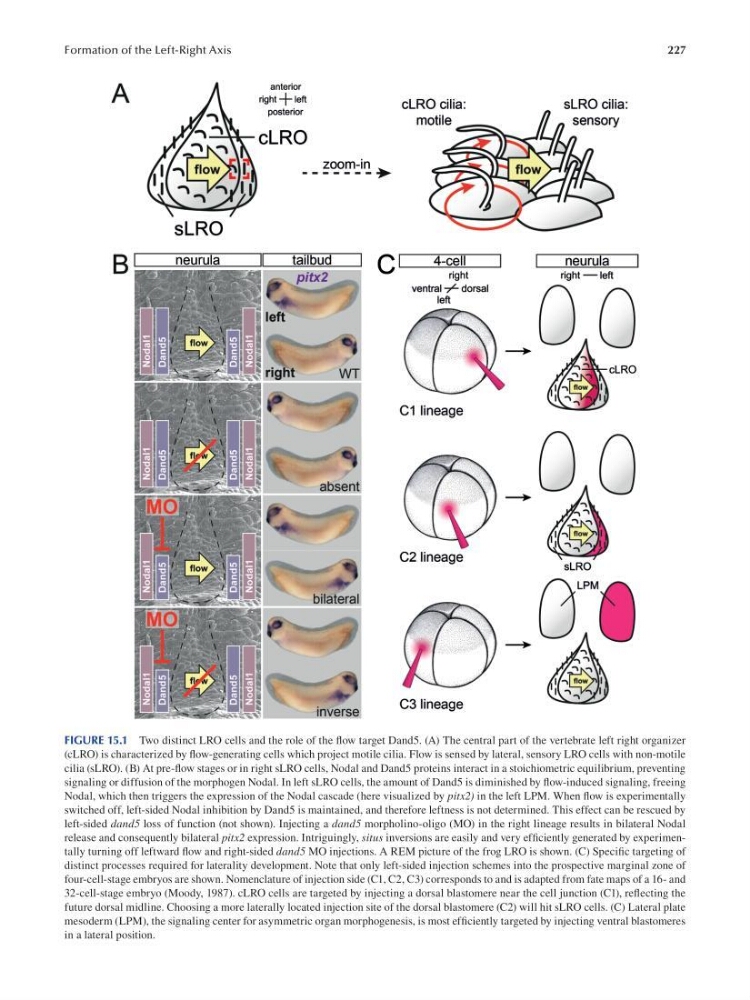
FIGURE 15.1 Two distinct LRO cells and the role of the f ow target Dand5. (A) The central part of the vertebrate left right organizer
(cLRO) is characterized by fow-generating cells which project motile cilia. Flow is sensed by lateral, sensory LRO cells with non-motile
cilia (sLRO). (B) At pre-fow stages or in right sLRO cells, Nodal and Dand5 proteins interact in a stoichiometric equilibrium, preventing
signaling or diffusion of the morphogen Nodal. In left sLRO cells, the amount of Dand5 is diminished by fow-induced signaling, freeing
Nodal, which then triggers the expression of the Nodal cascade (here visualized by pitx2) in the left LPM. When fow is experimentally
switched off, left-sided Nodal inhibition by Dand5 is maintained, and therefore leftness is not determined. This effect can be rescued by
left-sided dand5 loss of function (not shown). Injecting a dand5 morpholino-oligo (MO) in the right lineage results in bilateral Nodal
release and consequently bilateral pitx2 expression. Intriguingly, situs inversions are easily and very effciently generated by experimentally turning off leftward fow and right-sided dand5 MO injections. A REM picture of the frog LRO is shown. (C) Specifc targeting of
distinct processes required for laterality development. Note that only left-sided injection schemes into the prospective marginal zone of
four-cell-stage embryos are shown. Nomenclature of injection side (C1, C2, C3) corresponds to and is adapted from fate maps of a 16- and
32-cell-stage embryo (Moody, 1987). cLRO cells are targeted by injecting a dorsal blastomere near the cell junction (C1), ref ecting the
future dorsal midline. Choosing a more laterally located injection site of the dorsal blastomere (C2) will hit sLRO cells. (C) Lateral plate
mesoderm (LPM), the signaling center for asymmetric organ morphogenesis, is most effciently targeted by injecting ventral blastomeres
in a lateral position.
Formation of the Left-Right Axis
FIGURE 15.1 Two distinct LRO cells and the role of the f ow target Dand5. (A) The central part of the vertebrate left right organizer
(cLRO) is characterized by fow-generating cells which project motile cilia. Flow is sensed by lateral, sensory LRO cells with non-motile
cilia (sLRO). (B) At pre-fow stages or in right sLRO cells, Nodal and Dand5 proteins interact in a stoichiometric equilibrium, preventing
signaling or diffusion of the morphogen Nodal. In left sLRO cells, the amount of Dand5 is diminished by fow-induced signaling, freeing
Nodal, which then triggers the expression of the Nodal cascade (here visualized by pitx2) in the left LPM. When fow is experimentally
switched off, left-sided Nodal inhibition by Dand5 is maintained, and therefore leftness is not determined. This effect can be rescued by
left-sided dand5 loss of function (not shown). Injecting a dand5 morpholino-oligo (MO) in the right lineage results in bilateral Nodal
release and consequently bilateral pitx2 expression. Intriguingly, situs inversions are easily and very effciently generated by experimentally turning off leftward fow and right-sided dand5 MO injections. A REM picture of the frog LRO is shown. (C) Specifc targeting of
distinct processes required for laterality development. Note that only left-sided injection schemes into the prospective marginal zone of
four-cell-stage embryos are shown. Nomenclature of injection side (C1, C2, C3) corresponds to and is adapted from fate maps of a 16- and
32-cell-stage embryo (Moody, 1987). cLRO cells are targeted by injecting a dorsal blastomere near the cell junction (C1), ref ecting the
future dorsal midline. Choosing a more laterally located injection site of the dorsal blastomere (C2) will hit sLRO cells. (C) Lateral plate
mesoderm (LPM), the signaling center for asymmetric organ morphogenesis, is most effciently targeted by injecting ventral blastomeres
in a lateral position.