

189
GRNs Controlling Xenopus Embryogenesis
for a prolonged period to provide cell lineage memory.
Alternatively, the regulation may allow a surge of gene
transcription due to the production of more TF molecules,
which cause amplifcation of the TF-regulated output
response. Positive autoregulation can also lead to a stochastic difference in expression to specify cell fates due to
amplifcation of noise or cell-cell variations (Alon, 2007;
Peter and Davidson, 2015). The simplest positive feedback
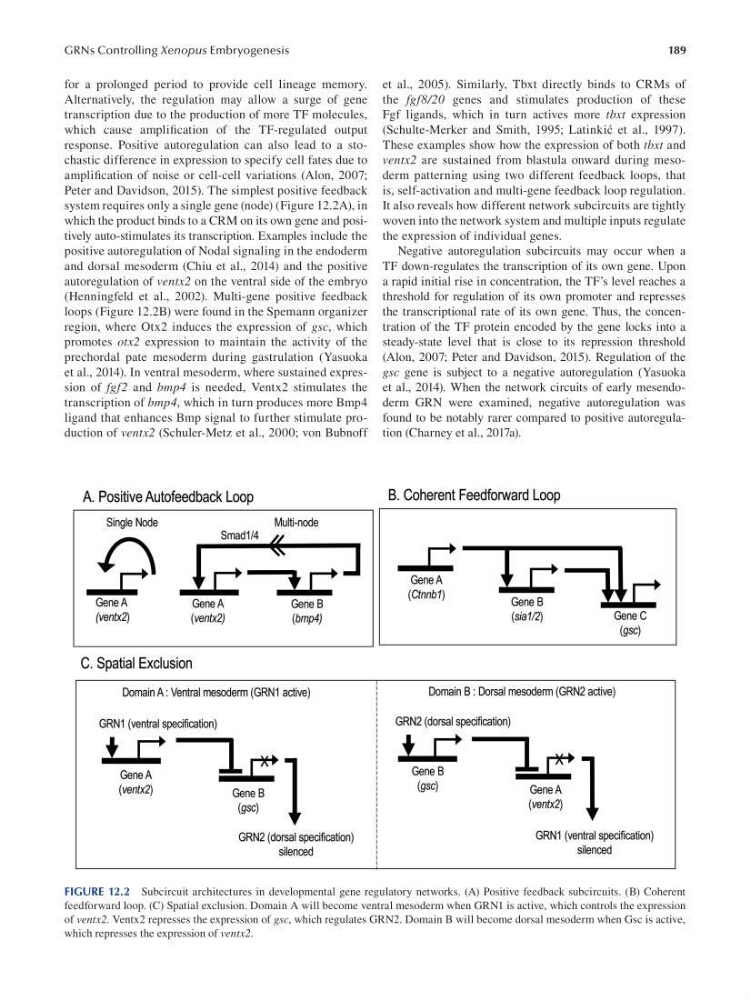
system requires only a single gene (node) (Figure 12.2A), in
which the product binds to a CRM on its own gene and positively auto-stimulates its transcription. Examples include the
positive autoregulation of Nodal signaling in the endoderm
and dorsal mesoderm (Chiu et al., 2014) and the positive
autoregulation of ventx2 on the ventral side of the embryo
(Henningfeld et al., 2002). Multi-gene positive feedback
loops (Figure 12.2B) were found in the Spemann organizer
region, where Otx2 induces the expression of gsc, which
promotes otx2 expression to maintain the activity of the
prechordal pate mesoderm during gastrulation (Yasuoka
et al., 2014). In ventral mesoderm, where sustained expression of fgf2 and bmp4 is needed, Ventx2 stimulates the
transcription of bmp4, which in turn produces more Bmp4
ligand that enhances Bmp signal to further stimulate production of ventx2 (Schuler-Metz et al., 2000; von Bubnoff
et al., 2005). Similarly, Tbxt directly binds to CRMs of
the fgf8/20 genes and stimulates production of these
Fgf ligands, which in turn actives more tbxt expression
( Schulte-Merker and Smith, 1995 ; Latinkić et al., 1997).
These examples show how the expression of both tbxt and
ventx2 are sustained from blastula onward during mesoderm patterning using two different feedback loops, that
is, self-activation and multi-gene feedback loop regulation.
It also reveals how different network subcircuits are tightly
woven into the network system and multiple inputs regulate
the expression of individual genes.
Negative autoregulation subcircuits may occur when a
TF down-regulates the transcription of its own gene. Upon
a rapid initial rise in concentration, the TF’s level reaches a
threshold for regulation of its own promoter and represses
the transcriptional rate of its own gene. Thus, the concentration of the TF protein encoded by the gene locks into a
steady-state level that is close to its repression threshold
(Alon, 2007; Peter and Davidson, 2015). Regulation of the
gsc gene is subject to a negative autoregulation (Yasuoka
et al., 2014). When the network circuits of early mesendoderm GRN were examined, negative autoregulation was
found to be notably rarer compared to positive autoregulation (Charney et al., 2017a).
FIGURE 12.2 Subcircuit architectures in developmental gene regulatory networks. (A) Positive feedback subcircuits. (B) Coherent
feedforward loop. (C) Spatial exclusion. Domain A will become ventral mesoderm when GRN1 is active, which controls the expression
of ventx2. Ventx2 represses the expression of gsc, which regulates GRN2. Domain B will become dorsal mesoderm when Gsc is active,
which represses the expression of ventx2.
GRNs Controlling Xenopus Embryogenesis
for a prolonged period to provide cell lineage memory.
Alternatively, the regulation may allow a surge of gene
transcription due to the production of more TF molecules,
which cause amplifcation of the TF-regulated output
response. Positive autoregulation can also lead to a stochastic difference in expression to specify cell fates due to
amplifcation of noise or cell-cell variations (Alon, 2007;
Peter and Davidson, 2015). The simplest positive feedback
system requires only a single gene (node) (Figure 12.2A), in
which the product binds to a CRM on its own gene and positively auto-stimulates its transcription. Examples include the
positive autoregulation of Nodal signaling in the endoderm
and dorsal mesoderm (Chiu et al., 2014) and the positive
autoregulation of ventx2 on the ventral side of the embryo
(Henningfeld et al., 2002). Multi-gene positive feedback
loops (Figure 12.2B) were found in the Spemann organizer
region, where Otx2 induces the expression of gsc, which
promotes otx2 expression to maintain the activity of the
prechordal pate mesoderm during gastrulation (Yasuoka
et al., 2014). In ventral mesoderm, where sustained expression of fgf2 and bmp4 is needed, Ventx2 stimulates the
transcription of bmp4, which in turn produces more Bmp4
ligand that enhances Bmp signal to further stimulate production of ventx2 (Schuler-Metz et al., 2000; von Bubnoff
et al., 2005). Similarly, Tbxt directly binds to CRMs of
the fgf8/20 genes and stimulates production of these
Fgf ligands, which in turn actives more tbxt expression
( Schulte-Merker and Smith, 1995 ; Latinkić et al., 1997).
These examples show how the expression of both tbxt and
ventx2 are sustained from blastula onward during mesoderm patterning using two different feedback loops, that
is, self-activation and multi-gene feedback loop regulation.
It also reveals how different network subcircuits are tightly
woven into the network system and multiple inputs regulate
the expression of individual genes.
Negative autoregulation subcircuits may occur when a
TF down-regulates the transcription of its own gene. Upon
a rapid initial rise in concentration, the TF’s level reaches a
threshold for regulation of its own promoter and represses
the transcriptional rate of its own gene. Thus, the concentration of the TF protein encoded by the gene locks into a
steady-state level that is close to its repression threshold
(Alon, 2007; Peter and Davidson, 2015). Regulation of the
gsc gene is subject to a negative autoregulation (Yasuoka
et al., 2014). When the network circuits of early mesendoderm GRN were examined, negative autoregulation was
found to be notably rarer compared to positive autoregulation (Charney et al., 2017a).
FIGURE 12.2 Subcircuit architectures in developmental gene regulatory networks. (A) Positive feedback subcircuits. (B) Coherent
feedforward loop. (C) Spatial exclusion. Domain A will become ventral mesoderm when GRN1 is active, which controls the expression
of ventx2. Ventx2 represses the expression of gsc, which regulates GRN2. Domain B will become dorsal mesoderm when Gsc is active,
which represses the expression of ventx2.