

187
GRNs Controlling Xenopus Embryogenesis
events in animal development. This occurs shortly after the
activation of the zygotic genome roughly around the midblastula transition stage (Blitz and Cho, 2021). With the
exception of amniotes, germ layer specifcation depends on
unequally distributed maternal determinants present in the
egg before fertilization (reviewed in Paraiso et al., 2020),
which are the frst inputs that specify the differentiation of
germ layer cell types. In Xenopus, maternal RNAs and proteins are specifcally enriched animally (future ectoderm)
or vegetally (future endoderm) in the egg, which are subsequently asymmetrically inherited by different blastomeres.
Ectoderm germ layer specifcation requires the maternally
expressed forkhead domain TF Foxi2, which is highly
enriched as mRNA in the animal region of the Xenopus
embryo (Cha et al., 2012) and is required for the zygotic
expression of ectodermal genes such as lhx5 and cdh1
(e-cadherin). Additionally, maternal Foxi2 has been shown
to directly activate the zygotic expression of foxi1 (a gene
encoding a closely related Foxi TF) by binding to the foxi1
promoter. Like Foxi2, Foxi1 is an important regulator of the
ectodermal gene expression program (Suri et al., 2005; Mir
et al., 2007). The mechanism by which these related Fox
TFs execute the ectodermal specif cation GRN program
is currently unknown. A signaling pathway important for
ectodermal cell patterning is Bmp signaling, which is mediated by signaling mediators Smad1/5/9 and Smad4 (hereafter called Smad1/4 complex) (review Harland, 2000; Hawley
et al., 1995). In the future, ChIP-seq analysis of Foxi2 and
Smad1/4, as well as the knockdown of these TFs, are likely
to uncover the beginnings of the ectodermal GRN structure.
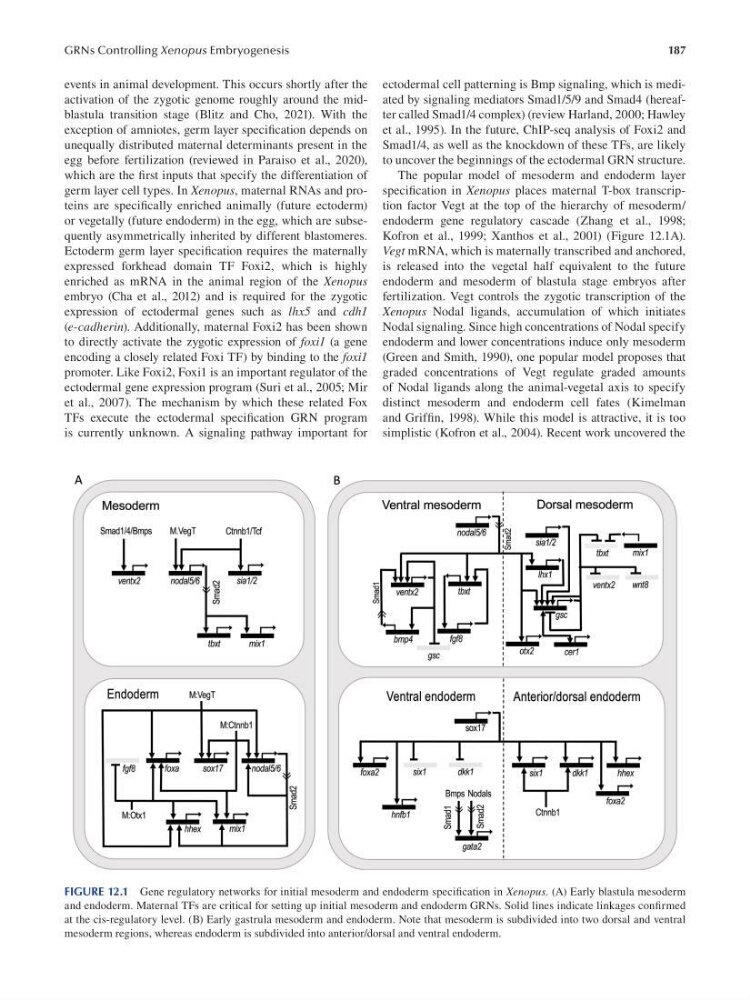
The popular model of mesoderm and endoderm layer
specifcation in Xenopus places maternal T-box transcription factor Vegt at the top of the hierarchy of mesoderm/
endoderm gene regulatory cascade ( Zhang et al., 1998;
Kofron et al., 1999; Xanthos et al., 2001) (Figure 12.1A).
Vegt mRNA, which is maternally transcribed and anchored,
is released into the vegetal half equivalent to the future
endoderm and mesoderm of blastula stage embryos after
fertilization. Vegt controls the zygotic transcription of the
Xenopus Nodal ligands, accumulation of which initiates
Nodal signaling. Since high concentrations of Nodal specify
endoderm and lower concentrations induce only mesoderm
(Green and Smith, 1990), one popular model proposes that
graded concentrations of Vegt regulate graded amounts
of Nodal ligands along the animal-vegetal axis to specify
distinct mesoderm and endoderm cell fates (Kimelman
and Griffn, 1998). While this model is attractive, it is too
simplistic (Kofron et al., 2004). Recent work uncovered the
FIGURE 12.1 Gene regulatory networks for initial mesoderm and endoderm specifcation in Xenopus. (A) Early blastula mesoderm
and endoderm. Maternal TFs are critical for setting up initial mesoderm and endoderm GRNs. Solid lines indicate linkages conf rmed
at the cis-regulatory level. (B) Early gastrula mesoderm and endoderm. Note that mesoderm is subdivided into two dorsal and ventral
mesoderm regions, whereas endoderm is subdivided into anterior/dorsal and ventral endoderm.
GRNs Controlling Xenopus Embryogenesis
events in animal development. This occurs shortly after the
activation of the zygotic genome roughly around the midblastula transition stage (Blitz and Cho, 2021). With the
exception of amniotes, germ layer specifcation depends on
unequally distributed maternal determinants present in the
egg before fertilization (reviewed in Paraiso et al., 2020),
which are the frst inputs that specify the differentiation of
germ layer cell types. In Xenopus, maternal RNAs and proteins are specifcally enriched animally (future ectoderm)
or vegetally (future endoderm) in the egg, which are subsequently asymmetrically inherited by different blastomeres.
Ectoderm germ layer specifcation requires the maternally
expressed forkhead domain TF Foxi2, which is highly
enriched as mRNA in the animal region of the Xenopus
embryo (Cha et al., 2012) and is required for the zygotic
expression of ectodermal genes such as lhx5 and cdh1
(e-cadherin). Additionally, maternal Foxi2 has been shown
to directly activate the zygotic expression of foxi1 (a gene
encoding a closely related Foxi TF) by binding to the foxi1
promoter. Like Foxi2, Foxi1 is an important regulator of the
ectodermal gene expression program (Suri et al., 2005; Mir
et al., 2007). The mechanism by which these related Fox
TFs execute the ectodermal specif cation GRN program
is currently unknown. A signaling pathway important for
ectodermal cell patterning is Bmp signaling, which is mediated by signaling mediators Smad1/5/9 and Smad4 (hereafter called Smad1/4 complex) (review Harland, 2000; Hawley
et al., 1995). In the future, ChIP-seq analysis of Foxi2 and
Smad1/4, as well as the knockdown of these TFs, are likely
to uncover the beginnings of the ectodermal GRN structure.
The popular model of mesoderm and endoderm layer
specifcation in Xenopus places maternal T-box transcription factor Vegt at the top of the hierarchy of mesoderm/
endoderm gene regulatory cascade ( Zhang et al., 1998;
Kofron et al., 1999; Xanthos et al., 2001) (Figure 12.1A).
Vegt mRNA, which is maternally transcribed and anchored,
is released into the vegetal half equivalent to the future
endoderm and mesoderm of blastula stage embryos after
fertilization. Vegt controls the zygotic transcription of the
Xenopus Nodal ligands, accumulation of which initiates
Nodal signaling. Since high concentrations of Nodal specify
endoderm and lower concentrations induce only mesoderm
(Green and Smith, 1990), one popular model proposes that
graded concentrations of Vegt regulate graded amounts
of Nodal ligands along the animal-vegetal axis to specify
distinct mesoderm and endoderm cell fates (Kimelman
and Griffn, 1998). While this model is attractive, it is too
simplistic (Kofron et al., 2004). Recent work uncovered the
FIGURE 12.1 Gene regulatory networks for initial mesoderm and endoderm specifcation in Xenopus. (A) Early blastula mesoderm
and endoderm. Maternal TFs are critical for setting up initial mesoderm and endoderm GRNs. Solid lines indicate linkages conf rmed
at the cis-regulatory level. (B) Early gastrula mesoderm and endoderm. Note that mesoderm is subdivided into two dorsal and ventral
mesoderm regions, whereas endoderm is subdivided into anterior/dorsal and ventral endoderm.