

6
Xenopus
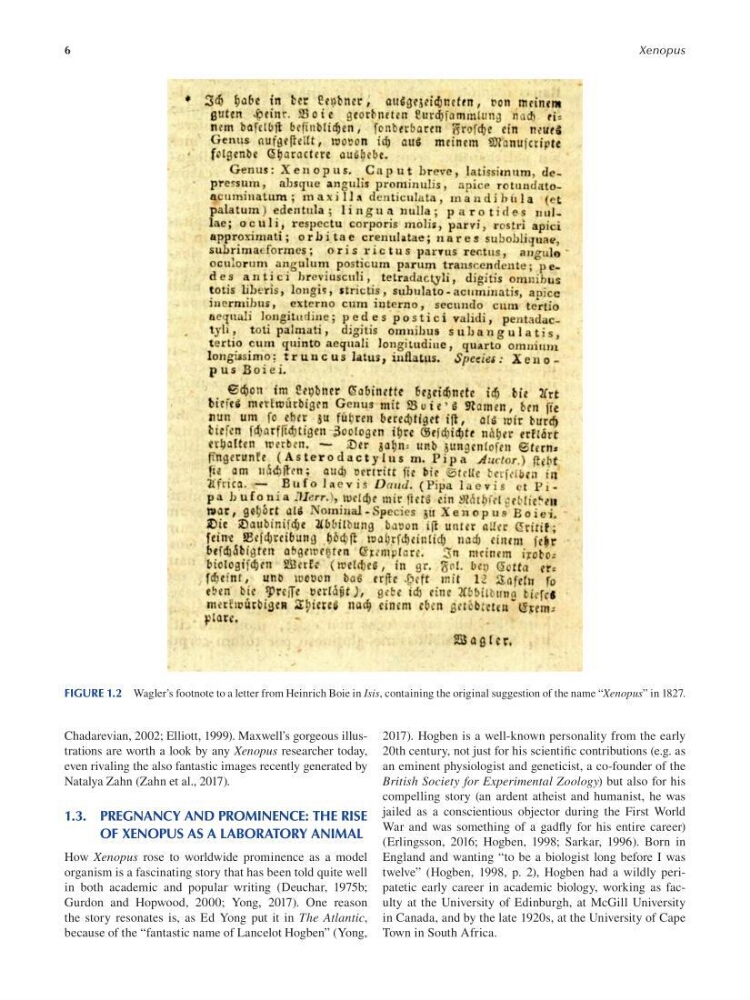
FIGURE 1.2 Wagler’s footnote to a letter from Heinrich Boie in Isis, containing the original suggestion of the name “Xenopus” in 1827.
Chadarevian, 2002; Elliott, 1999). Maxwell’s gorgeous illustrations are worth a look by any Xenopus researcher today,
even rivaling the also fantastic images recently generated by
Natalya Zahn ( Zahn et al., 2017).
1.3. PREGNANCY AND PROMINENCE: THE RISE
OF XENOPUS AS A LABORATORY ANIMAL
How Xenopus rose to worldwide prominence as a model
organism is a fascinating story that has been told quite well
in both academic and popular writing (Deuchar, 1975b;
Gurdon and Hopwood, 2000; Yong, 2017). One reason
the story resonates is, as Ed Yong put it in The Atlantic,
because of the “fantastic name of Lancelot Hogben” (Yong,
2017). Hogben is a well-known personality from the early
20th century, not just for his scientifc contributions (e.g. as
an eminent physiologist and geneticist, a co-founder of the
British Society for Experimental Zoology) but also for his
compelling story (an ardent atheist and humanist, he was
jailed as a conscientious objector during the First World
War and was something of a gadfy for his entire career)
(Erlingsson, 2016; Hogben, 1998; Sarkar, 1996 ). Born in
England and wanting “to be a biologist long before I was
twelve” (Hogben, 1998, p. 2), Hogben had a wildly peripatetic early career in academic biology, working as faculty at the University of Edinburgh, at McGill University
in Canada, and by the late 1920s, at the University of Cape
Town in South Africa.