

174
Xenopus
sections discussing chromatin dynamics in the context of
embryonic development (Sections 3–5 ). We will conclude
with future perspectives (Section 6 ).
11.2. OVERVIEW OF EPIGENOME MAPS:
WHAT IS WHERE, WHEN?
Chromatin state, or epigenome, refers to the way chromatin is
organized across the genome in a particular cell type or stage
of development. Each of the organization levels of chromatin
can be characterized using various techniques in combination
with next generation sequencing (Bright and Veenstra 2019;
Hontelez et al. 2019; Quigley and Heinz 2019; Gilchrist et al.
2020). The genome-wide regulatory landscapes are referred
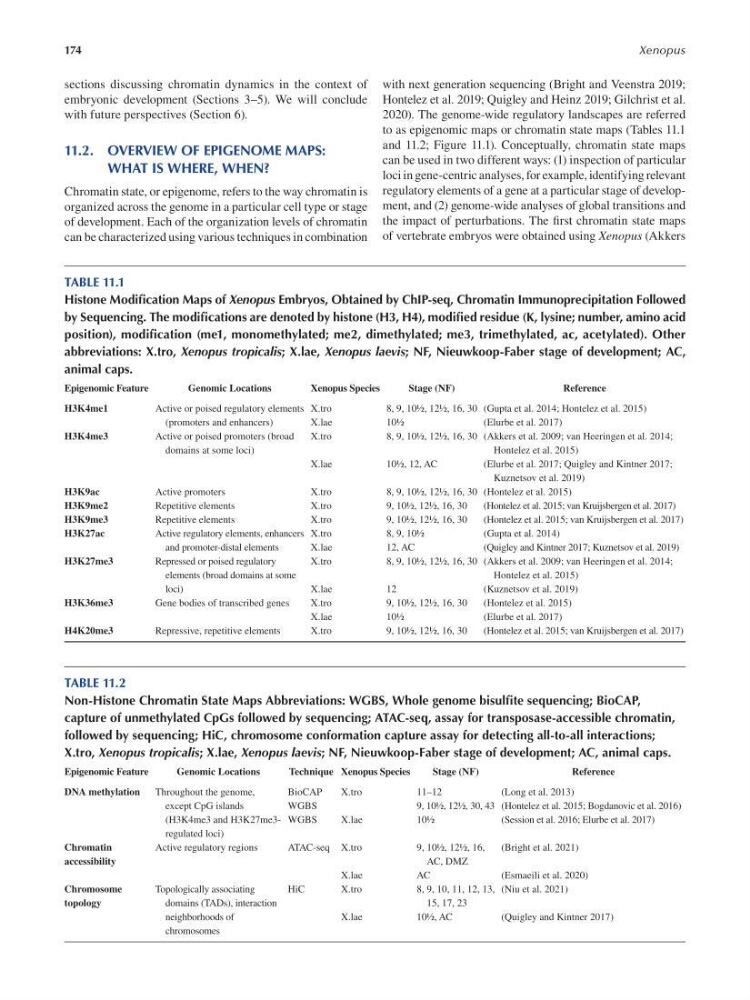
to as epigenomic maps or chromatin state maps (Tables 11.1
and 11.2; Figure 11.1). Conceptually, chromatin state maps
can be used in two different ways: (1) inspection of particular
loci in gene-centric analyses, for example, identifying relevant
regulatory elements of a gene at a particular stage of development, and (2) genome-wide analyses of global transitions and
the impact of perturbations. The frst chromatin state maps
of vertebrate embryos were obtained using Xenopus ( Akkers
TABLE 11.1
Histone Modification Maps of Xenopus Embryos, Obtained by ChIP-seq, Chromatin Immunoprecipitation Followed
by Sequencing. The modifications are denoted by histone (H3, H4), modified residue (K, lysine; number, amino acid
position), modification (me1, monomethylated; me2, dimethylated; me3, trimethylated, ac, acetylated). Other
abbreviations: X.tro, Xenopus tropicalis; X.lae, Xenopus laevis; NF, Nieuwkoop-Faber stage of development; AC,
animal caps.
Epigenomic Feature
Genomic Locations
Xenopus Species
Stage (NF)
Reference
H3K4me1
Active or poised regulatory elements X.tro
8, 9, 10½, 12½, 16, 30 ( Gupta et al. 2014 ; Hontelez et al. 2015 )
(promoters and enhancers)
X.lae
10½
( Elurbe et al. 2017 )
H3K4me3
Active or poised promoters (broad
X.tro
8, 9, 10½, 12½, 16, 30 ( Akkers et al. 2009 ; van Heeringen et al. 2014 ;
domains at some loci)
Hontelez et al. 2015 )
X.lae
10½, 12, AC
( Elurbe et al. 2017 ; Quigley and Kintner 2017 ;
Kuznetsov et al. 2019 )
H3K9ac
Active promoters
X.tro
8, 9, 10½, 12½, 16, 30 ( Hontelez et al. 2015 )
H3K9me2
Repetitive elements
X.tro
9, 10½, 12½, 16, 30
(Hontelez et al. 2015 ; van Kruijsbergen et al. 2017 )
H3K9me3
Repetitive elements
X.tro
9, 10½, 12½, 16, 30
(Hontelez et al. 2015 ; van Kruijsbergen et al. 2017 )
H3K27ac
Active regulatory elements, enhancers X.tro
8, 9, 10½
( Gupta et al. 2014 )
and promoter-distal elements
X.lae
12, AC
(Quigley and Kintner 2017 ; Kuznetsov et al. 2019 )
H3K27me3
Repressed or poised regulatory
X.tro
8, 9, 10½, 12½, 16, 30 ( Akkers et al. 2009 ; van Heeringen et al. 2014 ;
elements (broad domains at some
Hontelez et al. 2015 )
loci)
X.lae
12
( Kuznetsov et al. 2019 )
H3K36me3
Gene bodies of transcribed genes
X.tro
9, 10½, 12½, 16, 30
( Hontelez et al. 2015 )
X.lae
10½
( Elurbe et al. 2017 )
H4K20me3
Repressive, repetitive elements
X.tro
9, 10½, 12½, 16, 30
(Hontelez et al. 2015 ; van Kruijsbergen et al. 2017 )
TABLE 11.2
Non-Histone Chromatin State Maps Abbreviations: WGBS, Whole genome bisulfite sequencing; BioCAP,
capture of unmethylated CpGs followed by sequencing; ATAC-seq, assay for transposase-accessible chromatin,
followed by sequencing; HiC, chromosome conformation capture assay for detecting all-to-all interactions;
X.tro, Xenopus tropicalis ; X.lae, Xenopus laevis; NF, Nieuwkoop-Faber stage of development; AC, animal caps.
Epigenomic Feature
Genomic Locations
Technique Xenopus Species
Stage (NF)
Reference
DNA methylation
Throughout the genome,
BioCAP
X.tro
11–12
( Long et al. 2013 )
except CpG islands
WGBS
9, 10½, 12½, 30, 43 ( Hontelez et al. 2015 ; Bogdanovic et al. 2016 )
(H3K4me3 and H3K27me3- WGBS
X.lae
10½
(Session et al. 2016 ; Elurbe et al. 2017 )
regulated loci)
Chromatin
Active regulatory regions
ATAC-seq X.tro
9, 10½, 12½, 16,
( Bright et al. 2021 )
accessibility
AC, DMZ
X.lae
AC
( Esmaeili et al. 2020 )
Chromosome
Topologically associating
HiC
X.tro
8, 9, 10, 11, 12, 13, ( Niu et al. 202 1)
topology
domains (TADs), interaction
15, 17, 23
neighborhoods of
X.lae
10½, AC
( Quigley and Kintner 2017 )
chromosomes
Xenopus
sections discussing chromatin dynamics in the context of
embryonic development (Sections 3–5 ). We will conclude
with future perspectives (Section 6 ).
11.2. OVERVIEW OF EPIGENOME MAPS:
WHAT IS WHERE, WHEN?
Chromatin state, or epigenome, refers to the way chromatin is
organized across the genome in a particular cell type or stage
of development. Each of the organization levels of chromatin
can be characterized using various techniques in combination
with next generation sequencing (Bright and Veenstra 2019;
Hontelez et al. 2019; Quigley and Heinz 2019; Gilchrist et al.
2020). The genome-wide regulatory landscapes are referred
to as epigenomic maps or chromatin state maps (Tables 11.1
and 11.2; Figure 11.1). Conceptually, chromatin state maps
can be used in two different ways: (1) inspection of particular
loci in gene-centric analyses, for example, identifying relevant
regulatory elements of a gene at a particular stage of development, and (2) genome-wide analyses of global transitions and
the impact of perturbations. The frst chromatin state maps
of vertebrate embryos were obtained using Xenopus ( Akkers
TABLE 11.1
Histone Modification Maps of Xenopus Embryos, Obtained by ChIP-seq, Chromatin Immunoprecipitation Followed
by Sequencing. The modifications are denoted by histone (H3, H4), modified residue (K, lysine; number, amino acid
position), modification (me1, monomethylated; me2, dimethylated; me3, trimethylated, ac, acetylated). Other
abbreviations: X.tro, Xenopus tropicalis; X.lae, Xenopus laevis; NF, Nieuwkoop-Faber stage of development; AC,
animal caps.
Epigenomic Feature
Genomic Locations
Xenopus Species
Stage (NF)
Reference
H3K4me1
Active or poised regulatory elements X.tro
8, 9, 10½, 12½, 16, 30 ( Gupta et al. 2014 ; Hontelez et al. 2015 )
(promoters and enhancers)
X.lae
10½
( Elurbe et al. 2017 )
H3K4me3
Active or poised promoters (broad
X.tro
8, 9, 10½, 12½, 16, 30 ( Akkers et al. 2009 ; van Heeringen et al. 2014 ;
domains at some loci)
Hontelez et al. 2015 )
X.lae
10½, 12, AC
( Elurbe et al. 2017 ; Quigley and Kintner 2017 ;
Kuznetsov et al. 2019 )
H3K9ac
Active promoters
X.tro
8, 9, 10½, 12½, 16, 30 ( Hontelez et al. 2015 )
H3K9me2
Repetitive elements
X.tro
9, 10½, 12½, 16, 30
(Hontelez et al. 2015 ; van Kruijsbergen et al. 2017 )
H3K9me3
Repetitive elements
X.tro
9, 10½, 12½, 16, 30
(Hontelez et al. 2015 ; van Kruijsbergen et al. 2017 )
H3K27ac
Active regulatory elements, enhancers X.tro
8, 9, 10½
( Gupta et al. 2014 )
and promoter-distal elements
X.lae
12, AC
(Quigley and Kintner 2017 ; Kuznetsov et al. 2019 )
H3K27me3
Repressed or poised regulatory
X.tro
8, 9, 10½, 12½, 16, 30 ( Akkers et al. 2009 ; van Heeringen et al. 2014 ;
elements (broad domains at some
Hontelez et al. 2015 )
loci)
X.lae
12
( Kuznetsov et al. 2019 )
H3K36me3
Gene bodies of transcribed genes
X.tro
9, 10½, 12½, 16, 30
( Hontelez et al. 2015 )
X.lae
10½
( Elurbe et al. 2017 )
H4K20me3
Repressive, repetitive elements
X.tro
9, 10½, 12½, 16, 30
(Hontelez et al. 2015 ; van Kruijsbergen et al. 2017 )
TABLE 11.2
Non-Histone Chromatin State Maps Abbreviations: WGBS, Whole genome bisulfite sequencing; BioCAP,
capture of unmethylated CpGs followed by sequencing; ATAC-seq, assay for transposase-accessible chromatin,
followed by sequencing; HiC, chromosome conformation capture assay for detecting all-to-all interactions;
X.tro, Xenopus tropicalis ; X.lae, Xenopus laevis; NF, Nieuwkoop-Faber stage of development; AC, animal caps.
Epigenomic Feature
Genomic Locations
Technique Xenopus Species
Stage (NF)
Reference
DNA methylation
Throughout the genome,
BioCAP
X.tro
11–12
( Long et al. 2013 )
except CpG islands
WGBS
9, 10½, 12½, 30, 43 ( Hontelez et al. 2015 ; Bogdanovic et al. 2016 )
(H3K4me3 and H3K27me3- WGBS
X.lae
10½
(Session et al. 2016 ; Elurbe et al. 2017 )
regulated loci)
Chromatin
Active regulatory regions
ATAC-seq X.tro
9, 10½, 12½, 16,
( Bright et al. 2021 )
accessibility
AC, DMZ
X.lae
AC
( Esmaeili et al. 2020 )
Chromosome
Topologically associating
HiC
X.tro
8, 9, 10, 11, 12, 13, ( Niu et al. 202 1)
topology
domains (TADs), interaction
15, 17, 23
neighborhoods of
X.lae
10½, AC
( Quigley and Kintner 2017 )
chromosomes