

157
Continuing Evolution of Xenopus Genome
10.2. GENOME SEQUENCING OF
XENOPUS—THE HIGHLIGHTS
Whole genome sequencing (WGS) is a powerful tool for
analyzing the evolution of the genome. It can also reveal the
full genetic make-up of an organism, allowing for comprehensive analysis of the relationships among many genes and
their regulatory sequences. WGS of vertebrate organisms
has been done in humans and other major model organisms such as mice, zebrafsh, and medaka that are useful for
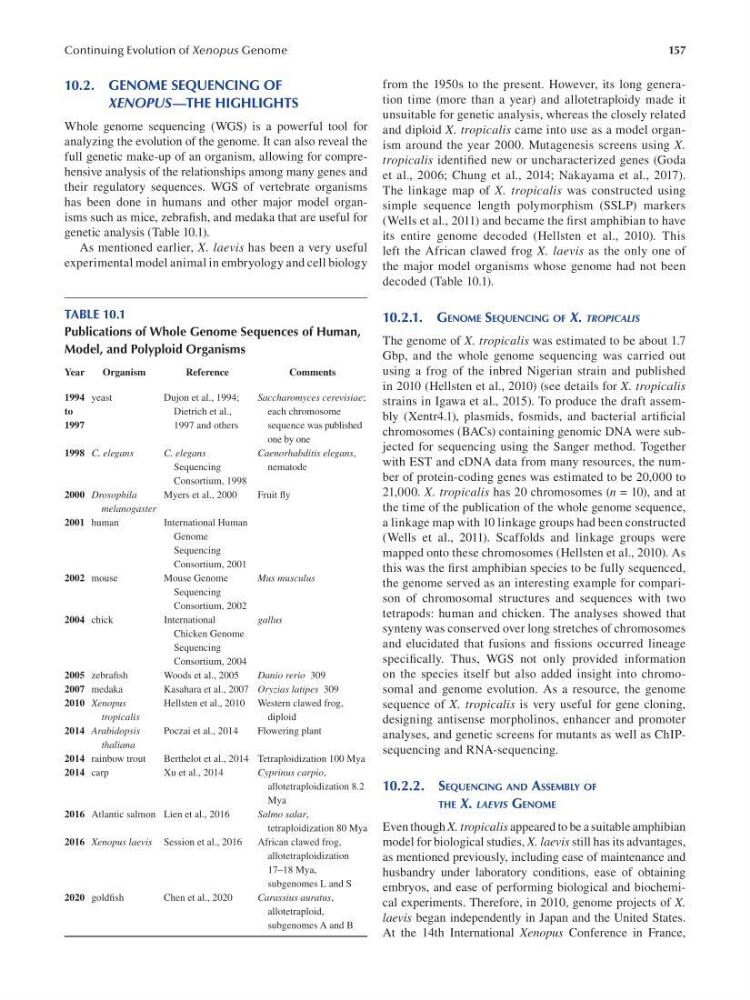
genetic analysis (Table 10.1).
As mentioned earlier, X. laevis has been a very useful
experimental model animal in embryology and cell biology
TABLE 10.1
Publications of Whole Genome Sequences of Human,
Model, and Polyploid Organisms
Year
Organism
Reference
Comments
1994 yeast
Dujon et al., 1994 ;
Saccharomyces cerevisiae;
to
Dietrich et al.,
each chromosome
1997
1997 and others
sequence was published
one by one
1998 C. elegans
C. elegans
Caenorhabditis elegans,
Sequencing
nematode
Consortium, 1998
2000 Drosophila
Myers et al., 2000
Fruit f y
melanogaster
2001 human
International Human
Genome
Sequencing
Consortium, 2001
2002 mouse
Mouse Genome
Mus musculus
Sequencing
Consortium, 2002
2004 chick
International
gallus
Chicken Genome
Sequencing
Consortium, 2004
2005 zebrafsh
Woods et al., 2005
Danio rerio 309
2007 medaka
Kasahara et al., 2007 Oryzias latipes 309
2010 Xenopus
Hellsten et al., 2010 Western clawed frog,
tropicalis
diploid
2014 Arabidopsis
Poczai et al., 2014
Flowering plant
thaliana
2014 rainbow trout
Berthelot et al., 2014 Tetraploidization 100 Mya
2014 carp
Xu et al., 2014
Cyprinus carpio,
allotetraploidization 8.2
Mya
2016 Atlantic salmon Lien et al., 2016
Salmo salar,
tetraploidization 80 Mya
2016 Xenopus laevis Session et al., 2016
African clawed frog,
allotetraploidization
17–18 Mya,
subgenomes L and S
2020 goldfsh
Chen et al., 2020
Carassius auratus,
allotetraploid,
subgenomes A and B
from the 1950s to the present. However, its long generation time (more than a year) and allotetraploidy made it
unsuitable for genetic analysis, whereas the closely related
and diploid X. tropicalis came into use as a model organism around the year 2000. Mutagenesis screens using X.
tropicalis identifed new or uncharacterized genes (Goda
et al., 2006; Chung et al., 2014; Nakayama et al., 2017).
The linkage map of X. tropicalis was constructed using
simple sequence length polymorphism (SSLP) markers
(Wells et al., 2011) and became the frst amphibian to have
its entire genome decoded (Hellsten et al., 2010). This
left the African clawed frog X. laevis as the only one of
the major model organisms whose genome had not been
decoded (Table 10.1).
10.2.1. GENOME SEQUENCING OF X. TROPICALIS
The genome of X. tropicalis was estimated to be about 1.7
Gbp, and the whole genome sequencing was carried out
using a frog of the inbred Nigerian strain and published
in 2010 (Hellsten et al., 2010) (see details for X. tropicalis
strains in Igawa et al., 2015). To produce the draft assembly (Xentr4.1), plasmids, fosmids, and bacterial artif cial
chromosomes (BACs) containing genomic DNA were subjected for sequencing using the Sanger method. Together
with EST and cDNA data from many resources, the number of protein-coding genes was estimated to be 20,000 to
21,000. X. tropicalis has 20 chromosomes (n = 10), and at
the time of the publication of the whole genome sequence,
a linkage map with 10 linkage groups had been constructed
(Wells et al., 2011). Scaffolds and linkage groups were
mapped onto these chromosomes (Hellsten et al., 2010). As
this was the frst amphibian species to be fully sequenced,
the genome served as an interesting example for comparison of chromosomal structures and sequences with two
tetrapods: human and chicken. The analyses showed that
synteny was conserved over long stretches of chromosomes
and elucidated that fusions and fssions occurred lineage
specifcally. Thus, WGS not only provided information
on the species itself but also added insight into chromosomal and genome evolution. As a resource, the genome
sequence of X. tropicalis is very useful for gene cloning,
designing antisense morpholinos, enhancer and promoter
analyses, and genetic screens for mutants as well as ChIPsequencing and RNA-sequencing.
10.2.2. SEQUENCING AND ASSEMBLY OF
THE X. LAEVIS GENOME
Even though X. tropicalis appeared to be a suitable amphibian
model for biological studies, X. laevis still has its advantages,
as mentioned previously, including ease of maintenance and
husbandry under laboratory conditions, ease of obtaining
embryos, and ease of performing biological and biochemical experiments. Therefore, in 2010, genome projects of X.
laevis began independently in Japan and the United States.
At the 14th International Xenopus Conference in France,
Continuing Evolution of Xenopus Genome
10.2. GENOME SEQUENCING OF
XENOPUS—THE HIGHLIGHTS
Whole genome sequencing (WGS) is a powerful tool for
analyzing the evolution of the genome. It can also reveal the
full genetic make-up of an organism, allowing for comprehensive analysis of the relationships among many genes and
their regulatory sequences. WGS of vertebrate organisms
has been done in humans and other major model organisms such as mice, zebrafsh, and medaka that are useful for
genetic analysis (Table 10.1).
As mentioned earlier, X. laevis has been a very useful
experimental model animal in embryology and cell biology
TABLE 10.1
Publications of Whole Genome Sequences of Human,
Model, and Polyploid Organisms
Year
Organism
Reference
Comments
1994 yeast
Dujon et al., 1994 ;
Saccharomyces cerevisiae;
to
Dietrich et al.,
each chromosome
1997
1997 and others
sequence was published
one by one
1998 C. elegans
C. elegans
Caenorhabditis elegans,
Sequencing
nematode
Consortium, 1998
2000 Drosophila
Myers et al., 2000
Fruit f y
melanogaster
2001 human
International Human
Genome
Sequencing
Consortium, 2001
2002 mouse
Mouse Genome
Mus musculus
Sequencing
Consortium, 2002
2004 chick
International
gallus
Chicken Genome
Sequencing
Consortium, 2004
2005 zebrafsh
Woods et al., 2005
Danio rerio 309
2007 medaka
Kasahara et al., 2007 Oryzias latipes 309
2010 Xenopus
Hellsten et al., 2010 Western clawed frog,
tropicalis
diploid
2014 Arabidopsis
Poczai et al., 2014
Flowering plant
thaliana
2014 rainbow trout
Berthelot et al., 2014 Tetraploidization 100 Mya
2014 carp
Xu et al., 2014
Cyprinus carpio,
allotetraploidization 8.2
Mya
2016 Atlantic salmon Lien et al., 2016
Salmo salar,
tetraploidization 80 Mya
2016 Xenopus laevis Session et al., 2016
African clawed frog,
allotetraploidization
17–18 Mya,
subgenomes L and S
2020 goldfsh
Chen et al., 2020
Carassius auratus,
allotetraploid,
subgenomes A and B
from the 1950s to the present. However, its long generation time (more than a year) and allotetraploidy made it
unsuitable for genetic analysis, whereas the closely related
and diploid X. tropicalis came into use as a model organism around the year 2000. Mutagenesis screens using X.
tropicalis identifed new or uncharacterized genes (Goda
et al., 2006; Chung et al., 2014; Nakayama et al., 2017).
The linkage map of X. tropicalis was constructed using
simple sequence length polymorphism (SSLP) markers
(Wells et al., 2011) and became the frst amphibian to have
its entire genome decoded (Hellsten et al., 2010). This
left the African clawed frog X. laevis as the only one of
the major model organisms whose genome had not been
decoded (Table 10.1).
10.2.1. GENOME SEQUENCING OF X. TROPICALIS
The genome of X. tropicalis was estimated to be about 1.7
Gbp, and the whole genome sequencing was carried out
using a frog of the inbred Nigerian strain and published
in 2010 (Hellsten et al., 2010) (see details for X. tropicalis
strains in Igawa et al., 2015). To produce the draft assembly (Xentr4.1), plasmids, fosmids, and bacterial artif cial
chromosomes (BACs) containing genomic DNA were subjected for sequencing using the Sanger method. Together
with EST and cDNA data from many resources, the number of protein-coding genes was estimated to be 20,000 to
21,000. X. tropicalis has 20 chromosomes (n = 10), and at
the time of the publication of the whole genome sequence,
a linkage map with 10 linkage groups had been constructed
(Wells et al., 2011). Scaffolds and linkage groups were
mapped onto these chromosomes (Hellsten et al., 2010). As
this was the frst amphibian species to be fully sequenced,
the genome served as an interesting example for comparison of chromosomal structures and sequences with two
tetrapods: human and chicken. The analyses showed that
synteny was conserved over long stretches of chromosomes
and elucidated that fusions and fssions occurred lineage
specifcally. Thus, WGS not only provided information
on the species itself but also added insight into chromosomal and genome evolution. As a resource, the genome
sequence of X. tropicalis is very useful for gene cloning,
designing antisense morpholinos, enhancer and promoter
analyses, and genetic screens for mutants as well as ChIPsequencing and RNA-sequencing.
10.2.2. SEQUENCING AND ASSEMBLY OF
THE X. LAEVIS GENOME
Even though X. tropicalis appeared to be a suitable amphibian
model for biological studies, X. laevis still has its advantages,
as mentioned previously, including ease of maintenance and
husbandry under laboratory conditions, ease of obtaining
embryos, and ease of performing biological and biochemical experiments. Therefore, in 2010, genome projects of X.
laevis began independently in Japan and the United States.
At the 14th International Xenopus Conference in France,