

91
Notch Signaling in Early Embryogenesis
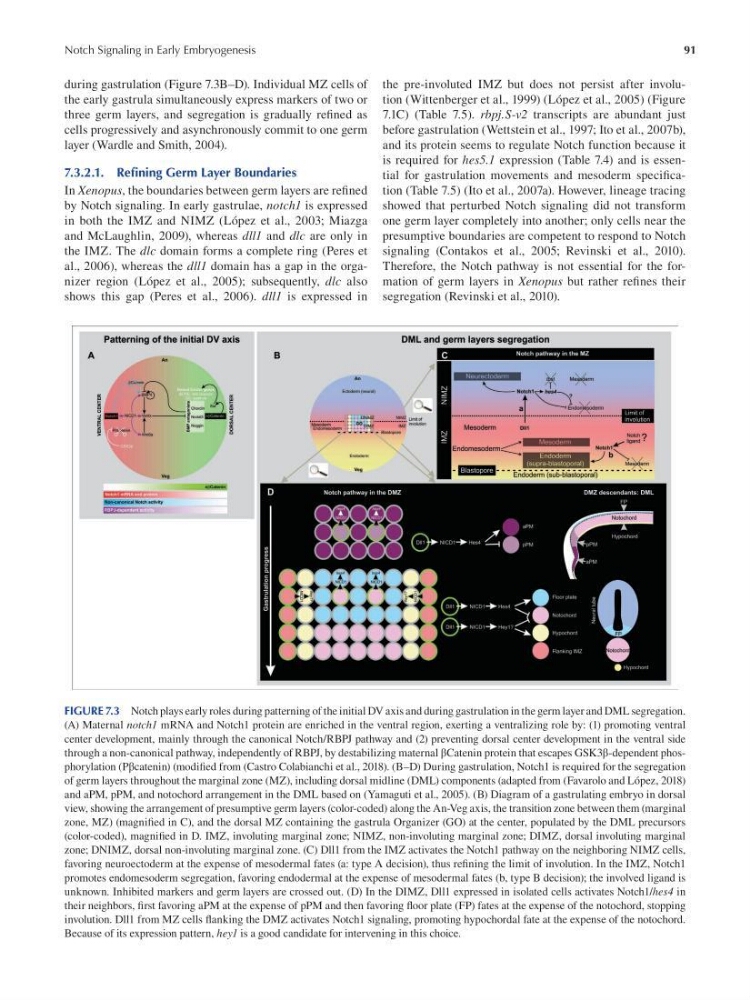
during gastrulation (Figure 7.3B–D). Individual MZ cells of
the early gastrula simultaneously express markers of two or
three germ layers, and segregation is gradually ref ned as
cells progressively and asynchronously commit to one germ
layer (Wardle and Smith, 2004).
7.3.2.1. Refining Germ Layer Boundaries
In Xenopus, the boundaries between germ layers are ref ned
by Notch signaling. In early gastrulae, notch1 is expressed
in both the IMZ and NIMZ (López et al., 2003; Miazga
and McLaughlin, 2009), whereas dll1 and dlc are only in
the IMZ. The dlc domain forms a complete ring (Peres et
al., 2006), whereas the dll1 domain has a gap in the organizer region (López et al., 2005); subsequently, dlc also
shows this gap (Peres et al., 2006). dll1 is expressed in
the pre-involuted IMZ but does not persist after involution (Wittenberger et al., 1999) (López et al., 2005 ) (Figure
7.1C ) ( Table 7.5 ). rbpj.S-v2 transcripts are abundant just
before gastrulation (Wettstein et al., 1997; Ito et al., 2007b),
and its protein seems to regulate Notch function because it
is required for hes5.1 expression (Table 7.4) and is essential for gastrulation movements and mesoderm specif cation (Table 7.5) (Ito et al., 2007a). However, lineage tracing
showed that perturbed Notch signaling did not transform
one germ layer completely into another; only cells near the
presumptive boundaries are competent to respond to Notch
signaling (Contakos et al., 2005; Revinski et al., 2010).
Therefore, the Notch pathway is not essential for the formation of germ layers in Xenopus but rather ref nes their
segregation (Revinski et al., 2010).
FIGURE 7.3 Notch plays early roles during patterning of the initial DV axis and during gastrulation in the germ layer and DML segregation.
(A) Maternal notch1 mRNA and Notch1 protein are enriched in the ventral region, exerting a ventralizing role by: (1) promoting ventral
center development, mainly through the canonical Notch/RBPJ pathway and (2) preventing dorsal center development in the ventral side
through a non-canonical pathway, independently of RBPJ, by destabilizing maternal βCatenin protein that escapes GSK3β-dependent phosphorylation (Pβcatenin) (modifed from (Castro Colabianchi et al., 2018). (B–D) During gastrulation, Notch1 is required for the segregation
of germ layers throughout the marginal zone (MZ), including dorsal midline (DML) components (adapted from (Favarolo and López, 2018)
and aPM, pPM, and notochord arrangement in the DML based on (Yamaguti et al., 2005 ). (B) Diagram of a gastrulating embryo in dorsal
view, showing the arrangement of presumptive germ layers (color-coded) along the An-Veg axis, the transition zone between them (marginal
zone, MZ) (magnifed in C), and the dorsal MZ containing the gastrula Organizer (GO) at the center, populated by the DML precursors
(color-coded), magnifed in D. IMZ, involuting marginal zone; NIMZ, non-involuting marginal zone; DIMZ, dorsal involuting marginal
zone; DNIMZ, dorsal non-involuting marginal zone. (C) Dll1 from the IMZ activates the Notch1 pathway on the neighboring NIMZ cells,
favoring neuroectoderm at the expense of mesodermal fates (a: type A decision), thus refning the limit of involution. In the IMZ, Notch1
promotes endomesoderm segregation, favoring endodermal at the expense of mesodermal fates (b, type B decision); the involved ligand is
unknown. Inhibited markers and germ layers are crossed out. (D) In the DIMZ, Dll1 expressed in isolated cells activates Notch1/hes4 in
their neighbors, frst favoring aPM at the expense of pPM and then favoring foor plate (FP) fates at the expense of the notochord, stopping
involution. Dll1 from MZ cells fanking the DMZ activates Notch1 signaling, promoting hypochordal fate at the expense of the notochord.
Because of its expression pattern, hey1 is a good candidate for intervening in this choice.
Notch Signaling in Early Embryogenesis
during gastrulation (Figure 7.3B–D). Individual MZ cells of
the early gastrula simultaneously express markers of two or
three germ layers, and segregation is gradually ref ned as
cells progressively and asynchronously commit to one germ
layer (Wardle and Smith, 2004).
7.3.2.1. Refining Germ Layer Boundaries
In Xenopus, the boundaries between germ layers are ref ned
by Notch signaling. In early gastrulae, notch1 is expressed
in both the IMZ and NIMZ (López et al., 2003; Miazga
and McLaughlin, 2009), whereas dll1 and dlc are only in
the IMZ. The dlc domain forms a complete ring (Peres et
al., 2006), whereas the dll1 domain has a gap in the organizer region (López et al., 2005); subsequently, dlc also
shows this gap (Peres et al., 2006). dll1 is expressed in
the pre-involuted IMZ but does not persist after involution (Wittenberger et al., 1999) (López et al., 2005 ) (Figure
7.1C ) ( Table 7.5 ). rbpj.S-v2 transcripts are abundant just
before gastrulation (Wettstein et al., 1997; Ito et al., 2007b),
and its protein seems to regulate Notch function because it
is required for hes5.1 expression (Table 7.4) and is essential for gastrulation movements and mesoderm specif cation (Table 7.5) (Ito et al., 2007a). However, lineage tracing
showed that perturbed Notch signaling did not transform
one germ layer completely into another; only cells near the
presumptive boundaries are competent to respond to Notch
signaling (Contakos et al., 2005; Revinski et al., 2010).
Therefore, the Notch pathway is not essential for the formation of germ layers in Xenopus but rather ref nes their
segregation (Revinski et al., 2010).
FIGURE 7.3 Notch plays early roles during patterning of the initial DV axis and during gastrulation in the germ layer and DML segregation.
(A) Maternal notch1 mRNA and Notch1 protein are enriched in the ventral region, exerting a ventralizing role by: (1) promoting ventral
center development, mainly through the canonical Notch/RBPJ pathway and (2) preventing dorsal center development in the ventral side
through a non-canonical pathway, independently of RBPJ, by destabilizing maternal βCatenin protein that escapes GSK3β-dependent phosphorylation (Pβcatenin) (modifed from (Castro Colabianchi et al., 2018). (B–D) During gastrulation, Notch1 is required for the segregation
of germ layers throughout the marginal zone (MZ), including dorsal midline (DML) components (adapted from (Favarolo and López, 2018)
and aPM, pPM, and notochord arrangement in the DML based on (Yamaguti et al., 2005 ). (B) Diagram of a gastrulating embryo in dorsal
view, showing the arrangement of presumptive germ layers (color-coded) along the An-Veg axis, the transition zone between them (marginal
zone, MZ) (magnifed in C), and the dorsal MZ containing the gastrula Organizer (GO) at the center, populated by the DML precursors
(color-coded), magnifed in D. IMZ, involuting marginal zone; NIMZ, non-involuting marginal zone; DIMZ, dorsal involuting marginal
zone; DNIMZ, dorsal non-involuting marginal zone. (C) Dll1 from the IMZ activates the Notch1 pathway on the neighboring NIMZ cells,
favoring neuroectoderm at the expense of mesodermal fates (a: type A decision), thus refning the limit of involution. In the IMZ, Notch1
promotes endomesoderm segregation, favoring endodermal at the expense of mesodermal fates (b, type B decision); the involved ligand is
unknown. Inhibited markers and germ layers are crossed out. (D) In the DIMZ, Dll1 expressed in isolated cells activates Notch1/hes4 in
their neighbors, frst favoring aPM at the expense of pPM and then favoring foor plate (FP) fates at the expense of the notochord, stopping
involution. Dll1 from MZ cells fanking the DMZ activates Notch1 signaling, promoting hypochordal fate at the expense of the notochord.
Because of its expression pattern, hey1 is a good candidate for intervening in this choice.