

3.1
Absorption and Fluorescence emission spectra:
The absorption spectra of resorufin in solution, and when doped in sol-gel (S2 / S3), are strongly affected by changes in pH
(Fig. 1), with the spectra recorded at low pH
† being weaker than those at high pH. The protonated form of resorufin (RH)
has an absorption maximum at 492 nm, which is the same when loaded into the S2 and S3 sol-gels (Fig. 1A). S4 sol-gels
had the same absorption spectra as S2.
15 The only significant difference on loading into sol-gel is the disappearance of the
shoulder at ~ 600 nm which is due to the change in environment. The resorufin anion (R
−
) in alkaline solution has a
maximum absorption at 572 nm, with a shorter wavelength shoulder around 535 nm, which is in good agreement with
previous studies
16
. At high pH ∼9, immobilisation of resorufin in the pure sol-gel (S2) results in a hypsochromic shift in
the absorption maximum to 560 nm when compared to the resorufin anion (R
−
) in solution (Fig. 1B). This again is probably
due to changes in the polarity of the microenvironment of the dye, shifting the pKa to higher pH, a similar effect was also
observed with aminofluorescein-doped sol-gels.
12 R
− in S2 also absorbs over a wider wavelength range than R
− in solution,
and this coupled with the fact that the fluorescence decay is bi-exponential (Section 3.2) indicates the presence of RH in S2
at pH 9. The surfactant modified sol-gel (S3) has a very similar absorption spectrum to that of R
− in solution indicating that
the surfactant has counteracted part of the pKa change induced by incorporation into sol-gel. At high pH (>12), however,
resorufin also undergoes a series of reactions, which eventually results in the formation of a colourless, non-fluorescent
solution, which could be the colourless hydroresorufin derivative.
17 All the measurements made in this study were done
with freshly made solutions to avoid any interference from these side reactions.
0
0.2
0.4
0.6
0.8
1.0
500
550
600
650
700
A
Wavelength (nm)
Intensity
0
0.2
0.4
0.6
0.8
1.0
500
550
600
650
700
B
Wavelength (nm)
Intensity
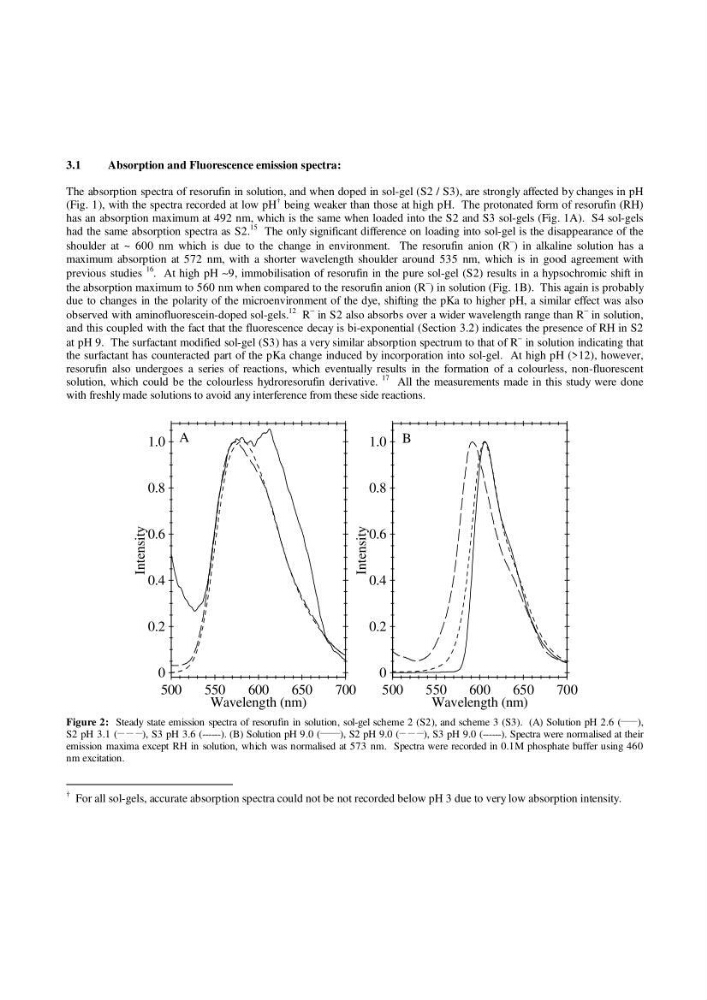
Figure 2: Steady state emission spectra of resorufin in solution, sol-gel scheme 2 (S2), and scheme 3 (S3). (A) Solution pH 2.6 (
_____
),
S2 pH 3.1 (
__ __ __
), S3 pH 3.6 (------). (B) Solution pH 9.0 (
______
), S2 pH 9.0 (
__ __ __
), S3 pH 9.0 (------). Spectra were normalised at their
emission maxima except RH in solution, which was normalised at 573 nm. Spectra were recorded in 0.1M phosphate buffer using 460
nm excitation.
† For all sol-gels, accurate absorption spectra could not be not recorded below pH 3 due to very low absorption intensity.
Absorption and Fluorescence emission spectra:
The absorption spectra of resorufin in solution, and when doped in sol-gel (S2 / S3), are strongly affected by changes in pH
(Fig. 1), with the spectra recorded at low pH
† being weaker than those at high pH. The protonated form of resorufin (RH)
has an absorption maximum at 492 nm, which is the same when loaded into the S2 and S3 sol-gels (Fig. 1A). S4 sol-gels
had the same absorption spectra as S2.
15 The only significant difference on loading into sol-gel is the disappearance of the
shoulder at ~ 600 nm which is due to the change in environment. The resorufin anion (R
−
) in alkaline solution has a
maximum absorption at 572 nm, with a shorter wavelength shoulder around 535 nm, which is in good agreement with
previous studies
16
. At high pH ∼9, immobilisation of resorufin in the pure sol-gel (S2) results in a hypsochromic shift in
the absorption maximum to 560 nm when compared to the resorufin anion (R
−
) in solution (Fig. 1B). This again is probably
due to changes in the polarity of the microenvironment of the dye, shifting the pKa to higher pH, a similar effect was also
observed with aminofluorescein-doped sol-gels.
12 R
− in S2 also absorbs over a wider wavelength range than R
− in solution,
and this coupled with the fact that the fluorescence decay is bi-exponential (Section 3.2) indicates the presence of RH in S2
at pH 9. The surfactant modified sol-gel (S3) has a very similar absorption spectrum to that of R
− in solution indicating that
the surfactant has counteracted part of the pKa change induced by incorporation into sol-gel. At high pH (>12), however,
resorufin also undergoes a series of reactions, which eventually results in the formation of a colourless, non-fluorescent
solution, which could be the colourless hydroresorufin derivative.
17 All the measurements made in this study were done
with freshly made solutions to avoid any interference from these side reactions.
0
0.2
0.4
0.6
0.8
1.0
500
550
600
650
700
A
Wavelength (nm)
Intensity
0
0.2
0.4
0.6
0.8
1.0
500
550
600
650
700
B
Wavelength (nm)
Intensity
Figure 2: Steady state emission spectra of resorufin in solution, sol-gel scheme 2 (S2), and scheme 3 (S3). (A) Solution pH 2.6 (
_____
),
S2 pH 3.1 (
__ __ __
), S3 pH 3.6 (------). (B) Solution pH 9.0 (
______
), S2 pH 9.0 (
__ __ __
), S3 pH 9.0 (------). Spectra were normalised at their
emission maxima except RH in solution, which was normalised at 573 nm. Spectra were recorded in 0.1M phosphate buffer using 460
nm excitation.
† For all sol-gels, accurate absorption spectra could not be not recorded below pH 3 due to very low absorption intensity.