

Resorufin in 0.1 M citrate-phosphate buffer had been previously studied using phase-modulation measurements and 442 nm
laser excitation which had shown that there was a relatively large lifetime change with pH over the pH 4 to 8 range.
7 This
dye, which can be efficiently excited using inexpensive blue or green LED light sources, is therefore a good candidate for
use as a lifetime based pH sensor. There have been few reports on the use of resorufin as a lifetime sensor or regarding its
immobilisation into any supporting matrix suitable for pH sensing. We have therefore decided to study the effects of
immobilising resorufin in a number of different sol-gels and modified sol-gels cross-linked with Polyvinylalcohol (PVA).
10
To adjust the pH sensing range of resorufin doped sol-gels we also investigated the addition of surfactants to the sol-gels.
This has been shown to be a facile method of adjusting the apparent pKa of immobilised indicators and should help to
produce sensors with the optimum pH range for biological and clinical applications.
11, 12 Our goal was to determine whether
or not a suitable pH sensing scheme could be developed using 460 nm LED excitation and sol-gel matrices.
2. EXPERIMENTAL:
2.1
Apparatus and Procedure:
UV-Visible spectra were recorded with a Shimadzu UV-1601 UV-visible spectrophotometer, and steady state fluorescence
spectra were measured using a Perkin Elmer LS 50B luminescence spectrometer. Fluorescence lifetimes were recorded
using a Time Correlated Single Photon Counting (TCSPC) system that was assembled in-house using modular components.
The excitation source was a 460 nm pulsed LED and the emission wavelength was selected by means of interference filters.
13, 14 The Instrument Response Function (IRF) was obtained from a non-fluorescing suspension of alumina in water held in
either 1 or 10 mm pathlength quartz cells and was assumed to be wavelength independent. Lifetimes were obtained by
deconvolution of the decay curves using the FluoFit software program (PicoQuant GmbH, Germany). All lifetimes were fit
to a χ
2 value of less than 1.2 and with a residuals trace that was fully symmetrical about the zero axis. The average lifetimes
quoted throughout are the intensity averaged lifetime, defined as
τ
= Σα i τ i
2
/ Σα i τ i .
2.2
Materials:
Resorufin, resorufin sodium salt, tetra-methoxysilane (TMOS), polyvinylalcohol (PVA), and all buffer materials were
Analar grade, obtained from Sigma-Aldrich, and were used without any further purification. The resorufin-doped sol-gels
were made up using the sodium salt derivative as this is more soluble in both non-alkaline aqueous and methanolic solutions
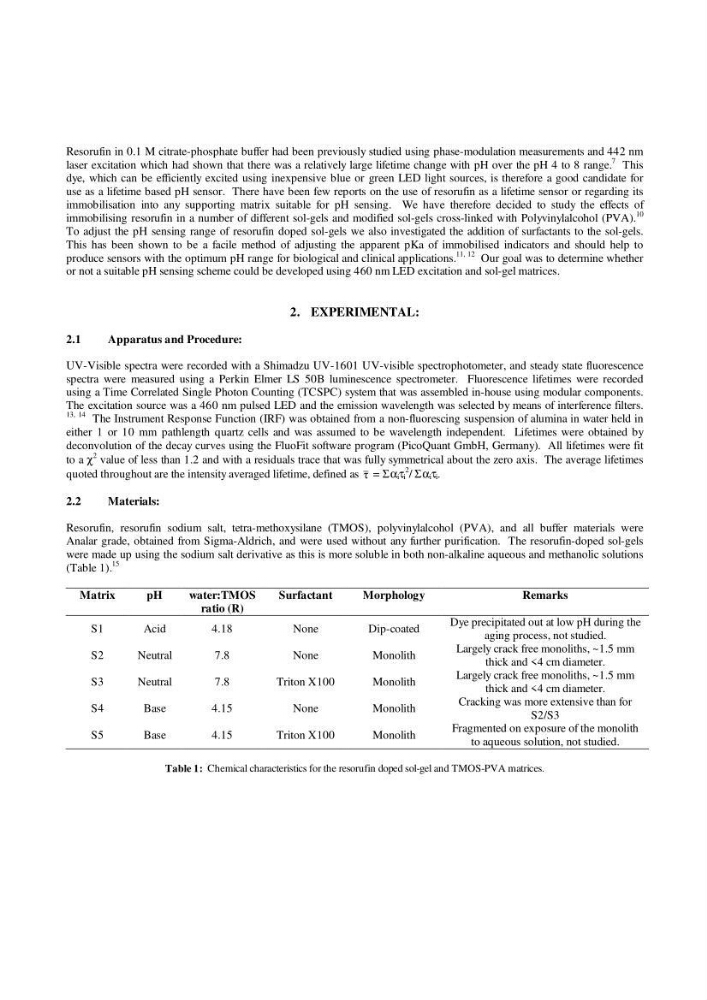
(Table 1).
15
Matrix
pH
water:TMOS
ratio (R)
Surfactant
Morphology
Remarks
S1
Acid
4.18
None
Dip-coated
Dye precipitated out at low pH during the
aging process, not studied.
S2
Neutral
7.8
None
Monolith
Largely crack free monoliths, ~1.5 mm
thick and <4 cm diameter.
S3
Neutral
7.8
Triton X100
Monolith
Largely crack free monoliths, ~1.5 mm
thick and <4 cm diameter.
S4
Base
4.15
None
Monolith
Cracking was more extensive than for
S2/S3
S5
Base
4.15
Triton X100
Monolith
Fragmented on exposure of the monolith
to aqueous solution, not studied.
Table 1: Chemical characteristics for the resorufin doped sol-gel and TMOS-PVA matrices.
laser excitation which had shown that there was a relatively large lifetime change with pH over the pH 4 to 8 range.
7 This
dye, which can be efficiently excited using inexpensive blue or green LED light sources, is therefore a good candidate for
use as a lifetime based pH sensor. There have been few reports on the use of resorufin as a lifetime sensor or regarding its
immobilisation into any supporting matrix suitable for pH sensing. We have therefore decided to study the effects of
immobilising resorufin in a number of different sol-gels and modified sol-gels cross-linked with Polyvinylalcohol (PVA).
10
To adjust the pH sensing range of resorufin doped sol-gels we also investigated the addition of surfactants to the sol-gels.
This has been shown to be a facile method of adjusting the apparent pKa of immobilised indicators and should help to
produce sensors with the optimum pH range for biological and clinical applications.
11, 12 Our goal was to determine whether
or not a suitable pH sensing scheme could be developed using 460 nm LED excitation and sol-gel matrices.
2. EXPERIMENTAL:
2.1
Apparatus and Procedure:
UV-Visible spectra were recorded with a Shimadzu UV-1601 UV-visible spectrophotometer, and steady state fluorescence
spectra were measured using a Perkin Elmer LS 50B luminescence spectrometer. Fluorescence lifetimes were recorded
using a Time Correlated Single Photon Counting (TCSPC) system that was assembled in-house using modular components.
The excitation source was a 460 nm pulsed LED and the emission wavelength was selected by means of interference filters.
13, 14 The Instrument Response Function (IRF) was obtained from a non-fluorescing suspension of alumina in water held in
either 1 or 10 mm pathlength quartz cells and was assumed to be wavelength independent. Lifetimes were obtained by
deconvolution of the decay curves using the FluoFit software program (PicoQuant GmbH, Germany). All lifetimes were fit
to a χ
2 value of less than 1.2 and with a residuals trace that was fully symmetrical about the zero axis. The average lifetimes
quoted throughout are the intensity averaged lifetime, defined as
τ
= Σα i τ i
2
/ Σα i τ i .
2.2
Materials:
Resorufin, resorufin sodium salt, tetra-methoxysilane (TMOS), polyvinylalcohol (PVA), and all buffer materials were
Analar grade, obtained from Sigma-Aldrich, and were used without any further purification. The resorufin-doped sol-gels
were made up using the sodium salt derivative as this is more soluble in both non-alkaline aqueous and methanolic solutions
(Table 1).
15
Matrix
pH
water:TMOS
ratio (R)
Surfactant
Morphology
Remarks
S1
Acid
4.18
None
Dip-coated
Dye precipitated out at low pH during the
aging process, not studied.
S2
Neutral
7.8
None
Monolith
Largely crack free monoliths, ~1.5 mm
thick and <4 cm diameter.
S3
Neutral
7.8
Triton X100
Monolith
Largely crack free monoliths, ~1.5 mm
thick and <4 cm diameter.
S4
Base
4.15
None
Monolith
Cracking was more extensive than for
S2/S3
S5
Base
4.15
Triton X100
Monolith
Fragmented on exposure of the monolith
to aqueous solution, not studied.
Table 1: Chemical characteristics for the resorufin doped sol-gel and TMOS-PVA matrices.