

ANALYSIS OF OILS USING FLUORESCENCE.
7
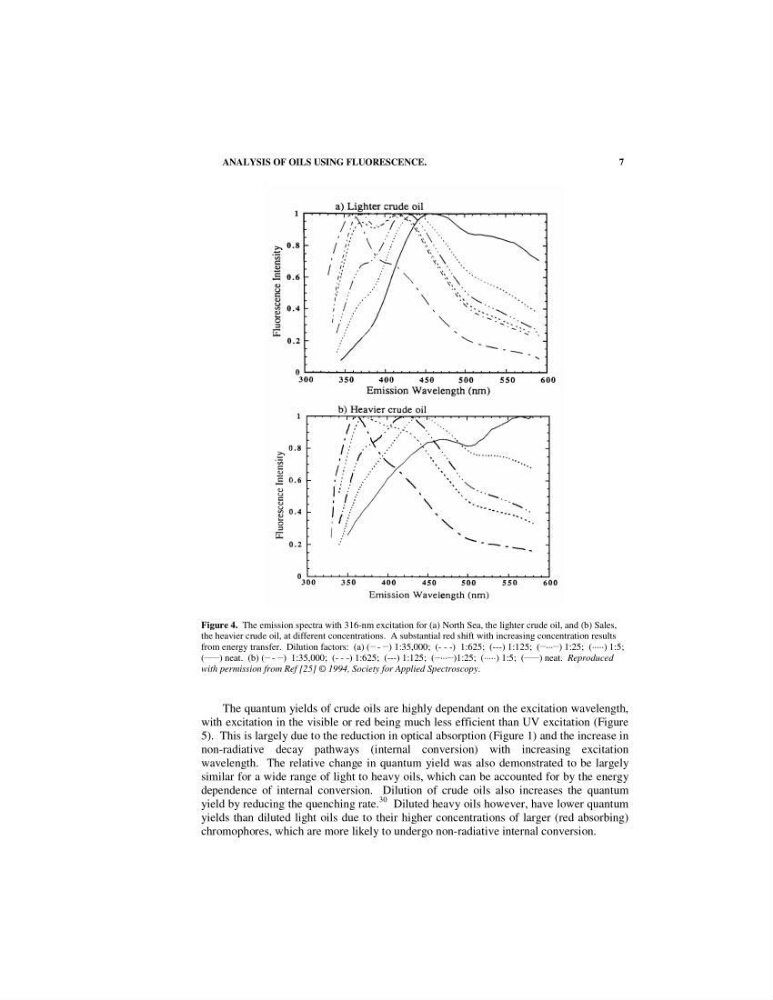
Figure 4. The emission spectra with 316-nm excitation for (a) North Sea, the lighter crude oil, and (b) Sales,
the heavier crude oil, at different concentrations. A substantial red shift with increasing concentration results
from energy transfer. Dilution factors: (a) (
__ -
__ ) 1:35,000; (- - -) 1:625; (---) 1:125; (
__ ···
__ ) 1:25; (·····) 1:5;
(
_____ ) neat. (b) (
__ -
__ ) 1:35,000; (- - -) 1:625; (---) 1:125; (
__
···
__ )1:25; (·····) 1:5; (
_____ ) neat. Reproduced
with permission from Ref [25] © 1994, Society for Applied Spectroscopy.
The quantum yields of crude oils are highly dependant on the excitation wavelength,
with excitation in the visible or red being much less efficient than UV excitation (Figure
5). This is largely due to the reduction in optical absorption (Figure 1) and the increase in
non-radiative decay pathways (internal conversion) with increasing excitation
wavelength. The relative change in quantum yield was also demonstrated to be largely
similar for a wide range of light to heavy oils, which can be accounted for by the energy
dependence of internal conversion. Dilution of crude oils also increases the quantum
yield by reducing the quenching rate.
30 Diluted heavy oils however, have lower quantum
yields than diluted light oils due to their higher concentrations of larger (red absorbing)
chromophores, which are more likely to undergo non-radiative internal conversion.
7
Figure 4. The emission spectra with 316-nm excitation for (a) North Sea, the lighter crude oil, and (b) Sales,
the heavier crude oil, at different concentrations. A substantial red shift with increasing concentration results
from energy transfer. Dilution factors: (a) (
__ -
__ ) 1:35,000; (- - -) 1:625; (---) 1:125; (
__ ···
__ ) 1:25; (·····) 1:5;
(
_____ ) neat. (b) (
__ -
__ ) 1:35,000; (- - -) 1:625; (---) 1:125; (
__
···
__ )1:25; (·····) 1:5; (
_____ ) neat. Reproduced
with permission from Ref [25] © 1994, Society for Applied Spectroscopy.
The quantum yields of crude oils are highly dependant on the excitation wavelength,
with excitation in the visible or red being much less efficient than UV excitation (Figure
5). This is largely due to the reduction in optical absorption (Figure 1) and the increase in
non-radiative decay pathways (internal conversion) with increasing excitation
wavelength. The relative change in quantum yield was also demonstrated to be largely
similar for a wide range of light to heavy oils, which can be accounted for by the energy
dependence of internal conversion. Dilution of crude oils also increases the quantum
yield by reducing the quenching rate.
30 Diluted heavy oils however, have lower quantum
yields than diluted light oils due to their higher concentrations of larger (red absorbing)
chromophores, which are more likely to undergo non-radiative internal conversion.