

12
A. G. RYDER
6
8
10
12
14
16
18
20
500
600
700
N8
N22
N39
N19
N9
N18
N31
(B)
Emission wavelength (nm)
Average lifetime (ns)
1
2
3
4
5
6
7
8
9
500
600
700
N36
N6
N5
N35
N11
(A)
Emission wavelength (nm)
Average lifetime (ns)
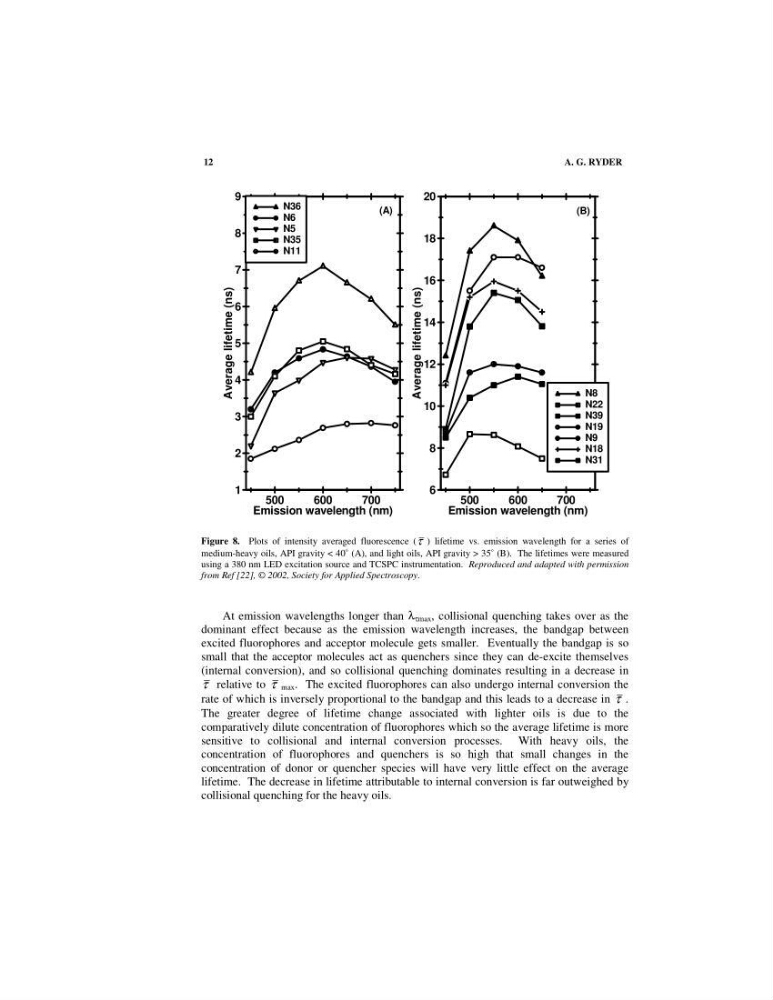
Figure 8. Plots of intensity averaged fluorescence (τ ) lifetime vs. emission wavelength for a series of
medium-heavy oils, API gravity < 40˚ (A), and light oils, API gravity > 35˚ (B). The lifetimes were measured
using a 380 nm LED excitation source and TCSPC instrumentation. Reproduced and adapted with permission
from Ref [22], © 2002, Society for Applied Spectroscopy.
At emission wavelengths longer than λ τmax , collisional quenching takes over as the
dominant effect because as the emission wavelength increases, the bandgap between
excited fluorophores and acceptor molecule gets smaller. Eventually the bandgap is so
small that the acceptor molecules act as quenchers since they can de-excite themselves
(internal conversion), and so collisional quenching dominates resulting in a decrease in
τ relative to τ max . The excited fluorophores can also undergo internal conversion the
rate of which is inversely proportional to the bandgap and this leads to a decrease in τ .
The greater degree of lifetime change associated with lighter oils is due to the
comparatively dilute concentration of fluorophores which so the average lifetime is more
sensitive to collisional and internal conversion processes. With heavy oils, the
concentration of fluorophores and quenchers is so high that small changes in the
concentration of donor or quencher species will have very little effect on the average
lifetime. The decrease in lifetime attributable to internal conversion is far outweighed by
collisional quenching for the heavy oils.
A. G. RYDER
6
8
10
12
14
16
18
20
500
600
700
N8
N22
N39
N19
N9
N18
N31
(B)
Emission wavelength (nm)
Average lifetime (ns)
1
2
3
4
5
6
7
8
9
500
600
700
N36
N6
N5
N35
N11
(A)
Emission wavelength (nm)
Average lifetime (ns)
Figure 8. Plots of intensity averaged fluorescence (τ ) lifetime vs. emission wavelength for a series of
medium-heavy oils, API gravity < 40˚ (A), and light oils, API gravity > 35˚ (B). The lifetimes were measured
using a 380 nm LED excitation source and TCSPC instrumentation. Reproduced and adapted with permission
from Ref [22], © 2002, Society for Applied Spectroscopy.
At emission wavelengths longer than λ τmax , collisional quenching takes over as the
dominant effect because as the emission wavelength increases, the bandgap between
excited fluorophores and acceptor molecule gets smaller. Eventually the bandgap is so
small that the acceptor molecules act as quenchers since they can de-excite themselves
(internal conversion), and so collisional quenching dominates resulting in a decrease in
τ relative to τ max . The excited fluorophores can also undergo internal conversion the
rate of which is inversely proportional to the bandgap and this leads to a decrease in τ .
The greater degree of lifetime change associated with lighter oils is due to the
comparatively dilute concentration of fluorophores which so the average lifetime is more
sensitive to collisional and internal conversion processes. With heavy oils, the
concentration of fluorophores and quenchers is so high that small changes in the
concentration of donor or quencher species will have very little effect on the average
lifetime. The decrease in lifetime attributable to internal conversion is far outweighed by
collisional quenching for the heavy oils.