

ANALYSIS OF OILS USING FLUORESCENCE.
9
nm LED or 405 nm violet laser diodes) produce emission that has a lower energy transfer
contribution (75-60%). Therefore, direct comparison of experimental results between
studies using different excitation sources needs to be approached with caution.
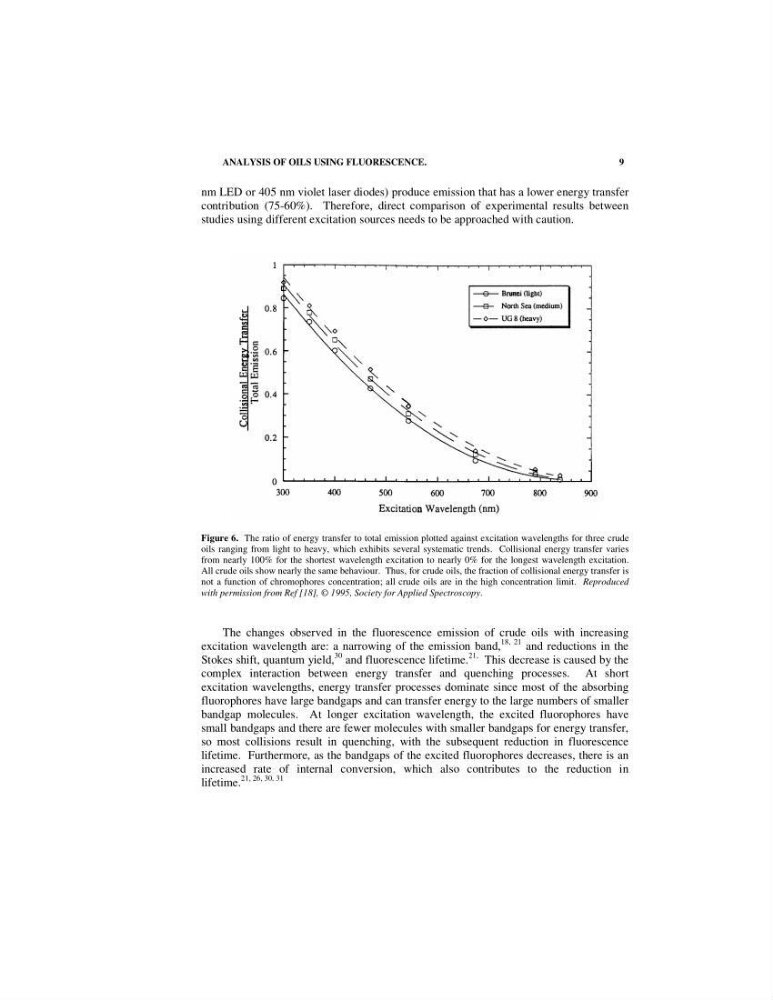
Figure 6. The ratio of energy transfer to total emission plotted against excitation wavelengths for three crude
oils ranging from light to heavy, which exhibits several systematic trends. Collisional energy transfer varies
from nearly 100% for the shortest wavelength excitation to nearly 0% for the longest wavelength excitation.
All crude oils show nearly the same behaviour. Thus, for crude oils, the fraction of collisional energy transfer is
not a function of chromophores concentration; all crude oils are in the high concentration limit. Reproduced
with permission from Ref [18], © 1995, Society for Applied Spectroscopy.
The changes observed in the fluorescence emission of crude oils with increasing
excitation wavelength are: a narrowing of the emission band,
18, 21 and reductions in the
Stokes shift, quantum yield,
30 and fluorescence lifetime.
21, This decrease is caused by the
complex interaction between energy transfer and quenching processes. At short
excitation wavelengths, energy transfer processes dominate since most of the absorbing
fluorophores have large bandgaps and can transfer energy to the large numbers of smaller
bandgap molecules. At longer excitation wavelength, the excited fluorophores have
small bandgaps and there are fewer molecules with smaller bandgaps for energy transfer,
so most collisions result in quenching, with the subsequent reduction in fluorescence
lifetime. Furthermore, as the bandgaps of the excited fluorophores decreases, there is an
increased rate of internal conversion, which also contributes to the reduction in
lifetime.
21, 26, 30, 31
9
nm LED or 405 nm violet laser diodes) produce emission that has a lower energy transfer
contribution (75-60%). Therefore, direct comparison of experimental results between
studies using different excitation sources needs to be approached with caution.
Figure 6. The ratio of energy transfer to total emission plotted against excitation wavelengths for three crude
oils ranging from light to heavy, which exhibits several systematic trends. Collisional energy transfer varies
from nearly 100% for the shortest wavelength excitation to nearly 0% for the longest wavelength excitation.
All crude oils show nearly the same behaviour. Thus, for crude oils, the fraction of collisional energy transfer is
not a function of chromophores concentration; all crude oils are in the high concentration limit. Reproduced
with permission from Ref [18], © 1995, Society for Applied Spectroscopy.
The changes observed in the fluorescence emission of crude oils with increasing
excitation wavelength are: a narrowing of the emission band,
18, 21 and reductions in the
Stokes shift, quantum yield,
30 and fluorescence lifetime.
21, This decrease is caused by the
complex interaction between energy transfer and quenching processes. At short
excitation wavelengths, energy transfer processes dominate since most of the absorbing
fluorophores have large bandgaps and can transfer energy to the large numbers of smaller
bandgap molecules. At longer excitation wavelength, the excited fluorophores have
small bandgaps and there are fewer molecules with smaller bandgaps for energy transfer,
so most collisions result in quenching, with the subsequent reduction in fluorescence
lifetime. Furthermore, as the bandgaps of the excited fluorophores decreases, there is an
increased rate of internal conversion, which also contributes to the reduction in
lifetime.
21, 26, 30, 31