

17
Depuis ces dernières années, l’espèce semble avoir une expansion de son aire de répartition
vers le nord de l’hémisphère Nord (Johnson, 2015 ; Mancinelli et al., 2021). A contrario, sur les
côtes de l’Amérique latine, son aire de répartition resterait stable (Fig. 10 ; Mancinelli et al.,
2021).
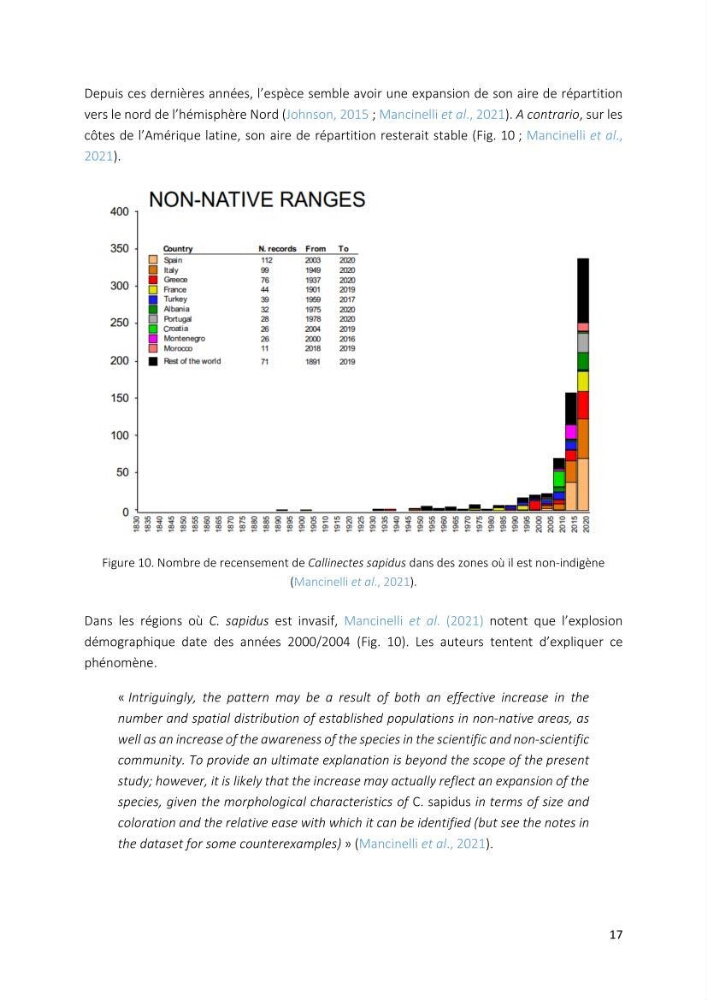
Figure 10. Nombre de recensement de Callinectes sapidus dans des zones où il est non-indigène
(Mancinelli et al., 2021).
Dans les régions où C. sapidus est invasif, Mancinelli et al. (2021) notent que l’explosion
démographique date des années 2000/2004 (Fig. 10). Les auteurs tentent d’expliquer ce
phénomène.
« Intriguingly, the pattern may be a result of both an effective increase in the
number and spatial distribution of established populations in non-native areas, as
well as an increase of the awareness of the species in the scientific and non-scientific
community. To provide an ultimate explanation is beyond the scope of the present
study; however, it is likely that the increase may actually reflect an expansion of the
species, given the morphological characteristics of C. sapidus in terms of size and
coloration and the relative ease with which it can be identified (but see the notes in
the dataset for some counterexamples) » (Mancinelli et al., 2021).
Depuis ces dernières années, l’espèce semble avoir une expansion de son aire de répartition
vers le nord de l’hémisphère Nord (Johnson, 2015 ; Mancinelli et al., 2021). A contrario, sur les
côtes de l’Amérique latine, son aire de répartition resterait stable (Fig. 10 ; Mancinelli et al.,
2021).
Figure 10. Nombre de recensement de Callinectes sapidus dans des zones où il est non-indigène
(Mancinelli et al., 2021).
Dans les régions où C. sapidus est invasif, Mancinelli et al. (2021) notent que l’explosion
démographique date des années 2000/2004 (Fig. 10). Les auteurs tentent d’expliquer ce
phénomène.
« Intriguingly, the pattern may be a result of both an effective increase in the
number and spatial distribution of established populations in non-native areas, as
well as an increase of the awareness of the species in the scientific and non-scientific
community. To provide an ultimate explanation is beyond the scope of the present
study; however, it is likely that the increase may actually reflect an expansion of the
species, given the morphological characteristics of C. sapidus in terms of size and
coloration and the relative ease with which it can be identified (but see the notes in
the dataset for some counterexamples) » (Mancinelli et al., 2021).