

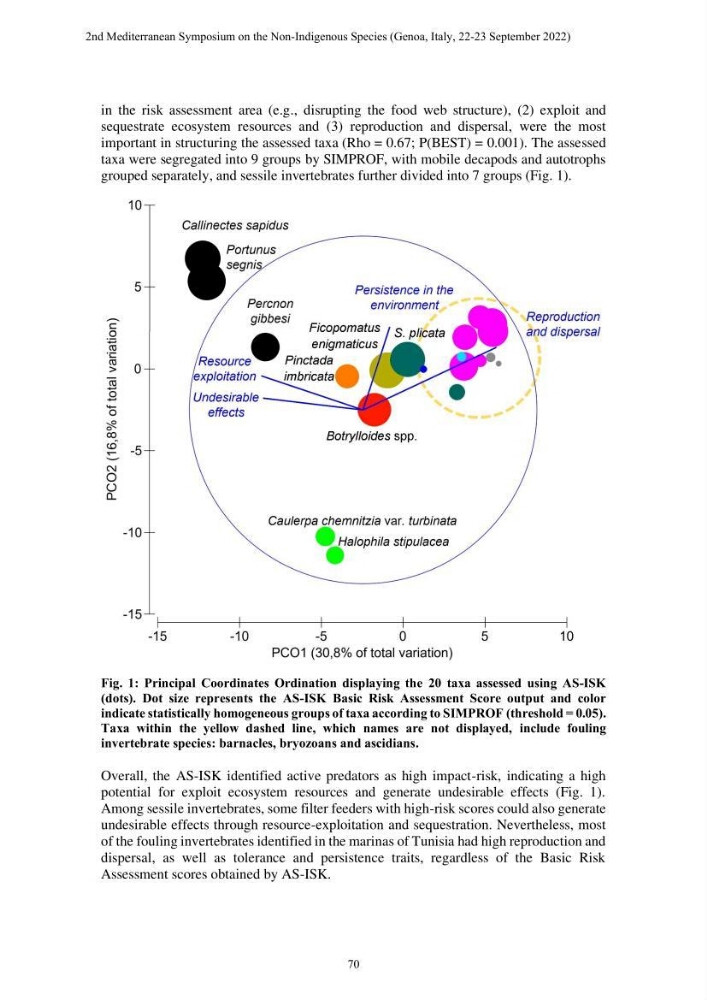
in the risk assessment area (e.g., disrupting the food web structure), (2) exploit and
sequestrate ecosystem resources and (3) reproduction and dispersal, were the most
important in structuring the assessed taxa (Rho = 0.67; P(BEST) = 0.001). The assessed
taxa were segregated into 9 groups by SIMPROF, with mobile decapods and autotrophs
grouped separately, and sessile invertebrates further divided into 7 groups (Fig. 1).
Fig. 1: Principal Coordinates Ordination displaying the 20 taxa assessed using AS-ISK
(dots). Dot size represents the AS-ISK Basic Risk Assessment Score output and color
indicate statistically homogeneous groups of taxa according to SIMPROF (threshold = 0.05).
Taxa within the yellow dashed line, which names are not displayed, include fouling
invertebrate species: barnacles, bryozoans and ascidians.
Overall, the AS-ISK identified active predators as high impact-risk, indicating a high
potential for exploit ecosystem resources and generate undesirable effects (Fig. 1).
Among sessile invertebrates, some filter feeders with high-risk scores could also generate
undesirable effects through resource-exploitation and sequestration. Nevertheless, most
of the fouling invertebrates identified in the marinas of Tunisia had high reproduction and
dispersal, as well as tolerance and persistence traits, regardless of the Basic Risk
Assessment scores obtained by AS-ISK.
2nd Mediterranean Symposium on the Non-Indigenous Species (Genoa, Italy, 22-23 September 2022)
70
sequestrate ecosystem resources and (3) reproduction and dispersal, were the most
important in structuring the assessed taxa (Rho = 0.67; P(BEST) = 0.001). The assessed
taxa were segregated into 9 groups by SIMPROF, with mobile decapods and autotrophs
grouped separately, and sessile invertebrates further divided into 7 groups (Fig. 1).
Fig. 1: Principal Coordinates Ordination displaying the 20 taxa assessed using AS-ISK
(dots). Dot size represents the AS-ISK Basic Risk Assessment Score output and color
indicate statistically homogeneous groups of taxa according to SIMPROF (threshold = 0.05).
Taxa within the yellow dashed line, which names are not displayed, include fouling
invertebrate species: barnacles, bryozoans and ascidians.
Overall, the AS-ISK identified active predators as high impact-risk, indicating a high
potential for exploit ecosystem resources and generate undesirable effects (Fig. 1).
Among sessile invertebrates, some filter feeders with high-risk scores could also generate
undesirable effects through resource-exploitation and sequestration. Nevertheless, most
of the fouling invertebrates identified in the marinas of Tunisia had high reproduction and
dispersal, as well as tolerance and persistence traits, regardless of the Basic Risk
Assessment scores obtained by AS-ISK.
2nd Mediterranean Symposium on the Non-Indigenous Species (Genoa, Italy, 22-23 September 2022)
70