

southern Greece. The goal was to investigate the biodiversity of sessile benthos in these
marinas with visual census methods for the first time, with special emphasis on NIS.
Materials and Methods
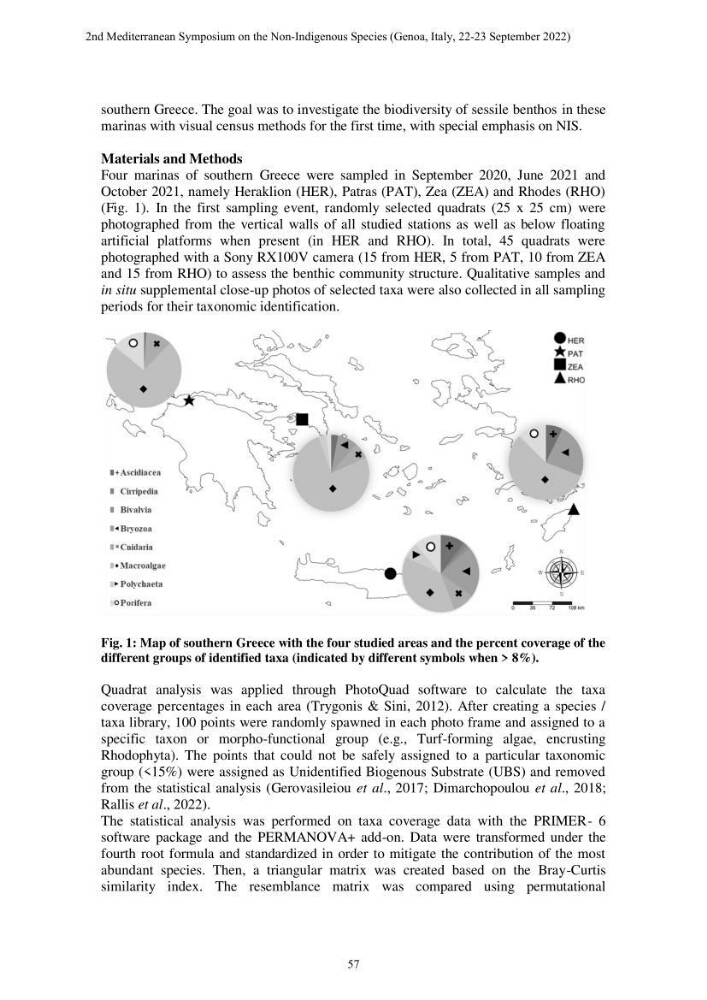
Four marinas of southern Greece were sampled in September 2020, June 2021 and
October 2021, namely Heraklion (HER), Patras (PAT), Zea (ZEA) and Rhodes (RHO)
(Fig. 1). In the first sampling event, randomly selected quadrats (25 x 25 cm) were
photographed from the vertical walls of all studied stations as well as below floating
artificial platforms when present (in HER and RHO). In total, 45 quadrats were
photographed with a Sony RX100V camera (15 from HER, 5 from PAT, 10 from ZEA
and 15 from RHO) to assess the benthic community structure. Qualitative samples and
in situ supplemental close-up photos of selected taxa were also collected in all sampling
periods for their taxonomic identification.
Fig. 1: Map of southern Greece with the four studied areas and the percent coverage of the
different groups of identified taxa (indicated by different symbols when > 8%).
Quadrat analysis was applied through PhotoQuad software to calculate the taxa
coverage percentages in each area (Trygonis & Sini, 2012). After creating a species /
taxa library, 100 points were randomly spawned in each photo frame and assigned to a
specific taxon or morpho-functional group (e.g., Turf-forming algae, encrusting
Rhodophyta). The points that could not be safely assigned to a particular taxonomic
group (<15%) were assigned as Unidentified Biogenous Substrate (UBS) and removed
from the statistical analysis (Gerovasileiou et al., 2017; Dimarchopoulou et al., 2018;
Rallis et al., 2022).
The statistical analysis was performed on taxa coverage data with the PRIMER- 6
software package and the PERMANOVA+ add-on. Data were transformed under the
fourth root formula and standardized in order to mitigate the contribution of the most
abundant species. Then, a triangular matrix was created based on the Bray-Curtis
similarity index. The resemblance matrix was compared using permutational
2nd Mediterranean Symposium on the Non-Indigenous Species (Genoa, Italy, 22-23 September 2022)
57
marinas with visual census methods for the first time, with special emphasis on NIS.
Materials and Methods
Four marinas of southern Greece were sampled in September 2020, June 2021 and
October 2021, namely Heraklion (HER), Patras (PAT), Zea (ZEA) and Rhodes (RHO)
(Fig. 1). In the first sampling event, randomly selected quadrats (25 x 25 cm) were
photographed from the vertical walls of all studied stations as well as below floating
artificial platforms when present (in HER and RHO). In total, 45 quadrats were
photographed with a Sony RX100V camera (15 from HER, 5 from PAT, 10 from ZEA
and 15 from RHO) to assess the benthic community structure. Qualitative samples and
in situ supplemental close-up photos of selected taxa were also collected in all sampling
periods for their taxonomic identification.
Fig. 1: Map of southern Greece with the four studied areas and the percent coverage of the
different groups of identified taxa (indicated by different symbols when > 8%).
Quadrat analysis was applied through PhotoQuad software to calculate the taxa
coverage percentages in each area (Trygonis & Sini, 2012). After creating a species /
taxa library, 100 points were randomly spawned in each photo frame and assigned to a
specific taxon or morpho-functional group (e.g., Turf-forming algae, encrusting
Rhodophyta). The points that could not be safely assigned to a particular taxonomic
group (<15%) were assigned as Unidentified Biogenous Substrate (UBS) and removed
from the statistical analysis (Gerovasileiou et al., 2017; Dimarchopoulou et al., 2018;
Rallis et al., 2022).
The statistical analysis was performed on taxa coverage data with the PRIMER- 6
software package and the PERMANOVA+ add-on. Data were transformed under the
fourth root formula and standardized in order to mitigate the contribution of the most
abundant species. Then, a triangular matrix was created based on the Bray-Curtis
similarity index. The resemblance matrix was compared using permutational
2nd Mediterranean Symposium on the Non-Indigenous Species (Genoa, Italy, 22-23 September 2022)
57