

34.5 below sea floor (bsf) down to cm 39.5 bfs, while in the 2019 core, only a few
individuals are observed at cm 28.5 bsf (Tab. 1). This pattern reveals that the species
had two separate introduction events: an earlier one, that lasted for a limited amount of
time and resulted in a failed invasion, and a later one, still ongoing.
The radiometric dating of the two cores also reflects very similar patterns of
210
Pb
activity, showing the typical activity-depth profile, with higher values at the upper levels
of the core that rapidly decrease down core. The obtained age models were also similar:
in the 2018 core,
210
Pb isotope halved within the first 20 cm bsf; this interval was used
to calculate a constant sediment accumulation rate of about 0.2 cm yr
-1,
corresponding to
an estimated time interval of about 5 years for each centimetre of sediment. In the 2019
core
210
Pb activity halved within the first 35 cm bsf, providing a more accurate
estimation of sediment accumulation rate (0.22 cm yr
-1
) and consequently a second
more constrained age model, where each centimetre of sediment core corresponds to
about 4.5 years.
Following these age models, we should conclude that the two cores represent sediments
accumulated in Marsamxett Harbour in about 200 years, and that A. lobifera first
occurred in Malta around the year 1840. However, this scenario must be discarded,
since A. lobifera is a Red Sea species that entered the Mediterranean Sea through the
Suez Canal, which opened only in 1869 (Prazeres et al., 2020).
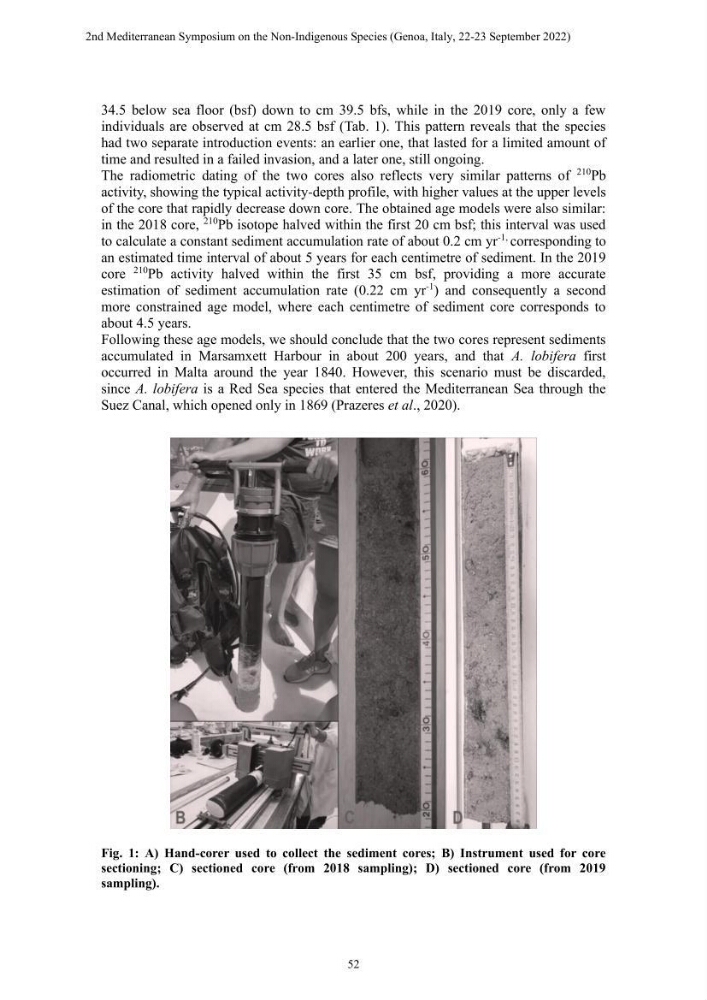
Fig. 1: A) Hand-corer used to collect the sediment cores; B) Instrument used for core
sectioning; C) sectioned core (from 2018 sampling); D) sectioned core (from 2019
sampling).
2nd Mediterranean Symposium on the Non-Indigenous Species (Genoa, Italy, 22-23 September 2022)
52
individuals are observed at cm 28.5 bsf (Tab. 1). This pattern reveals that the species
had two separate introduction events: an earlier one, that lasted for a limited amount of
time and resulted in a failed invasion, and a later one, still ongoing.
The radiometric dating of the two cores also reflects very similar patterns of
210
Pb
activity, showing the typical activity-depth profile, with higher values at the upper levels
of the core that rapidly decrease down core. The obtained age models were also similar:
in the 2018 core,
210
Pb isotope halved within the first 20 cm bsf; this interval was used
to calculate a constant sediment accumulation rate of about 0.2 cm yr
-1,
corresponding to
an estimated time interval of about 5 years for each centimetre of sediment. In the 2019
core
210
Pb activity halved within the first 35 cm bsf, providing a more accurate
estimation of sediment accumulation rate (0.22 cm yr
-1
) and consequently a second
more constrained age model, where each centimetre of sediment core corresponds to
about 4.5 years.
Following these age models, we should conclude that the two cores represent sediments
accumulated in Marsamxett Harbour in about 200 years, and that A. lobifera first
occurred in Malta around the year 1840. However, this scenario must be discarded,
since A. lobifera is a Red Sea species that entered the Mediterranean Sea through the
Suez Canal, which opened only in 1869 (Prazeres et al., 2020).
Fig. 1: A) Hand-corer used to collect the sediment cores; B) Instrument used for core
sectioning; C) sectioned core (from 2018 sampling); D) sectioned core (from 2019
sampling).
2nd Mediterranean Symposium on the Non-Indigenous Species (Genoa, Italy, 22-23 September 2022)
52