

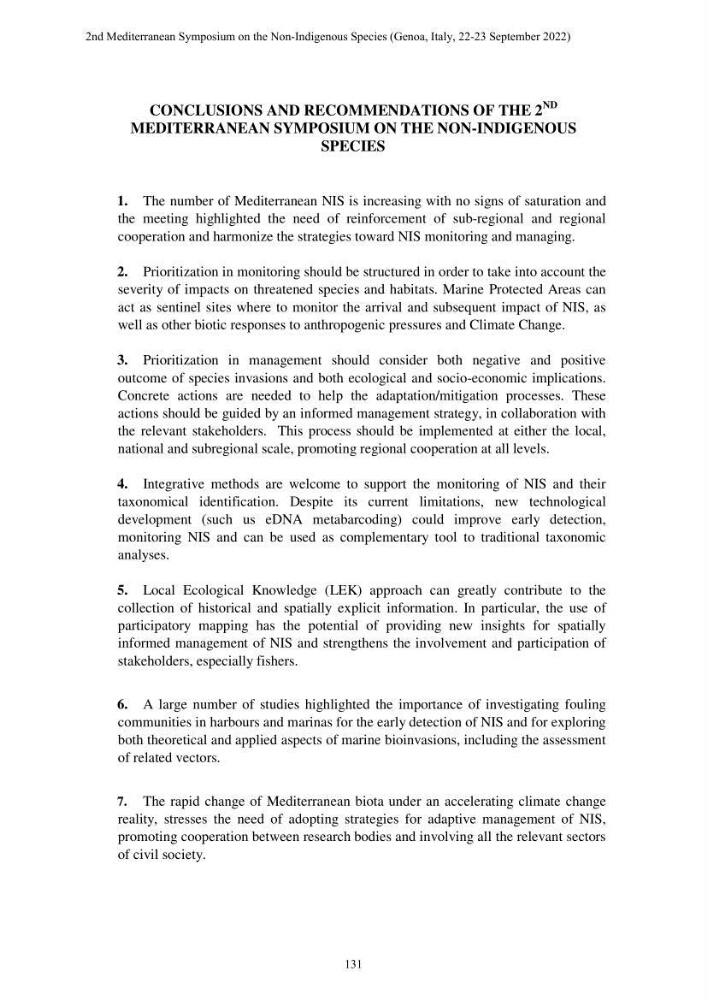
CONCLUSIONS AND RECOMMENDATIONS OF THE 2
ND
MEDITERRANEAN SYMPOSIUM ON THE NON-INDIGENOUS
SPECIES
1. The number of Mediterranean NIS is increasing with no signs of saturation and
the meeting highlighted the need of reinforcement of sub-regional and regional
cooperation and harmonize the strategies toward NIS monitoring and managing.
2. Prioritization in monitoring should be structured in order to take into account the
severity of impacts on threatened species and habitats. Marine Protected Areas can
act as sentinel sites where to monitor the arrival and subsequent impact of NIS, as
well as other biotic responses to anthropogenic pressures and Climate Change.
3. Prioritization in management should consider both negative and positive
outcome of species invasions and both ecological and socio-economic implications.
Concrete actions are needed to help the adaptation/mitigation processes. These
actions should be guided by an informed management strategy, in collaboration with
the relevant stakeholders. This process should be implemented at either the local,
national and subregional scale, promoting regional cooperation at all levels.
4. Integrative methods are welcome to support the monitoring of NIS and their
taxonomical identification. Despite its current limitations, new technological
development (such us eDNA metabarcoding) could improve early detection,
monitoring NIS and can be used as complementary tool to traditional taxonomic
analyses.
5. Local Ecological Knowledge (LEK) approach can greatly contribute to the
collection of historical and spatially explicit information. In particular, the use of
participatory mapping has the potential of providing new insights for spatially
informed management of NIS and strengthens the involvement and participation of
stakeholders, especially fishers.
6. A large number of studies highlighted the importance of investigating fouling
communities in harbours and marinas for the early detection of NIS and for exploring
both theoretical and applied aspects of marine bioinvasions, including the assessment
of related vectors.
7. The rapid change of Mediterranean biota under an accelerating climate change
reality, stresses the need of adopting strategies for adaptive management of NIS,
promoting cooperation between research bodies and involving all the relevant sectors
of civil society.
2nd Mediterranean Symposium on the Non-Indigenous Species (Genoa, Italy, 22-23 September 2022)
131
ND
MEDITERRANEAN SYMPOSIUM ON THE NON-INDIGENOUS
SPECIES
1. The number of Mediterranean NIS is increasing with no signs of saturation and
the meeting highlighted the need of reinforcement of sub-regional and regional
cooperation and harmonize the strategies toward NIS monitoring and managing.
2. Prioritization in monitoring should be structured in order to take into account the
severity of impacts on threatened species and habitats. Marine Protected Areas can
act as sentinel sites where to monitor the arrival and subsequent impact of NIS, as
well as other biotic responses to anthropogenic pressures and Climate Change.
3. Prioritization in management should consider both negative and positive
outcome of species invasions and both ecological and socio-economic implications.
Concrete actions are needed to help the adaptation/mitigation processes. These
actions should be guided by an informed management strategy, in collaboration with
the relevant stakeholders. This process should be implemented at either the local,
national and subregional scale, promoting regional cooperation at all levels.
4. Integrative methods are welcome to support the monitoring of NIS and their
taxonomical identification. Despite its current limitations, new technological
development (such us eDNA metabarcoding) could improve early detection,
monitoring NIS and can be used as complementary tool to traditional taxonomic
analyses.
5. Local Ecological Knowledge (LEK) approach can greatly contribute to the
collection of historical and spatially explicit information. In particular, the use of
participatory mapping has the potential of providing new insights for spatially
informed management of NIS and strengthens the involvement and participation of
stakeholders, especially fishers.
6. A large number of studies highlighted the importance of investigating fouling
communities in harbours and marinas for the early detection of NIS and for exploring
both theoretical and applied aspects of marine bioinvasions, including the assessment
of related vectors.
7. The rapid change of Mediterranean biota under an accelerating climate change
reality, stresses the need of adopting strategies for adaptive management of NIS,
promoting cooperation between research bodies and involving all the relevant sectors
of civil society.
2nd Mediterranean Symposium on the Non-Indigenous Species (Genoa, Italy, 22-23 September 2022)
131