

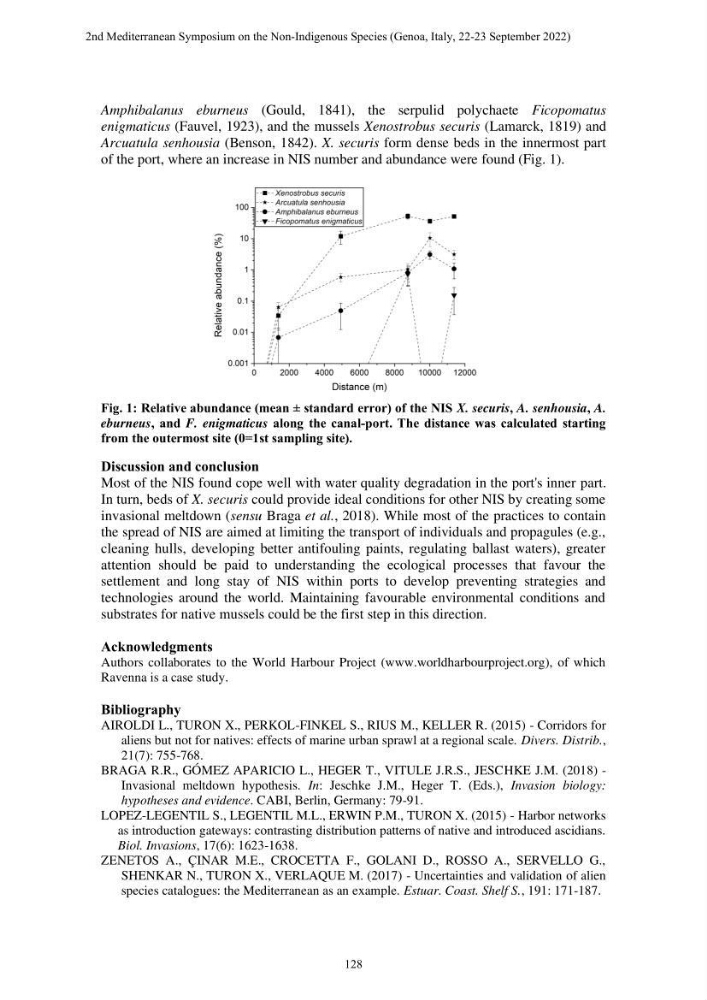
Amphibalanus eburneus (Gould, 1841), the serpulid polychaete Ficopomatus
enigmaticus (Fauvel, 1923), and the mussels Xenostrobus securis (Lamarck, 1819) and
Arcuatula senhousia (Benson, 1842). X. securis form dense beds in the innermost part
of the port, where an increase in NIS number and abundance were found (Fig. 1).
Fig. 1: Relative abundance (mean ± standard error) of the NIS X. securis, A. senhousia, A.
eburneus, and F. enigmaticus along the canal-port. The distance was calculated starting
from the outermost site (0=1st sampling site).
Discussion and conclusion
Most of the NIS found cope well with water quality degradation in the port's inner part.
In turn, beds of X. securis could provide ideal conditions for other NIS by creating some
invasional meltdown (sensu Braga et al., 2018). While most of the practices to contain
the spread of NIS are aimed at limiting the transport of individuals and propagules (e.g.,
cleaning hulls, developing better antifouling paints, regulating ballast waters), greater
attention should be paid to understanding the ecological processes that favour the
settlement and long stay of NIS within ports to develop preventing strategies and
technologies around the world. Maintaining favourable environmental conditions and
substrates for native mussels could be the first step in this direction.
Acknowledgments
Authors collaborates to the World Harbour Project (www.worldharbourproject.org), of which
Ravenna is a case study.
Bibliography
AIROLDI L., TURON X., PERKOL-FINKEL S., RIUS M., KELLER R. (2015) - Corridors for
aliens but not for natives: effects of marine urban sprawl at a regional scale. Divers. Distrib.,
21(7): 755-768.
BRAGA R.R., GÓMEZ APARICIO L., HEGER T., VITULE J.R.S., JESCHKE J.M. (2018) -
Invasional meltdown hypothesis. In: Jeschke J.M., Heger T. (Eds.), Invasion biology:
hypotheses and evidence. CABI, Berlin, Germany: 79-91.
LOPEZ-LEGENTIL S., LEGENTIL M.L., ERWIN P.M., TURON X. (2015) - Harbor networks
as introduction gateways: contrasting distribution patterns of native and introduced ascidians.
Biol. Invasions, 17(6): 1623-1638.
ZENETOS A., ÇINAR M.E., CROCETTA F., GOLANI D., ROSSO A., SERVELLO G.,
SHENKAR N., TURON X., VERLAQUE M. (2017) - Uncertainties and validation of alien
species catalogues: the Mediterranean as an example. Estuar. Coast. Shelf S., 191: 171-187.
2nd Mediterranean Symposium on the Non-Indigenous Species (Genoa, Italy, 22-23 September 2022)
128
enigmaticus (Fauvel, 1923), and the mussels Xenostrobus securis (Lamarck, 1819) and
Arcuatula senhousia (Benson, 1842). X. securis form dense beds in the innermost part
of the port, where an increase in NIS number and abundance were found (Fig. 1).
Fig. 1: Relative abundance (mean ± standard error) of the NIS X. securis, A. senhousia, A.
eburneus, and F. enigmaticus along the canal-port. The distance was calculated starting
from the outermost site (0=1st sampling site).
Discussion and conclusion
Most of the NIS found cope well with water quality degradation in the port's inner part.
In turn, beds of X. securis could provide ideal conditions for other NIS by creating some
invasional meltdown (sensu Braga et al., 2018). While most of the practices to contain
the spread of NIS are aimed at limiting the transport of individuals and propagules (e.g.,
cleaning hulls, developing better antifouling paints, regulating ballast waters), greater
attention should be paid to understanding the ecological processes that favour the
settlement and long stay of NIS within ports to develop preventing strategies and
technologies around the world. Maintaining favourable environmental conditions and
substrates for native mussels could be the first step in this direction.
Acknowledgments
Authors collaborates to the World Harbour Project (www.worldharbourproject.org), of which
Ravenna is a case study.
Bibliography
AIROLDI L., TURON X., PERKOL-FINKEL S., RIUS M., KELLER R. (2015) - Corridors for
aliens but not for natives: effects of marine urban sprawl at a regional scale. Divers. Distrib.,
21(7): 755-768.
BRAGA R.R., GÓMEZ APARICIO L., HEGER T., VITULE J.R.S., JESCHKE J.M. (2018) -
Invasional meltdown hypothesis. In: Jeschke J.M., Heger T. (Eds.), Invasion biology:
hypotheses and evidence. CABI, Berlin, Germany: 79-91.
LOPEZ-LEGENTIL S., LEGENTIL M.L., ERWIN P.M., TURON X. (2015) - Harbor networks
as introduction gateways: contrasting distribution patterns of native and introduced ascidians.
Biol. Invasions, 17(6): 1623-1638.
ZENETOS A., ÇINAR M.E., CROCETTA F., GOLANI D., ROSSO A., SERVELLO G.,
SHENKAR N., TURON X., VERLAQUE M. (2017) - Uncertainties and validation of alien
species catalogues: the Mediterranean as an example. Estuar. Coast. Shelf S., 191: 171-187.
2nd Mediterranean Symposium on the Non-Indigenous Species (Genoa, Italy, 22-23 September 2022)
128