

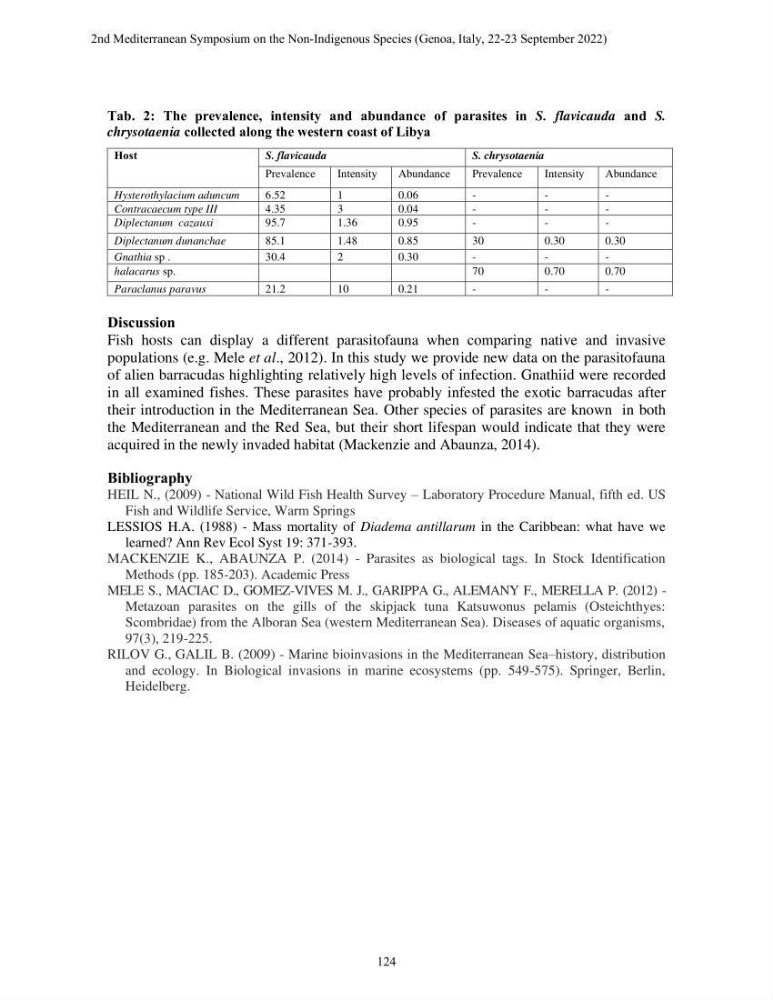
Tab. 2: The prevalence, intensity and abundance of parasites in S. flavicauda and S.
chrysotaenia collected along the western coast of Libya
Host
S. flavicauda
S. chrysotaenia
Prevalence
Intensity
Abundance
Prevalence
Intensity
Abundance
Hysterothylacium aduncum
6.52
1
0.06
-
-
-
Contracaecum type III
4.35
3
0.04
-
-
-
Diplectanum cazauxi
95.7
1.36
0.95
-
-
-
Diplectanum dunanchae
85.1
1.48
0.85
30
0.30
0.30
Gnathia sp .
30.4
2
0.30
-
-
-
halacarus sp.
70
0.70
0.70
Paraclanus paravus
21.2
10
0.21
-
-
-
Discussion
Fish hosts can display a different parasitofauna when comparing native and invasive
populations (e.g. Mele et al., 2012). In this study we provide new data on the parasitofauna
of alien barracudas highlighting relatively high levels of infection. Gnathiid were recorded
in all examined fishes. These parasites have probably infested the exotic barracudas after
their introduction in the Mediterranean Sea. Other species of parasites are known in both
the Mediterranean and the Red Sea, but their short lifespan would indicate that they were
acquired in the newly invaded habitat (Mackenzie and Abaunza, 2014).
Bibliography
HEIL N., (2009) - National Wild Fish Health Survey – Laboratory Procedure Manual, fifth ed. US
Fish and Wildlife Service, Warm Springs
LESSIOS H.A. (1988) - Mass mortality of Diadema antillarum in the Caribbean: what have we
learned? Ann Rev Ecol Syst 19: 371-393.
MACKENZIE K., ABAUNZA P. (2014) - Parasites as biological tags. In Stock Identification
Methods (pp. 185-203). Academic Press
MELE S., MACIAC D., GOMEZ-VIVES M. J., GARIPPA G., ALEMANY F., MERELLA P. (2012) -
Metazoan parasites on the gills of the skipjack tuna Katsuwonus pelamis (Osteichthyes:
Scombridae) from the Alboran Sea (western Mediterranean Sea). Diseases of aquatic organisms,
97(3), 219-225.
RILOV G., GALIL B. (2009) - Marine bioinvasions in the Mediterranean Sea–history, distribution
and ecology. In Biological invasions in marine ecosystems (pp. 549-575). Springer, Berlin,
Heidelberg.
2nd Mediterranean Symposium on the Non-Indigenous Species (Genoa, Italy, 22-23 September 2022)
124
chrysotaenia collected along the western coast of Libya
Host
S. flavicauda
S. chrysotaenia
Prevalence
Intensity
Abundance
Prevalence
Intensity
Abundance
Hysterothylacium aduncum
6.52
1
0.06
-
-
-
Contracaecum type III
4.35
3
0.04
-
-
-
Diplectanum cazauxi
95.7
1.36
0.95
-
-
-
Diplectanum dunanchae
85.1
1.48
0.85
30
0.30
0.30
Gnathia sp .
30.4
2
0.30
-
-
-
halacarus sp.
70
0.70
0.70
Paraclanus paravus
21.2
10
0.21
-
-
-
Discussion
Fish hosts can display a different parasitofauna when comparing native and invasive
populations (e.g. Mele et al., 2012). In this study we provide new data on the parasitofauna
of alien barracudas highlighting relatively high levels of infection. Gnathiid were recorded
in all examined fishes. These parasites have probably infested the exotic barracudas after
their introduction in the Mediterranean Sea. Other species of parasites are known in both
the Mediterranean and the Red Sea, but their short lifespan would indicate that they were
acquired in the newly invaded habitat (Mackenzie and Abaunza, 2014).
Bibliography
HEIL N., (2009) - National Wild Fish Health Survey – Laboratory Procedure Manual, fifth ed. US
Fish and Wildlife Service, Warm Springs
LESSIOS H.A. (1988) - Mass mortality of Diadema antillarum in the Caribbean: what have we
learned? Ann Rev Ecol Syst 19: 371-393.
MACKENZIE K., ABAUNZA P. (2014) - Parasites as biological tags. In Stock Identification
Methods (pp. 185-203). Academic Press
MELE S., MACIAC D., GOMEZ-VIVES M. J., GARIPPA G., ALEMANY F., MERELLA P. (2012) -
Metazoan parasites on the gills of the skipjack tuna Katsuwonus pelamis (Osteichthyes:
Scombridae) from the Alboran Sea (western Mediterranean Sea). Diseases of aquatic organisms,
97(3), 219-225.
RILOV G., GALIL B. (2009) - Marine bioinvasions in the Mediterranean Sea–history, distribution
and ecology. In Biological invasions in marine ecosystems (pp. 549-575). Springer, Berlin,
Heidelberg.
2nd Mediterranean Symposium on the Non-Indigenous Species (Genoa, Italy, 22-23 September 2022)
124