

Results
Statistically derived clusters of years based on landings from the Chioggia fish market highly
matched the time frames identified by fishers in the questionnaires. We grouped M. leidyi
occurrence as Absence (A; 1997-2009), Presence (P; 2010-2013), and Bloom (B; 2014-2019)
(nMDS, stress 0.1). Since the P period landings started to decrease, markedly between the A
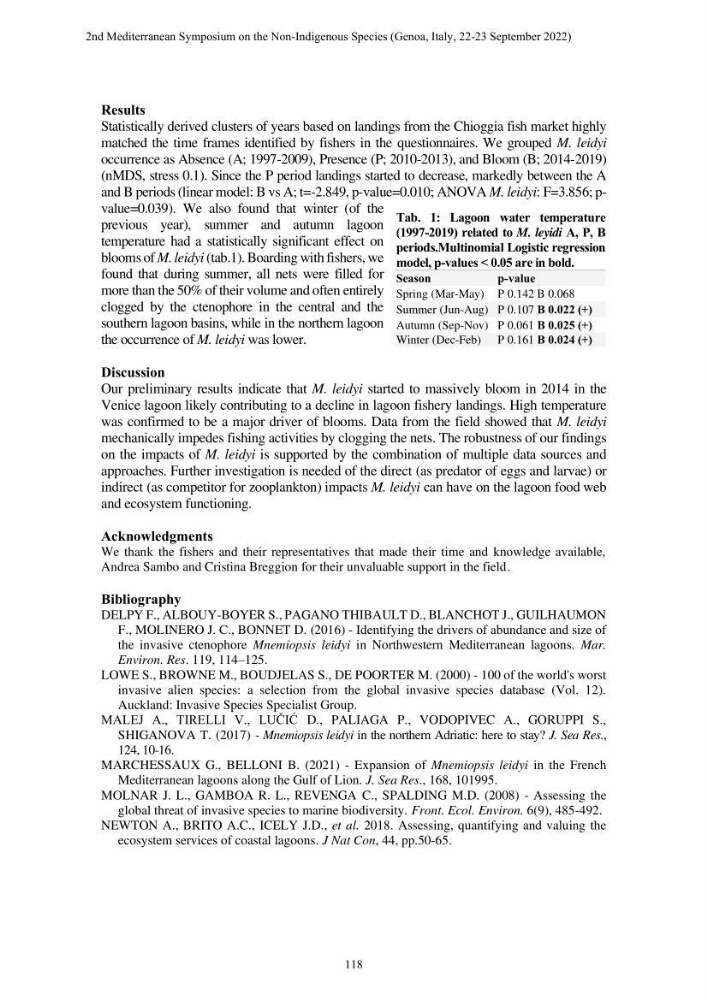
and B periods (linear model: B vs A; t=-2.849, p-value=0.010; ANOVA M. leidyi: F=3.856; pvalue=0.039). We also found that winter (of the
previous year), summer and autumn lagoon
temperature had a statistically significant effect on
blooms of M. leidyi (tab.1). Boarding with fishers, we
found that during summer, all nets were filled for
more than the 50% of their volume and often entirely
clogged by the ctenophore in the central and the
southern lagoon basins, while in the northern lagoon
the occurrence of M. leidyi was lower.
Discussion
Our preliminary results indicate that M. leidyi started to massively bloom in 2014 in the
Venice lagoon likely contributing to a decline in lagoon fishery landings. High temperature
was confirmed to be a major driver of blooms. Data from the field showed that M. leidyi
mechanically impedes fishing activities by clogging the nets. The robustness of our findings
on the impacts of M. leidyi is supported by the combination of multiple data sources and
approaches. Further investigation is needed of the direct (as predator of eggs and larvae) or
indirect (as competitor for zooplankton) impacts M. leidyi can have on the lagoon food web
and ecosystem functioning.
Acknowledgments
We thank the fishers and their representatives that made their time and knowledge available,
Andrea Sambo and Cristina Breggion for their unvaluable support in the field.
Bibliography
DELPY F., ALBOUY-BOYER S., PAGANO THIBAULT D., BLANCHOT J., GUILHAUMON
F., MOLINERO J. C., BONNET D. (2016) - Identifying the drivers of abundance and size of
the invasive ctenophore Mnemiopsis leidyi in Northwestern Mediterranean lagoons. Mar.
Environ. Res. 119, 114–125.
LOWE S., BROWNE M., BOUDJELAS S., DE POORTER M. (2000) - 100 of the world's worst
invasive alien species: a selection from the global invasive species database (Vol. 12).
Auckland: Invasive Species Specialist Group.
MALEJ A., TIRELLI V., LUČIĆ D., PALIAGA P., VODOPIVEC A., GORUPPI S.,
SHIGANOVA T. (2017) - Mnemiopsis leidyi in the northern Adriatic: here to stay? J. Sea Res.,
124, 10-16.
MARCHESSAUX G., BELLONI B. (2021) - Expansion of Mnemiopsis leidyi in the French
Mediterranean lagoons along the Gulf of Lion. J. Sea Res., 168, 101995.
MOLNAR J. L., GAMBOA R. L., REVENGA C., SPALDING M.D. (2008) - Assessing the
global threat of invasive species to marine biodiversity. Front. Ecol. Environ. 6(9), 485-492.
NEWTON A., BRITO A.C., ICELY J.D., et al. 2018. Assessing, quantifying and valuing the
ecosystem services of coastal lagoons. J Nat Con, 44, pp.50-65.
Tab. 1: Lagoon water temperature
(1997-2019) related to M. leyidi A, P, B
periods.Multinomial Logistic regression
model, p-values < 0.05 are in bold.
Season
p-value
Spring (Mar-May) P 0.142 B 0.068
Summer (Jun-Aug) P 0.107 B 0.022 (+)
Autumn (Sep-Nov) P 0.061 B 0.025 (+)
Winter (Dec-Feb) P 0.161 B 0.024 (+)
2nd Mediterranean Symposium on the Non-Indigenous Species (Genoa, Italy, 22-23 September 2022)
118
Statistically derived clusters of years based on landings from the Chioggia fish market highly
matched the time frames identified by fishers in the questionnaires. We grouped M. leidyi
occurrence as Absence (A; 1997-2009), Presence (P; 2010-2013), and Bloom (B; 2014-2019)
(nMDS, stress 0.1). Since the P period landings started to decrease, markedly between the A
and B periods (linear model: B vs A; t=-2.849, p-value=0.010; ANOVA M. leidyi: F=3.856; pvalue=0.039). We also found that winter (of the
previous year), summer and autumn lagoon
temperature had a statistically significant effect on
blooms of M. leidyi (tab.1). Boarding with fishers, we
found that during summer, all nets were filled for
more than the 50% of their volume and often entirely
clogged by the ctenophore in the central and the
southern lagoon basins, while in the northern lagoon
the occurrence of M. leidyi was lower.
Discussion
Our preliminary results indicate that M. leidyi started to massively bloom in 2014 in the
Venice lagoon likely contributing to a decline in lagoon fishery landings. High temperature
was confirmed to be a major driver of blooms. Data from the field showed that M. leidyi
mechanically impedes fishing activities by clogging the nets. The robustness of our findings
on the impacts of M. leidyi is supported by the combination of multiple data sources and
approaches. Further investigation is needed of the direct (as predator of eggs and larvae) or
indirect (as competitor for zooplankton) impacts M. leidyi can have on the lagoon food web
and ecosystem functioning.
Acknowledgments
We thank the fishers and their representatives that made their time and knowledge available,
Andrea Sambo and Cristina Breggion for their unvaluable support in the field.
Bibliography
DELPY F., ALBOUY-BOYER S., PAGANO THIBAULT D., BLANCHOT J., GUILHAUMON
F., MOLINERO J. C., BONNET D. (2016) - Identifying the drivers of abundance and size of
the invasive ctenophore Mnemiopsis leidyi in Northwestern Mediterranean lagoons. Mar.
Environ. Res. 119, 114–125.
LOWE S., BROWNE M., BOUDJELAS S., DE POORTER M. (2000) - 100 of the world's worst
invasive alien species: a selection from the global invasive species database (Vol. 12).
Auckland: Invasive Species Specialist Group.
MALEJ A., TIRELLI V., LUČIĆ D., PALIAGA P., VODOPIVEC A., GORUPPI S.,
SHIGANOVA T. (2017) - Mnemiopsis leidyi in the northern Adriatic: here to stay? J. Sea Res.,
124, 10-16.
MARCHESSAUX G., BELLONI B. (2021) - Expansion of Mnemiopsis leidyi in the French
Mediterranean lagoons along the Gulf of Lion. J. Sea Res., 168, 101995.
MOLNAR J. L., GAMBOA R. L., REVENGA C., SPALDING M.D. (2008) - Assessing the
global threat of invasive species to marine biodiversity. Front. Ecol. Environ. 6(9), 485-492.
NEWTON A., BRITO A.C., ICELY J.D., et al. 2018. Assessing, quantifying and valuing the
ecosystem services of coastal lagoons. J Nat Con, 44, pp.50-65.
Tab. 1: Lagoon water temperature
(1997-2019) related to M. leyidi A, P, B
periods.Multinomial Logistic regression
model, p-values < 0.05 are in bold.
Season
p-value
Spring (Mar-May) P 0.142 B 0.068
Summer (Jun-Aug) P 0.107 B 0.022 (+)
Autumn (Sep-Nov) P 0.061 B 0.025 (+)
Winter (Dec-Feb) P 0.161 B 0.024 (+)
2nd Mediterranean Symposium on the Non-Indigenous Species (Genoa, Italy, 22-23 September 2022)
118