

Gemma MARTÍNEZ-LAIZ, MACLEOD C., HESKETH A., KONECNY C., ROS M.,
GUERRA-GARCÍA J.M., HARLEY C.
Laboratory of Marine Biology, University of Seville, Seville, Spain.
Email: martinezlaiz@us.es
EXPLORING DISLODGEMENT RISK OF MOBILE EPIFAUNA
DURING VESSEL TRANSPORT
Abstract
Vessel hull-fouling is responsible for most biological invasion events in the marine environment. We
evaluated the performance of mobile epifauna during vessel transport via laboratory simulations,
using the well-known invasive Japanese skeleton shrimp (Caprella mutica), and its native congener C.
laeviuscula as case study. The invader did not possess any advantage in comparison to the native
species in terms of inherent resistance to drag. Instead, its performance was conditioned by the
complexity of secondary substrate. Dislodgement risk was significantly reduced as we progressively
added sessile fouling basibionts; which provided refugia and boosted the probability of Caprella
mutica remaining attached from 7% to 65% in laboratory flow exposure trials. The invader exhibited
significantly higher exploratory tendency than its congener at zero-flow conditions. Implications in
terms of en-route survivorship, invasion success and macrofouling management are discussed.
Key-words: basibionts, vector, hydrodynamics, non-indigenous species, boldness
Introduction
The accumulation of organisms attached to or associated with man-made underwater or
wetted surfaces is responsible for approximately half of the currently established nonindigenous species (NIS) in coastal waters worldwide. Since experts agree that biosecurity
needs to operate with a precautionary approach, the study of the early phases of the
invasion process becomes of critical importance. The goal of this study was to evaluate the
response of mobile invasive epifauna to a simulated vessel voyage, to gain insight into the
factors facilitating or hampering this phase of the invasion process. We evaluated 1) the
resistance of two species (one native and one invasive) to hydrodynamic stress; 2) whether
the sessile component of the fouling (basibionts) enhances the chances of the invader
overcoming the vessel trip; 3) the boldness behaviour of both species at zero-flow conditions.
Materials and methods
Fauna was collected from marina artificial structures in British Columbia, Canada; transported
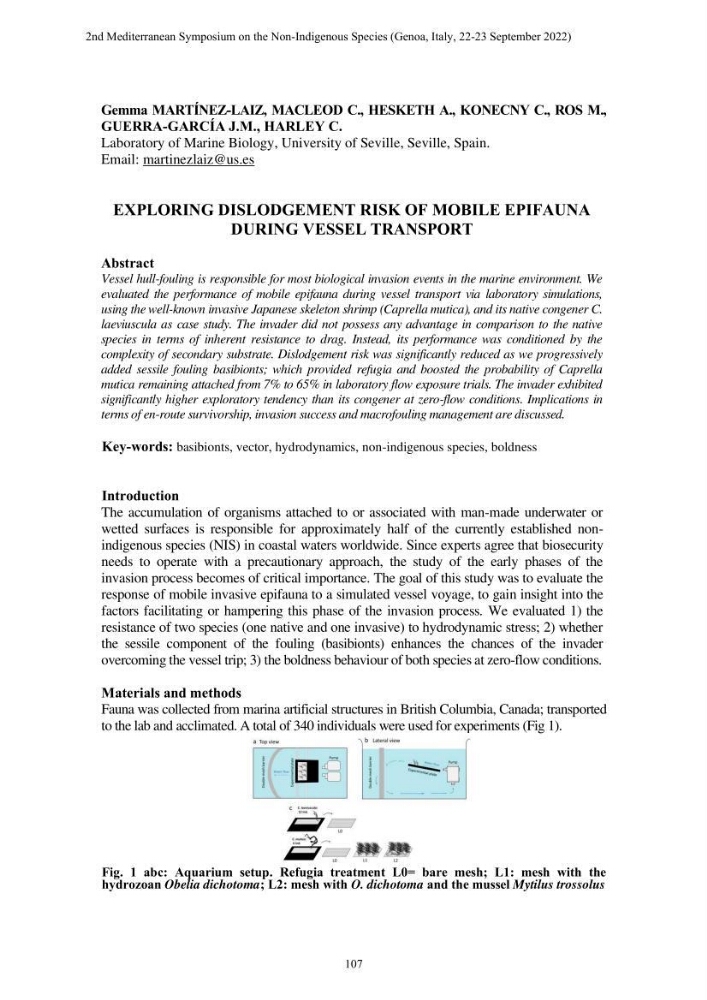
to the lab and acclimated. A total of 340 individuals were used for experiments (Fig 1).
Fig. 1 abc: Aquarium setup. Refugia treatment L0= bare mesh; L1: mesh with the
hydrozoan Obelia dichotoma; L2: mesh with O. dichotoma and the mussel Mytilus trossolus
2nd Mediterranean Symposium on the Non-Indigenous Species (Genoa, Italy, 22-23 September 2022)
107
GUERRA-GARCÍA J.M., HARLEY C.
Laboratory of Marine Biology, University of Seville, Seville, Spain.
Email: martinezlaiz@us.es
EXPLORING DISLODGEMENT RISK OF MOBILE EPIFAUNA
DURING VESSEL TRANSPORT
Abstract
Vessel hull-fouling is responsible for most biological invasion events in the marine environment. We
evaluated the performance of mobile epifauna during vessel transport via laboratory simulations,
using the well-known invasive Japanese skeleton shrimp (Caprella mutica), and its native congener C.
laeviuscula as case study. The invader did not possess any advantage in comparison to the native
species in terms of inherent resistance to drag. Instead, its performance was conditioned by the
complexity of secondary substrate. Dislodgement risk was significantly reduced as we progressively
added sessile fouling basibionts; which provided refugia and boosted the probability of Caprella
mutica remaining attached from 7% to 65% in laboratory flow exposure trials. The invader exhibited
significantly higher exploratory tendency than its congener at zero-flow conditions. Implications in
terms of en-route survivorship, invasion success and macrofouling management are discussed.
Key-words: basibionts, vector, hydrodynamics, non-indigenous species, boldness
Introduction
The accumulation of organisms attached to or associated with man-made underwater or
wetted surfaces is responsible for approximately half of the currently established nonindigenous species (NIS) in coastal waters worldwide. Since experts agree that biosecurity
needs to operate with a precautionary approach, the study of the early phases of the
invasion process becomes of critical importance. The goal of this study was to evaluate the
response of mobile invasive epifauna to a simulated vessel voyage, to gain insight into the
factors facilitating or hampering this phase of the invasion process. We evaluated 1) the
resistance of two species (one native and one invasive) to hydrodynamic stress; 2) whether
the sessile component of the fouling (basibionts) enhances the chances of the invader
overcoming the vessel trip; 3) the boldness behaviour of both species at zero-flow conditions.
Materials and methods
Fauna was collected from marina artificial structures in British Columbia, Canada; transported
to the lab and acclimated. A total of 340 individuals were used for experiments (Fig 1).
Fig. 1 abc: Aquarium setup. Refugia treatment L0= bare mesh; L1: mesh with the
hydrozoan Obelia dichotoma; L2: mesh with O. dichotoma and the mussel Mytilus trossolus
2nd Mediterranean Symposium on the Non-Indigenous Species (Genoa, Italy, 22-23 September 2022)
107