

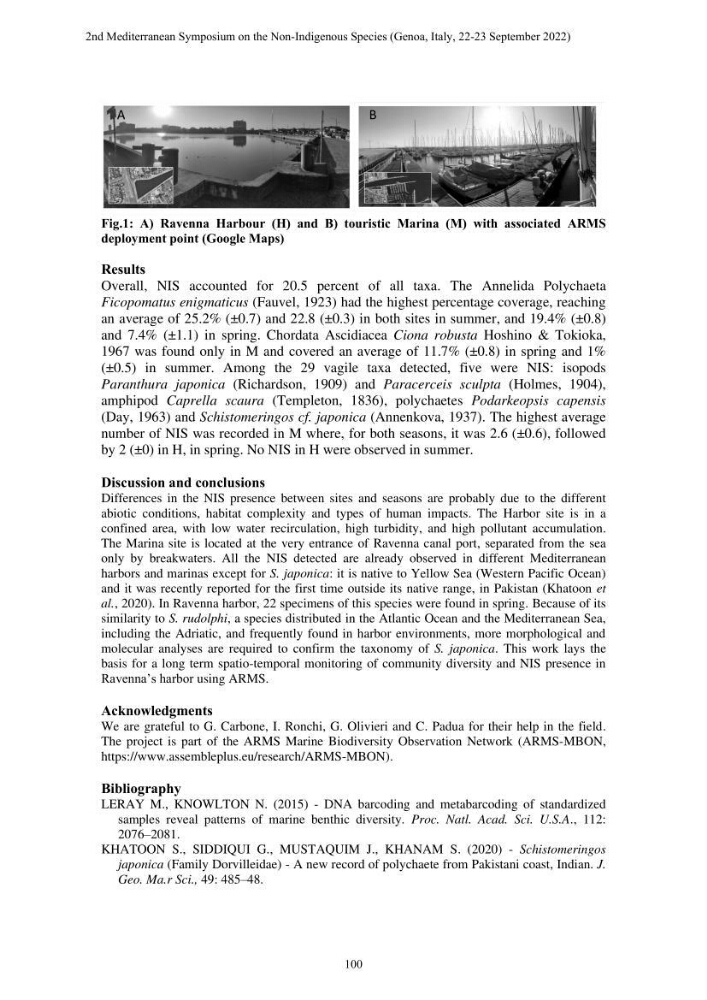
Fig.1: A) Ravenna Harbour (H) and B) touristic Marina (M) with associated ARMS
deployment point (Google Maps)
Results
Overall, NIS accounted for 20.5 percent of all taxa. The Annelida Polychaeta
Ficopomatus enigmaticus (Fauvel, 1923) had the highest percentage coverage, reaching
an average of 25.2% (±0.7) and 22.8 (±0.3) in both sites in summer, and 19.4% (±0.8)
and 7.4% (±1.1) in spring. Chordata Ascidiacea Ciona robusta Hoshino & Tokioka,
1967 was found only in M and covered an average of 11.7% (±0.8) in spring and 1%
(±0.5) in summer. Among the 29 vagile taxa detected, five were NIS: isopods
Paranthura japonica (Richardson, 1909) and Paracerceis sculpta (Holmes, 1904),
amphipod Caprella scaura (Templeton, 1836), polychaetes Podarkeopsis capensis
(Day, 1963) and Schistomeringos cf. japonica (Annenkova, 1937). The highest average
number of NIS was recorded in M where, for both seasons, it was 2.6 (±0.6), followed
by 2 (±0) in H, in spring. No NIS in H were observed in summer.
Discussion and conclusions
Differences in the NIS presence between sites and seasons are probably due to the different
abiotic conditions, habitat complexity and types of human impacts. The Harbor site is in a
confined area, with low water recirculation, high turbidity, and high pollutant accumulation.
The Marina site is located at the very entrance of Ravenna canal port, separated from the sea
only by breakwaters. All the NIS detected are already observed in different Mediterranean
harbors and marinas except for S. japonica: it is native to Yellow Sea (Western Pacific Ocean)
and it was recently reported for the first time outside its native range, in Pakistan (Khatoon et
al., 2020). In Ravenna harbor, 22 specimens of this species were found in spring. Because of its
similarity to S. rudolphi, a species distributed in the Atlantic Ocean and the Mediterranean Sea,
including the Adriatic, and frequently found in harbor environments, more morphological and
molecular analyses are required to confirm the taxonomy of S. japonica. This work lays the
basis for a long term spatio-temporal monitoring of community diversity and NIS presence in
Ravenna’s harbor using ARMS.
Acknowledgments
We are grateful to G. Carbone, I. Ronchi, G. Olivieri and C. Padua for their help in the field.
The project is part of the ARMS Marine Biodiversity Observation Network (ARMS-MBON,
https://www.assembleplus.eu/research/ARMS-MBON).
Bibliography
LERAY M., KNOWLTON N. (2015) - DNA barcoding and metabarcoding of standardized
samples reveal patterns of marine benthic diversity. Proc. Natl. Acad. Sci. U.S.A., 112:
2076–2081.
KHATOON S., SIDDIQUI G., MUSTAQUIM J., KHANAM S. (2020) - Schistomeringos
japonica (Family Dorvilleidae) - A new record of polychaete from Pakistani coast, Indian. J.
Geo. Ma.r Sci., 49: 485–48.
A
B
2nd Mediterranean Symposium on the Non-Indigenous Species (Genoa, Italy, 22-23 September 2022)
100
deployment point (Google Maps)
Results
Overall, NIS accounted for 20.5 percent of all taxa. The Annelida Polychaeta
Ficopomatus enigmaticus (Fauvel, 1923) had the highest percentage coverage, reaching
an average of 25.2% (±0.7) and 22.8 (±0.3) in both sites in summer, and 19.4% (±0.8)
and 7.4% (±1.1) in spring. Chordata Ascidiacea Ciona robusta Hoshino & Tokioka,
1967 was found only in M and covered an average of 11.7% (±0.8) in spring and 1%
(±0.5) in summer. Among the 29 vagile taxa detected, five were NIS: isopods
Paranthura japonica (Richardson, 1909) and Paracerceis sculpta (Holmes, 1904),
amphipod Caprella scaura (Templeton, 1836), polychaetes Podarkeopsis capensis
(Day, 1963) and Schistomeringos cf. japonica (Annenkova, 1937). The highest average
number of NIS was recorded in M where, for both seasons, it was 2.6 (±0.6), followed
by 2 (±0) in H, in spring. No NIS in H were observed in summer.
Discussion and conclusions
Differences in the NIS presence between sites and seasons are probably due to the different
abiotic conditions, habitat complexity and types of human impacts. The Harbor site is in a
confined area, with low water recirculation, high turbidity, and high pollutant accumulation.
The Marina site is located at the very entrance of Ravenna canal port, separated from the sea
only by breakwaters. All the NIS detected are already observed in different Mediterranean
harbors and marinas except for S. japonica: it is native to Yellow Sea (Western Pacific Ocean)
and it was recently reported for the first time outside its native range, in Pakistan (Khatoon et
al., 2020). In Ravenna harbor, 22 specimens of this species were found in spring. Because of its
similarity to S. rudolphi, a species distributed in the Atlantic Ocean and the Mediterranean Sea,
including the Adriatic, and frequently found in harbor environments, more morphological and
molecular analyses are required to confirm the taxonomy of S. japonica. This work lays the
basis for a long term spatio-temporal monitoring of community diversity and NIS presence in
Ravenna’s harbor using ARMS.
Acknowledgments
We are grateful to G. Carbone, I. Ronchi, G. Olivieri and C. Padua for their help in the field.
The project is part of the ARMS Marine Biodiversity Observation Network (ARMS-MBON,
https://www.assembleplus.eu/research/ARMS-MBON).
Bibliography
LERAY M., KNOWLTON N. (2015) - DNA barcoding and metabarcoding of standardized
samples reveal patterns of marine benthic diversity. Proc. Natl. Acad. Sci. U.S.A., 112:
2076–2081.
KHATOON S., SIDDIQUI G., MUSTAQUIM J., KHANAM S. (2020) - Schistomeringos
japonica (Family Dorvilleidae) - A new record of polychaete from Pakistani coast, Indian. J.
Geo. Ma.r Sci., 49: 485–48.
A
B
2nd Mediterranean Symposium on the Non-Indigenous Species (Genoa, Italy, 22-23 September 2022)
100