

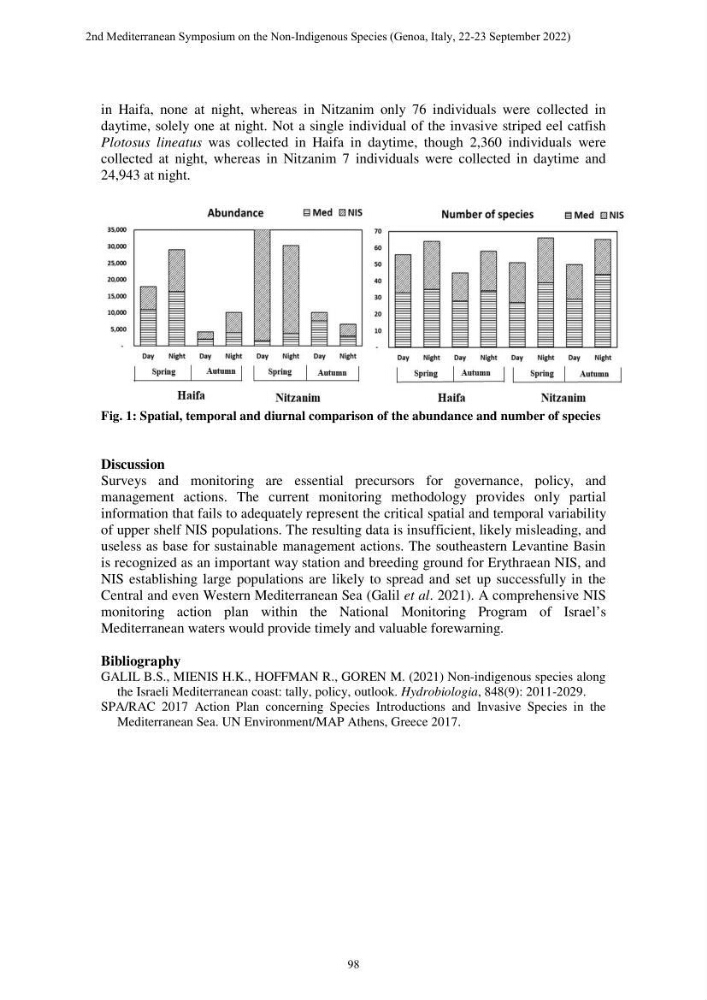
in Haifa, none at night, whereas in Nitzanim only 76 individuals were collected in
daytime, solely one at night. Not a single individual of the invasive striped eel catfish
Plotosus lineatus was collected in Haifa in daytime, though 2,360 individuals were
collected at night, whereas in Nitzanim 7 individuals were collected in daytime and
24,943 at night.
Fig. 1: Spatial, temporal and diurnal comparison of the abundance and number of species
Discussion
Surveys and monitoring are essential precursors for governance, policy, and
management actions. The current monitoring methodology provides only partial
information that fails to adequately represent the critical spatial and temporal variability
of upper shelf NIS populations. The resulting data is insufficient, likely misleading, and
useless as base for sustainable management actions. The southeastern Levantine Basin
is recognized as an important way station and breeding ground for Erythraean NIS, and
NIS establishing large populations are likely to spread and set up successfully in the
Central and even Western Mediterranean Sea (Galil et al. 2021). A comprehensive NIS
monitoring action plan within the National Monitoring Program of Israel’s
Mediterranean waters would provide timely and valuable forewarning.
Bibliography
GALIL B.S., MIENIS H.K., HOFFMAN R., GOREN M. (2021) Non-indigenous species along
the Israeli Mediterranean coast: tally, policy, outlook. Hydrobiologia, 848(9): 2011-2029.
SPA/RAC 2017 Action Plan concerning Species Introductions and Invasive Species in the
Mediterranean Sea. UN Environment/MAP Athens, Greece 2017.
2nd Mediterranean Symposium on the Non-Indigenous Species (Genoa, Italy, 22-23 September 2022)
98
daytime, solely one at night. Not a single individual of the invasive striped eel catfish
Plotosus lineatus was collected in Haifa in daytime, though 2,360 individuals were
collected at night, whereas in Nitzanim 7 individuals were collected in daytime and
24,943 at night.
Fig. 1: Spatial, temporal and diurnal comparison of the abundance and number of species
Discussion
Surveys and monitoring are essential precursors for governance, policy, and
management actions. The current monitoring methodology provides only partial
information that fails to adequately represent the critical spatial and temporal variability
of upper shelf NIS populations. The resulting data is insufficient, likely misleading, and
useless as base for sustainable management actions. The southeastern Levantine Basin
is recognized as an important way station and breeding ground for Erythraean NIS, and
NIS establishing large populations are likely to spread and set up successfully in the
Central and even Western Mediterranean Sea (Galil et al. 2021). A comprehensive NIS
monitoring action plan within the National Monitoring Program of Israel’s
Mediterranean waters would provide timely and valuable forewarning.
Bibliography
GALIL B.S., MIENIS H.K., HOFFMAN R., GOREN M. (2021) Non-indigenous species along
the Israeli Mediterranean coast: tally, policy, outlook. Hydrobiologia, 848(9): 2011-2029.
SPA/RAC 2017 Action Plan concerning Species Introductions and Invasive Species in the
Mediterranean Sea. UN Environment/MAP Athens, Greece 2017.
2nd Mediterranean Symposium on the Non-Indigenous Species (Genoa, Italy, 22-23 September 2022)
98