

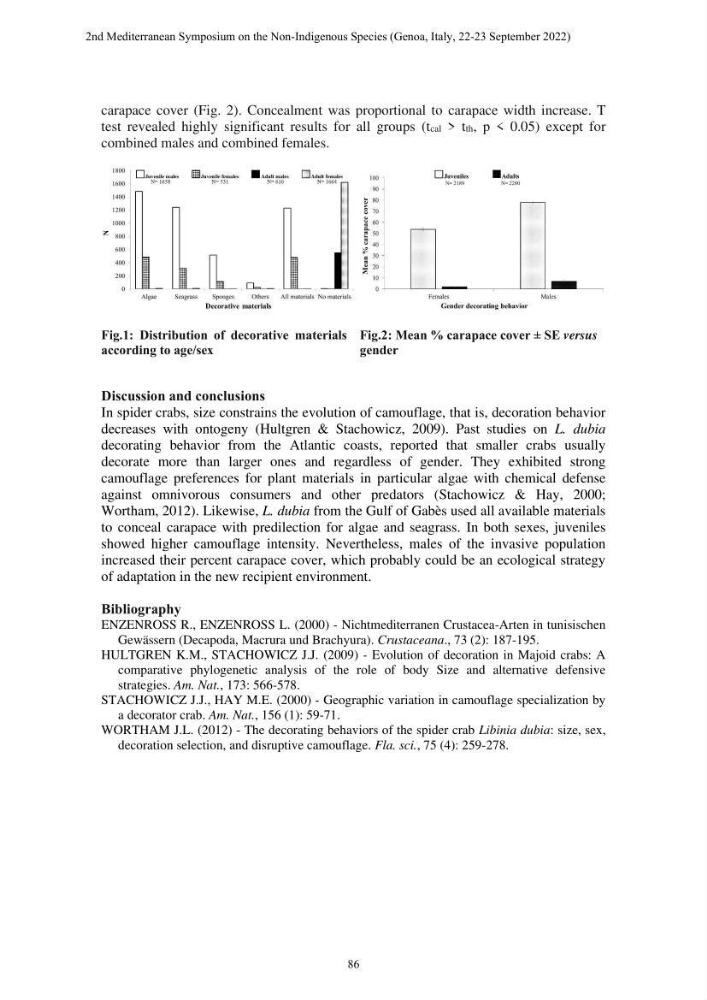
carapace cover (Fig. 2). Concealment was proportional to carapace width increase. T
test revealed highly significant results for all groups (tcal > tth, p < 0.05) except for
combined males and combined females.
Fig.1: Distribution of decorative materials
according to age/sex
Fig.2: Mean % carapace cover ± SE versus
gender
Discussion and conclusions
In spider crabs, size constrains the evolution of camouflage, that is, decoration behavior
decreases with ontogeny (Hultgren & Stachowicz, 2009). Past studies on L. dubia
decorating behavior from the Atlantic coasts, reported that smaller crabs usually
decorate more than larger ones and regardless of gender. They exhibited strong
camouflage preferences for plant materials in particular algae with chemical defense
against omnivorous consumers and other predators (Stachowicz & Hay, 2000;
Wortham, 2012). Likewise, L. dubia from the Gulf of Gabès used all available materials
to conceal carapace with predilection for algae and seagrass. In both sexes, juveniles
showed higher camouflage intensity. Nevertheless, males of the invasive population
increased their percent carapace cover, which probably could be an ecological strategy
of adaptation in the new recipient environment.
Bibliography
ENZENROSS R., ENZENROSS L. (2000) - Nichtmediterranen Crustacea-Arten in tunisischen
Gewässern (Decapoda, Macrura und Brachyura). Crustaceana., 73 (2): 187-195.
HULTGREN K.M., STACHOWICZ J.J. (2009) - Evolution of decoration in Majoid crabs: A
comparative phylogenetic analysis of the role of body Size and alternative defensive
strategies. Am. Nat., 173: 566-578.
STACHOWICZ J.J., HAY M.E. (2000) - Geographic variation in camouflage specialization by
a decorator crab. Am. Nat., 156 (1): 59-71.
WORTHAM J.L. (2012) - The decorating behaviors of the spider crab Libinia dubia: size, sex,
decoration selection, and disruptive camouflage. Fla. sci., 75 (4): 259-278.
2nd Mediterranean Symposium on the Non-Indigenous Species (Genoa, Italy, 22-23 September 2022)
86
test revealed highly significant results for all groups (tcal > tth, p < 0.05) except for
combined males and combined females.
Fig.1: Distribution of decorative materials
according to age/sex
Fig.2: Mean % carapace cover ± SE versus
gender
Discussion and conclusions
In spider crabs, size constrains the evolution of camouflage, that is, decoration behavior
decreases with ontogeny (Hultgren & Stachowicz, 2009). Past studies on L. dubia
decorating behavior from the Atlantic coasts, reported that smaller crabs usually
decorate more than larger ones and regardless of gender. They exhibited strong
camouflage preferences for plant materials in particular algae with chemical defense
against omnivorous consumers and other predators (Stachowicz & Hay, 2000;
Wortham, 2012). Likewise, L. dubia from the Gulf of Gabès used all available materials
to conceal carapace with predilection for algae and seagrass. In both sexes, juveniles
showed higher camouflage intensity. Nevertheless, males of the invasive population
increased their percent carapace cover, which probably could be an ecological strategy
of adaptation in the new recipient environment.
Bibliography
ENZENROSS R., ENZENROSS L. (2000) - Nichtmediterranen Crustacea-Arten in tunisischen
Gewässern (Decapoda, Macrura und Brachyura). Crustaceana., 73 (2): 187-195.
HULTGREN K.M., STACHOWICZ J.J. (2009) - Evolution of decoration in Majoid crabs: A
comparative phylogenetic analysis of the role of body Size and alternative defensive
strategies. Am. Nat., 173: 566-578.
STACHOWICZ J.J., HAY M.E. (2000) - Geographic variation in camouflage specialization by
a decorator crab. Am. Nat., 156 (1): 59-71.
WORTHAM J.L. (2012) - The decorating behaviors of the spider crab Libinia dubia: size, sex,
decoration selection, and disruptive camouflage. Fla. sci., 75 (4): 259-278.
2nd Mediterranean Symposium on the Non-Indigenous Species (Genoa, Italy, 22-23 September 2022)
86