

.
‘
'
.
81
is usual to “sandwich the chàrcoal'betWèen
layers,"or°tb
waterlog it before use, thei*eby reducing the chances" of its_beihg
swept" into the
A large mechanicäl‘ftér with gravel and
charcoal as its media can be maintained in two ways. Either it can
be Cleaned frequently and the charcoal replaced when fully loaded
so
that it performs its mechanical and chemical functions at top
efficiency, or it can be left dir—ty and allowed to acquire a population
of nitrifying bacteria, thus r€placing the failing chemical action by
.
_‘
an
improving biological function. Thelast argument, however, only
holds goOd if the surface area is large enough and if aerobic con»
ditions are maintained in the filter.
,
_
-
‘
_
Ç
A further system of some interest is that in which an aquarium
'
populated by ancillary animals, such as snails and daphnia
_
water), or filter feeders (saltwater), can be used to clean the water
of another aquarium containing fishes which would not tolerate the
.
presence of these animals if they were kept all together. Water is
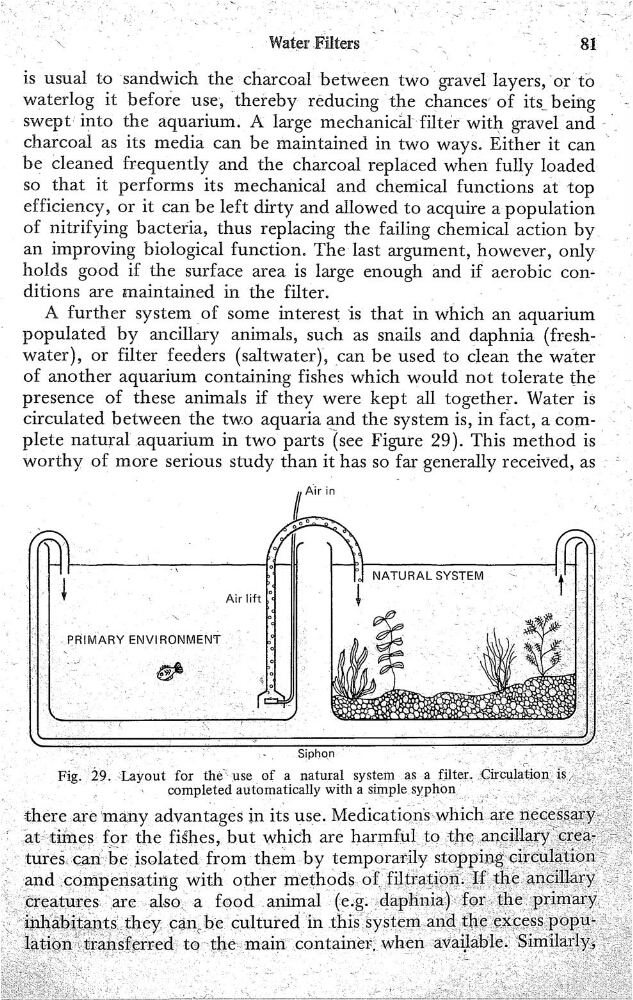
circulated between the two aquaria and the system is, in fact, a complete natural aquarium in two' parts (see Figure 29). This method is
Worthy of more serious study than it has so far generally receiVed, as
/
Air in
_
.
_
__
”\
NAT_URALSYsTEM
l
'
il
°
—
Airlift :°‘
'
l
'_
Â
’
.P_RIMARY ENVIRONMENT Ï
'
__ «
ï
"
.
'_
—
’
'
_
‘
Fig
«Layout for
use
_
of a natural system as a
Cuoulaüonls
.
\
completed automatically with a simple syphonj
Ï
_
sthere_,.are ‘Ïmany advantages in its use.
att1mes îlot the fiêhes, but which are
turescanbe isolated
them by temp oraräily stepplngC1rculaüen
with other Ïr?‘e£h_ôdS= offtratwnIfth€anafÿ
food animal ‘—-'(ae—ëgèdaphma)ffthepmafÿ
1nhab1tantsther
‘
éu»1tured Îîn th1$Sÿstemandthe€XCCSSPGP“
‘
'
.
81
is usual to “sandwich the chàrcoal'betWèen
layers,"or°tb
waterlog it before use, thei*eby reducing the chances" of its_beihg
swept" into the
A large mechanicäl‘ftér with gravel and
charcoal as its media can be maintained in two ways. Either it can
be Cleaned frequently and the charcoal replaced when fully loaded
so
that it performs its mechanical and chemical functions at top
efficiency, or it can be left dir—ty and allowed to acquire a population
of nitrifying bacteria, thus r€placing the failing chemical action by
.
_‘
an
improving biological function. Thelast argument, however, only
holds goOd if the surface area is large enough and if aerobic con»
ditions are maintained in the filter.
,
_
-
‘
_
Ç
A further system of some interest is that in which an aquarium
'
populated by ancillary animals, such as snails and daphnia
_
water), or filter feeders (saltwater), can be used to clean the water
of another aquarium containing fishes which would not tolerate the
.
presence of these animals if they were kept all together. Water is
circulated between the two aquaria and the system is, in fact, a complete natural aquarium in two' parts (see Figure 29). This method is
Worthy of more serious study than it has so far generally receiVed, as
/
Air in
_
.
_
__
”\
NAT_URALSYsTEM
l
'
il
°
—
Airlift :°‘
'
l
'_
Â
’
.P_RIMARY ENVIRONMENT Ï
'
__ «
ï
"
.
'_
—
’
'
_
‘
Fig
«Layout for
use
_
of a natural system as a
Cuoulaüonls
.
\
completed automatically with a simple syphonj
Ï
_
sthere_,.are ‘Ïmany advantages in its use.
att1mes îlot the fiêhes, but which are
turescanbe isolated
them by temp oraräily stepplngC1rculaüen
with other Ïr?‘e£h_ôdS= offtratwnIfth€anafÿ
food animal ‘—-'(ae—ëgèdaphma)ffthepmafÿ
1nhab1tantsther
‘
éu»1tured Îîn th1$Sÿstemandthe€XCCSSPGP“